
Ductable AC vs Split AC (Complete Air Conditioner Comparison Guide)
Air conditioning technology has evolved significantly, offering different types of cooling systems designed for specific environments and building structures. Two of the most commonly used air conditioning systems are ductable air conditioners and split air conditioners.
Homeowners, architects, and HVAC consultants often ask:
Which is better: Ductable AC or Split AC?
Both systems provide effective cooling but differ in installation method, airflow distribution, cooling capacity, cost, and applications.
Understanding the Ductable AC vs Split AC difference helps building owners and HVAC professionals choose the right system based on their cooling requirements and building design.
In this detailed guide, you will learn:
-
What ductable AC and split AC systems are
-
Major differences between ductable AC and split AC
-
Installation requirements
-
Cooling efficiency comparison
-
Cost comparison
-
Advantages and disadvantages
-
Best applications for each system
By the end of this article, you will clearly understand which system is suitable for your cooling needs.
What Is a Ductable Air Conditioner?
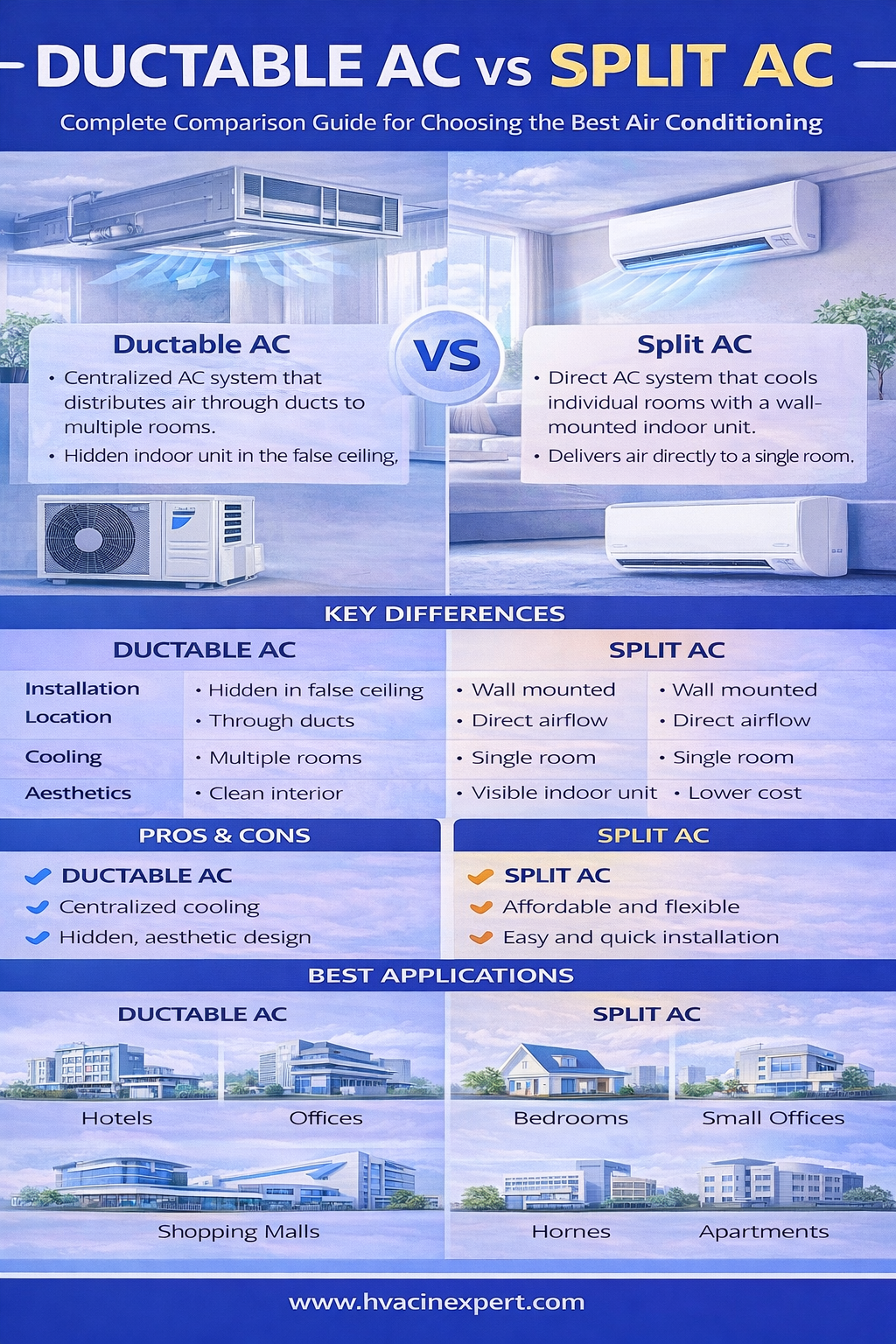
A ductable air conditioner is a centralized cooling system that distributes cooled air through a network of ducts installed in the ceiling.
The indoor unit is typically hidden inside a false ceiling or mechanical room, while air is delivered to different rooms through ducts and air diffusers.
Ductable AC systems are commonly used in:
-
Offices
-
Hotels
-
Restaurants
-
Shopping malls
-
Large homes
-
Commercial buildings
These systems are ideal for spaces requiring centralized cooling with clean interior aesthetics.
Components of a Ductable AC System
A ductable AC system includes several components that work together to provide cooling.
Indoor Unit
The indoor unit contains the evaporator coil and blower fan.
Outdoor Unit
The outdoor unit includes the compressor and condenser coil.
Duct System
Ducts distribute conditioned air throughout the building.
Air Diffusers
Diffusers release cooled air into the room.
Return Air Grilles
Return air grilles allow air to return to the indoor unit.
Together, these components create a centralized air distribution system.
What Is a Split Air Conditioner?
A split air conditioner is a direct expansion cooling system consisting of two units:
-
Indoor unit (evaporator)
-
Outdoor unit (condenser)
The indoor unit is mounted on a wall and delivers cooled air directly into the room.
Split AC systems are widely used in:
-
Homes
-
Bedrooms
-
Small offices
-
Apartments
-
Retail shops
These systems are popular because they are affordable and easy to install.
Components of Split AC Systems
Split air conditioning systems include several components.
Indoor Unit
The indoor unit contains:
-
Evaporator coil
-
Fan blower
-
Air filters
Outdoor Unit
The outdoor unit includes:
-
Compressor
-
Condenser coil
-
Expansion valve
Refrigerant Piping
Copper pipes connect the indoor and outdoor units.
Ductable AC vs Split AC: Key Differences
Below is a comparison between ductable AC and split AC systems.
| Feature | Ductable AC | Split AC |
|---|---|---|
| Installation Location | Hidden in false ceiling | Wall mounted |
| Air Distribution | Through ducts | Direct airflow |
| Cooling Coverage | Multiple rooms | Single room |
| Aesthetics | Clean interior | Visible indoor unit |
| Cost | Higher | Lower |
Ductable AC systems provide centralized cooling, while split AC systems cool individual rooms.
Cooling Performance Comparison
Cooling performance is a major factor when selecting an AC system.
Ductable AC Cooling Performance
Ductable AC systems distribute cooled air evenly through ducts.
This provides uniform cooling across multiple rooms.
Split AC Cooling Performance
Split AC systems cool individual rooms effectively but may struggle to cool large open spaces.
Therefore, ductable AC systems are better for larger areas.
Airflow Distribution
Airflow distribution plays a key role in indoor comfort.
Ductable AC Airflow
Ductable systems distribute air through multiple diffusers.
This ensures consistent cooling across the building.
Split AC Airflow
Split AC units deliver air from a single indoor unit.
Airflow may not reach all corners of large rooms.
Installation Requirements
Installation complexity differs significantly between the two systems.
Ductable AC Installation
Ductable AC installation requires:
-
False ceiling space
-
Duct network
-
Air diffusers
-
Return air ducts
Installation is complex and requires HVAC design.
Split AC Installation
Split AC installation requires:
-
Wall mounting bracket
-
Refrigerant piping
-
Electrical wiring
Installation is simple and quick.
Space Requirements
Space availability influences AC system selection.
Ductable AC Space Requirement
Ductable AC systems require false ceiling space of around 300–400 mm.
Split AC Space Requirement
Split AC systems require only wall space.
They are ideal for buildings without false ceilings.
Energy Efficiency Comparison
Energy efficiency depends on system design and application.
Ductable AC Efficiency
Ductable systems are efficient for cooling multiple rooms simultaneously.
Split AC Efficiency
Split AC units are efficient for individual room cooling.
Inverter technology improves efficiency in both systems.
Cost Comparison: Ductable AC vs Split AC
Cost is an important factor when choosing an AC system.
Ductable AC Cost
Typical ductable AC system cost:
₹70,000 – ₹2,00,000
depending on capacity and ductwork.
Split AC Cost
Typical split AC cost:
₹30,000 – ₹60,000
depending on brand and features.
Ductable AC systems are more expensive due to duct installation.
Maintenance Requirements
Regular maintenance ensures reliable AC performance.
Ductable AC Maintenance
Maintenance tasks include:
-
Cleaning air filters
-
Inspecting ductwork
-
Checking refrigerant pressure
Split AC Maintenance
Maintenance tasks include:
-
Cleaning filters
-
Cleaning condenser coil
-
Inspecting refrigerant lines
Split AC maintenance is generally easier.
Advantages of Ductable AC
Ductable AC systems offer several advantages.
Centralized Cooling
A single system cools multiple rooms.
Better Aesthetics
Indoor units are hidden in the ceiling.
Uniform Cooling
Air distribution through ducts ensures consistent cooling.
Advantages of Split AC
Split AC systems also provide several benefits.
Affordable Cost
Split AC units are cheaper than ductable systems.
Easy Installation
Installation is quick and simple.
Ideal for Homes
Split AC units are perfect for residential cooling.
Disadvantages of Ductable AC
Ductable AC systems have some limitations.
Higher Installation Cost
Duct installation increases project cost.
Complex Installation
Requires professional HVAC design.
Disadvantages of Split AC
Split AC systems also have disadvantages.
Limited Cooling Coverage
Each room requires a separate unit.
Aesthetic Limitations
Indoor units are visible on walls.
Applications of Ductable AC
Ductable AC systems are widely used in:
-
Hotels
-
Offices
-
Restaurants
-
Shopping malls
-
Large residential homes
These spaces require centralized cooling.
Applications of Split AC
Split AC systems are commonly used in:
-
Homes
-
Bedrooms
-
Small offices
-
Shops
-
Apartments
These spaces require simple and affordable cooling.
Future Trends in Air Conditioning Technology
Air conditioning technology continues to evolve.
Inverter Compressors
Inverter technology improves energy efficiency.
Smart HVAC Systems
Smart AC systems allow remote control through mobile apps.
Eco-Friendly Refrigerants
Modern refrigerants reduce environmental impact.
These innovations improve system performance.
Frequently Asked Questions
Which is better ductable AC or split AC?
Ductable AC systems are better for large spaces and centralized cooling, while split AC systems are ideal for individual rooms.
Is ductable AC expensive?
Yes, ductable AC systems are more expensive due to duct installation and complex design.
Can ductable AC be installed in homes?
Yes, ductable AC systems can be installed in homes with sufficient ceiling space.
Which AC is more energy efficient?
Both systems can be efficient depending on building size and usage.
How long do ductable AC systems last?
Ductable AC systems typically last 15–20 years with proper maintenance.
Final Summary
Understanding the Ductable AC vs Split AC comparison helps in selecting the right air conditioning system.
Key differences include:
-
Ductable AC systems provide centralized cooling.
-
Split AC systems cool individual rooms.
-
Ductable AC offers better aesthetics and uniform airflow.
-
Split AC systems are more affordable and easier to install.
Choosing the right system depends on building design, cooling load, and budget.
Conclusion
Ductable AC and split AC systems are both effective cooling solutions but serve different purposes.
Ductable AC systems are ideal for centralized cooling in large spaces, while split AC systems provide affordable and flexible cooling for individual rooms.
Understanding their differences helps building owners and HVAC professionals select the most suitable system for their cooling needs.