AHU vs FCU Difference
AHU vs FCU Difference (Complete HVAC Comparison Guide)
In commercial HVAC systems, two of the most commonly used air distribution units are Air Handling Units (AHU) and Fan Coil Units (FCU). These systems play a critical role in maintaining indoor air comfort by controlling temperature, humidity, and airflow.
HVAC engineers, consultants, and technicians often ask:
What is the difference between AHU and FCU?
Although both AHUs and FCUs are used for air conditioning and ventilation, they differ significantly in design, capacity, functionality, and application.
Understanding the AHU vs FCU difference helps building engineers choose the right HVAC equipment for specific applications.
This comprehensive guide explains everything you need to know about AHU and FCU systems, including:
-
Definition of AHU and FCU
-
Components and working principle
-
Key differences between AHU and FCU
-
Advantages and disadvantages
-
Installation and maintenance requirements
-
Applications in commercial HVAC systems
This guide will help you understand which system is best for different building environments.
What Is an AHU (Air Handling Unit)?
An Air Handling Unit (AHU) is a large HVAC device used to condition and circulate air as part of a heating, ventilation, and air conditioning system.
AHUs are typically installed in mechanical rooms, rooftops, or HVAC plant rooms.
The primary function of an AHU is to:
-
Filter air
-
Control temperature
-
Control humidity
-
Circulate conditioned air through ducts
AHUs are widely used in large commercial and industrial buildings.
Typical AHU applications include:
-
Hospitals
-
Airports
-
Shopping malls
-
Hotels
-
Office buildings
-
Industrial facilities
AHUs handle large volumes of air and are essential components of centralized HVAC systems.
Components of an AHU
An air handling unit contains several components that work together to condition air.
Air Filters
Air filters remove dust, pollen, and contaminants from incoming air.
Cooling Coil
The cooling coil cools air using chilled water or refrigerant.
Heating Coil
Heating coils warm air when heating is required.
Blower Fan
The blower fan circulates air through ducts.
Dampers
Dampers regulate airflow inside the system.
Humidifier
Some AHUs include humidifiers to control indoor humidity.
These components allow AHUs to control indoor air quality effectively.
What Is an FCU (Fan Coil Unit)?
A Fan Coil Unit (FCU) is a smaller HVAC unit used for localized heating or cooling.
FCUs are typically installed inside rooms or ceilings and provide temperature control for individual spaces.
Unlike AHUs, FCUs do not handle fresh air ventilation.
FCUs are commonly used in:
-
Hotels
-
Apartments
-
Hospitals
-
Office buildings
-
Residential complexes
FCUs provide zone-level cooling and heating.
Components of an FCU
Fan coil units have fewer components than AHUs.
Fan
The fan circulates air across the coil.
Cooling Coil
The cooling coil cools air using chilled water.
Air Filter
The filter removes dust from air.
Control Valve
The valve controls chilled water flow.
These components allow FCUs to provide efficient localized cooling.
Working Principle of AHU
The AHU works by conditioning and distributing air through ducts.
The process includes:
-
Fresh air enters the AHU through intake dampers.
-
Air passes through filters to remove contaminants.
-
The air flows through cooling or heating coils.
-
The blower fan distributes conditioned air through ductwork.
This process ensures proper indoor air quality and temperature control.
Working Principle of FCU
The FCU operates using chilled water supplied from a chiller system.
The working process includes:
-
Room air is drawn into the unit.
-
Air passes through a cooling coil.
-
The fan blows cooled air back into the room.
FCUs operate independently in each room.
Key Differences Between AHU and FCU
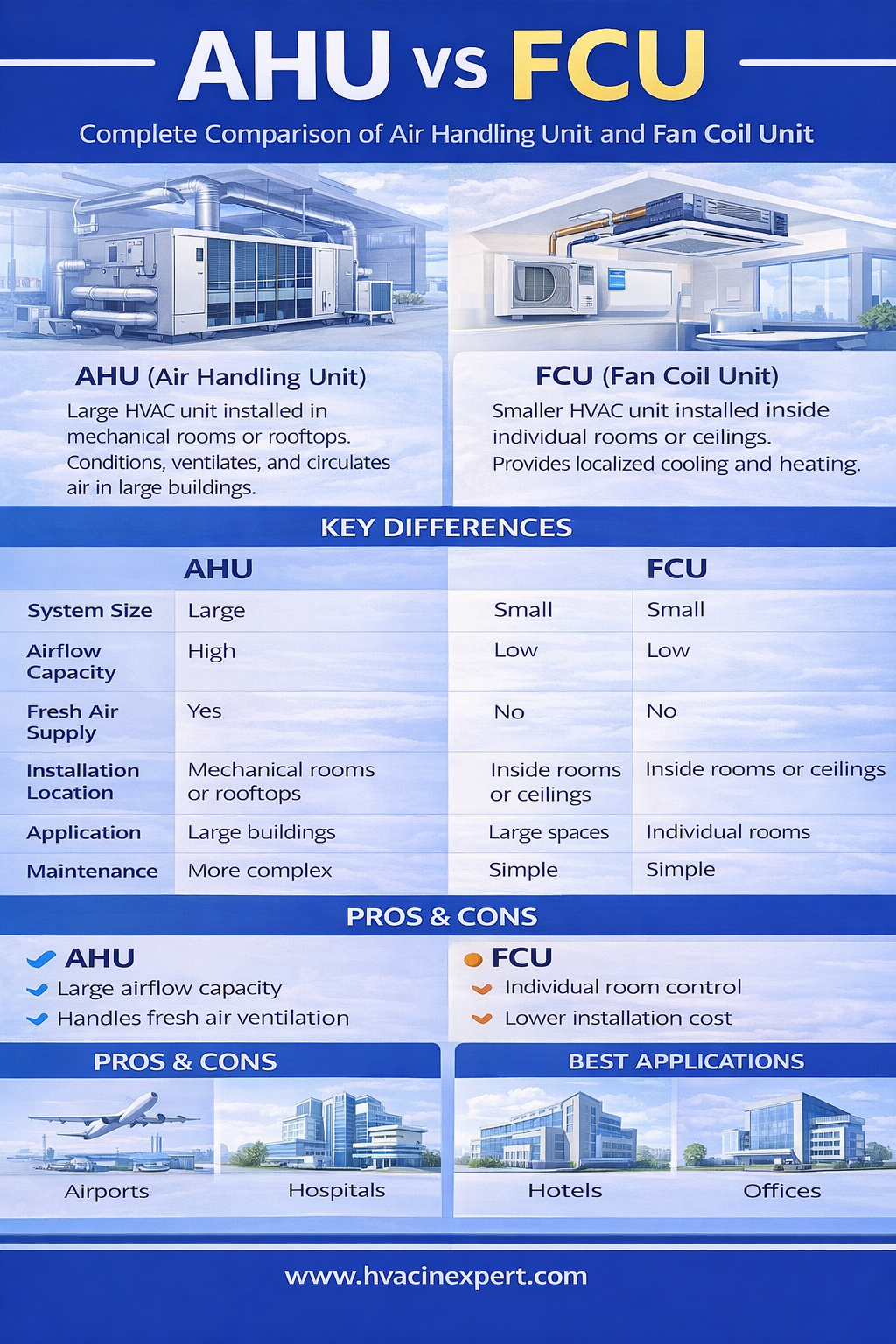
The following table explains the AHU vs FCU difference clearly.
| Feature | AHU | FCU |
|---|---|---|
| System Size | Large | Small |
| Airflow Capacity | High | Low |
| Fresh Air Supply | Yes | No |
| Installation Location | Mechanical rooms | Inside rooms or ceilings |
| Application | Large buildings | Individual rooms |
| Maintenance | Complex | Simple |
AHUs handle centralized air conditioning, while FCUs provide localized cooling.
AHU vs FCU Airflow Capacity
Airflow capacity is one of the biggest differences.
AHU Airflow Capacity
AHUs handle large airflow volumes ranging from:
2000 CFM to 50,000+ CFM
FCU Airflow Capacity
FCUs typically handle smaller airflow volumes:
200 CFM to 2000 CFM
This makes AHUs suitable for large spaces.
AHU vs FCU Fresh Air Handling
Fresh air ventilation is another key difference.
AHU Fresh Air Capability
AHUs can introduce fresh outdoor air into the building.
This improves indoor air quality.
FCU Fresh Air Capability
FCUs typically recirculate indoor air and do not handle fresh air directly.
Therefore, FCUs often work together with AHUs.
AHU vs FCU Installation Differences
Installation requirements differ significantly.
AHU Installation
AHUs require:
-
Mechanical room space
-
Large duct networks
-
Chilled water connections
Installation is complex.
FCU Installation
FCUs are installed inside rooms or ceilings.
Installation is simpler and requires minimal ductwork.
AHU vs FCU Energy Efficiency
Energy efficiency depends on system design.
AHU Efficiency
AHUs are efficient for centralized cooling systems.
FCU Efficiency
FCUs are efficient for zone-based cooling applications.
Combining both systems can optimize HVAC performance.
AHU vs FCU Maintenance Requirements
Maintenance is essential for reliable HVAC operation.
AHU Maintenance
Maintenance tasks include:
-
Filter replacement
-
Coil cleaning
-
Fan inspection
-
Damper adjustments
FCU Maintenance
Maintenance tasks include:
-
Cleaning air filters
-
Inspecting fan motor
-
Checking chilled water valves
FCU maintenance is generally simpler.
Advantages of AHU Systems
AHUs offer several benefits.
Large Airflow Capacity
AHUs can handle large building cooling loads.
Fresh Air Ventilation
AHUs improve indoor air quality.
Centralized Control
AHUs allow centralized HVAC management.
Advantages of FCU Systems
FCUs also offer advantages.
Individual Room Control
Each room can maintain its own temperature.
Compact Size
FCUs fit inside ceilings or walls.
Lower Installation Cost
FCUs require less infrastructure.
Disadvantages of AHU Systems
AHUs also have limitations.
Higher Installation Cost
AHU systems require ductwork and mechanical rooms.
Complex Maintenance
Maintenance requires skilled technicians.
Disadvantages of FCU Systems
FCUs also have some limitations.
No Fresh Air Supply
FCUs cannot provide fresh air ventilation.
Limited Airflow Capacity
FCUs are not suitable for large spaces.
Applications of AHU Systems
AHUs are used in large buildings such as:
-
Airports
-
Hospitals
-
Shopping malls
-
Industrial plants
-
Large commercial buildings
These buildings require centralized HVAC systems.
Applications of FCU Systems
FCUs are commonly used in:
-
Hotels
-
Apartments
-
Offices
-
Residential buildings
-
Small commercial spaces
FCUs provide flexible zone cooling.
AHU and FCU in Central HVAC Systems
In many commercial buildings, AHUs and FCUs work together.
AHUs handle fresh air ventilation, while FCUs provide localized cooling.
This hybrid system improves energy efficiency and indoor comfort.
Future Trends in AHU and FCU Technology
Modern HVAC technology is evolving rapidly.
Smart HVAC Controls
Building automation systems optimize HVAC operation.
Energy Efficient Motors
EC motors reduce energy consumption.
IoT Monitoring
IoT sensors enable real-time system monitoring.
These innovations improve HVAC system performance.
Frequently Asked Questions
What is the main difference between AHU and FCU?
AHUs handle large airflow and fresh air ventilation, while FCUs provide localized cooling without fresh air supply.
Where are AHUs used?
AHUs are used in large buildings such as hospitals, airports, and shopping malls.
Where are FCUs used?
FCUs are commonly used in hotels, apartments, and offices.
Can AHU and FCU work together?
Yes, AHUs and FCUs are often used together in centralized HVAC systems.
Which system is more energy efficient?
Both systems can be energy efficient depending on system design and application.
Final Summary
Understanding the AHU vs FCU difference is important for HVAC system design.
Key differences include:
-
AHUs handle large airflow and fresh air ventilation.
-
FCUs provide localized cooling.
-
AHUs are used in centralized HVAC systems.
-
FCUs are used for zone-level cooling.
Selecting the right system improves building comfort and energy efficiency.
Conclusion
AHUs and FCUs are essential components of modern HVAC systems.
While AHUs provide centralized air handling and ventilation, FCUs offer flexible zone-based cooling.
Choosing the right equipment depends on building size, ventilation requirements, and HVAC design.
Proper system selection ensures efficient air conditioning and long-term building comfort.