cfm full form

CFM Full Form – Meaning, Formula, Calculation & Complete Guide
But what exactly does CFM mean?
In this complete guide, we will explain:
-
CFM full form
-
Meaning of CFM in HVAC
-
CFM formula
-
How to calculate CFM
-
CFM per ton rule
-
CFM in ducts and ventilation
-
Difference between CFM and FPM
-
Practical examples
-
FAQs
Let’s start with the basics.
What Is the Full Form of CFM?
CFM stands for Cubic Feet per Minute.
It is a unit used to measure the volume of air flowing per minute in an HVAC or ventilation system.
In simple words:
CFM tells us how much air moves through a system every minute.
What Does CFM Measure?
CFM measures airflow volume, not speed.
For example:
-
400 CFM means 400 cubic feet of air moves per minute.
-
1200 CFM means 1200 cubic feet of air moves per minute.
It is commonly used in:
-
Air conditioners
-
Air handling units
-
Ventilation systems
-
Exhaust fans
-
Industrial blowers
Why Is CFM Important?
Proper airflow ensures:
- Uniform cooling
- Better air circulation
- Humidity control
- Energy efficiency
- Comfortable indoor environment
If CFM is too low:
-
Poor cooling
-
Ice formation
-
High humidity
If CFM is too high:
-
Noise
-
Draft discomfort
-
Reduced dehumidification
Balanced airflow is essential.
CFM in HVAC Systems
CFM plays a major role in:
-
Split AC systems
-
Ductable AC
-
VRF systems
-
Central air conditioning
-
Ventilation design
In HVAC design, airflow is calculated before equipment selection.
Standard CFM Per Ton Rule
In air conditioning:
1 Ton of Cooling ≈ 400 CFM
This is a commonly used thumb rule.
| AC Capacity | Required CFM |
|---|---|
| 1 Ton | 400 CFM |
| 1.5 Ton | 600 CFM |
| 2 Ton | 800 CFM |
| 3 Ton | 1200 CFM |
| 5 Ton | 2000 CFM |
This may vary based on humidity and climate conditions.
CFM Formula
There are different ways to calculate CFM.
CFM from Air Velocity
CFM = Air Velocity × Duct Area
Where:
-
Velocity in FPM (Feet Per Minute)
-
Area in square feet
Example:
Velocity = 1000 FPM
Duct Area = 2 sq ft
CFM = 1000 × 2 = 2000 CFM
CFM Using Cooling Load Formula
Cubic Feet per Minute = BTU/hr ÷ (1.08 × ΔT)
Where:
-
BTU/hr = Cooling load
-
ΔT = Temperature difference
Used in detailed HVAC design.
CFM vs FPM – What’s the Difference?
Many beginners confuse these terms.
| Term | Meaning |
|---|---|
| CFM | Airflow volume |
| FPM | Air velocity |
CFM = FPM × Area
High velocity does not always mean high airflow. Duct size matters.
CFM in Duct Design
HVAC ductwork
Duct size depends on required CFM.
If duct is undersized:
-
High noise
-
Pressure drop
-
Reduced airflow
If oversized:
-
Increased cost
-
Installation issues
Correct duct sizing ensures smooth airflow.
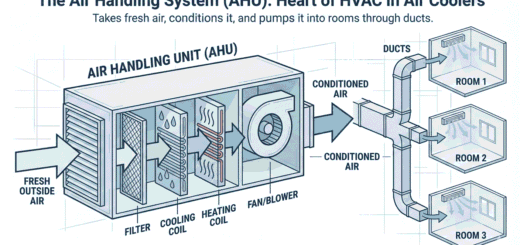
CFM in Air Handling Units (AHU)
Air Handling Unit
AHUs are rated in CFM.
Examples:
-
5000 CFM AHU
-
10,000 CFM AHU
It indicates how much air the unit can circulate per minute.
CFM in Ventilation Systems
CFM is used in:
-
Toilet exhaust
-
Kitchen exhaust
-
Basement ventilation
-
Fresh air systems
Typical values:
-
Toilet: 100–150 CFM
-
Kitchen: 500–1500 CFM
-
Office fresh air: 10–20 CFM per person
Proper ventilation improves indoor air quality.
CFM in Residential Air Conditioning
For homes:
Bedroom (100–150 sq ft) → 100–200 CFM
Living room → 300–500 CFM
Correct airflow prevents uneven cooling.
CFM in Commercial Buildings
In offices and malls:
-
Approx 1 CFM per sq ft (varies by design)
-
Hospitals require higher ventilation
Commercial systems use software like HAP or Trace 700 for airflow design.
CFM in VRF Systems
Variable Refrigerant Flow
Each indoor unit has specific airflow rating.
Example:
1.5 HP cassette → 600–700 CFM
2 HP cassette → 800–900 CFM
Zoned airflow improves efficiency.
How to Measure CFM Practically?
Tools used:
-
Anemometer
-
Flow hood
-
Pitot tube
-
Manometer
Steps:
-
Measure velocity
-
Calculate duct area
-
Multiply velocity × area
CFM Conversion to CMH
In India, CMH (Cubic Meter per Hour) is common.
1 CFM = 1.699 CMH
1 CMH = 0.588 CFM
Example:
1000 CFM = 1699 CMH
Effects of Incorrect CFM
Low CFM Causes:
-
Coil freezing
-
Compressor stress
-
Poor cooling
High CFM Causes:
-
Draft discomfort
-
Reduced moisture removal
-
Noise issues
Balanced airflow improves comfort.
Real-Life Practical Example
Room Size:
Length = 20 ft
Width = 15 ft
Height = 10 ft
Room Volume = 3000 cubic feet
If AC supplies 600 CFM:
Air changes per minute = 600
Full air circulation time = 3000 ÷ 600 = 5 minutes
This ensures uniform cooling.
CFM and Energy Efficiency
Proper airflow:
- Reduces electricity bill
- Prevents compressor overload
- Improves system life
Energy-efficient HVAC depends on balanced airflow.
CFM in Industrial Applications
Used in:
-
Paint booths
-
Clean rooms
-
Factories
-
Warehouses
Industrial airflow is much higher than residential.
Common Mistakes Related to CFM
- Ignoring duct friction loss
- Wrong velocity assumption
- Not balancing diffusers
- Using thumb rule without calculation
Professional HVAC design avoids these mistakes.
Frequently Asked Questions (FAQ)
What is CFM full form?
Cubic Feet per Minute.
What is 400 CFM rule?
1 Ton AC requires approx 400 CFM airflow.
Is higher CFM better?
Not always. Balanced airflow is important.
How do I check my AC CFM?
Check manufacturer specifications.
Does CFM affect electricity bill?
Yes, incorrect airflow increases power consumption.
Final Summary
CFM stands for Cubic Feet per Minute.
It measures:
-
Airflow volume
-
Cooling performance
-
Ventilation efficiency
Key Points:
- 1 Ton AC ≈ 400 CFM
- CFM = Velocity × Area
- Used in ducts, AHU, ventilation
- Critical for HVAC performance
Conclusion
Understanding CFM is essential for HVAC students, technicians, contractors, and building owners.
Whether you’re designing a duct system, installing an AC, or troubleshooting airflow issues, knowing how CFM works helps you improve performance and energy efficiency.
Airflow is the heart of HVAC systems — and CFM is the language that defines it.
Master CFM, and you master HVAC fundamentals.