
Chiller vs VRF System
Chiller vs VRF System (Complete HVAC Comparison Guide)
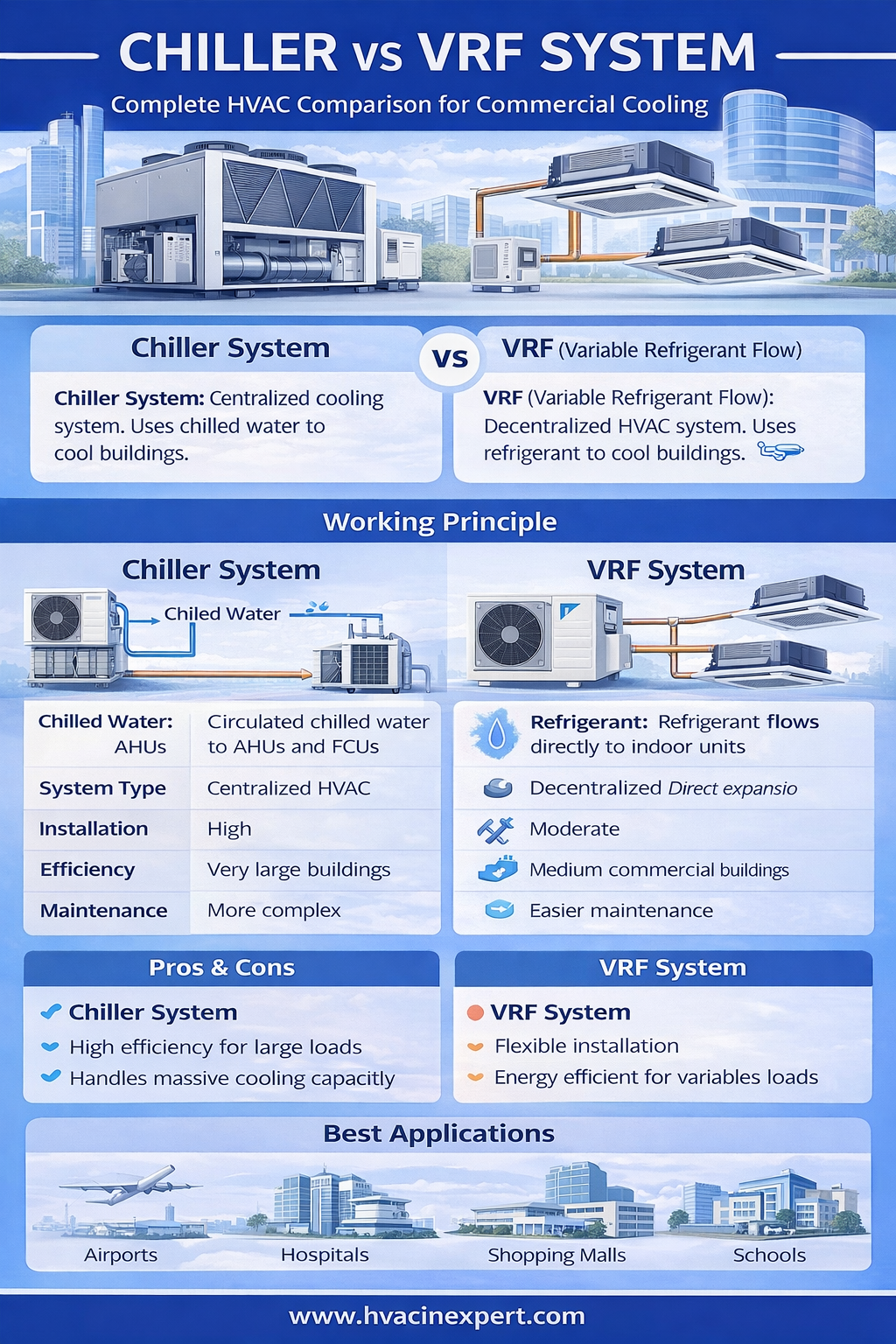
Modern commercial buildings require advanced cooling systems that provide high efficiency, reliable operation, and flexible temperature control. Two of the most commonly used HVAC solutions in large buildings are chiller systems and VRF systems.
HVAC engineers, building consultants, and facility managers often ask:
Which is better: Chiller system or VRF system?
Both technologies are widely used in commercial and industrial air conditioning applications, but they operate using different cooling principles and offer different advantages.
Understanding the Chiller vs VRF system comparison helps HVAC professionals choose the right cooling solution for specific building requirements.
This guide explains everything you need to know about chiller and VRF systems, including:
-
Working principles
-
Major components
-
Advantages and disadvantages
-
Installation cost comparison
-
Energy efficiency analysis
-
Best applications for each system
This detailed guide will help you select the most suitable HVAC system for commercial projects.
What Is a Chiller System?
A chiller system is a central air conditioning system that removes heat from water and circulates chilled water through air handling units or fan coil units to cool a building.
The chilled water absorbs heat from indoor air and carries it back to the chiller where the heat is removed.
Chiller systems are widely used in large buildings such as:
-
Hospitals
-
Airports
-
Shopping malls
-
Industrial plants
-
Large commercial buildings
-
Data centers
Chillers are capable of handling very large cooling loads.
Components of a Chiller System
A chiller HVAC system consists of several major components.
Chiller Unit
The chiller unit is the main equipment responsible for cooling water.
Cooling Tower
The cooling tower removes heat from condenser water in water-cooled chillers.
Chilled Water Pumps
These pumps circulate chilled water through the building.
Air Handling Units (AHU)
AHUs distribute cooled air into different areas of the building.
Fan Coil Units (FCU)
FCUs provide localized cooling in specific rooms or zones.
Together, these components form a central cooling system.
Types of Chiller Systems
Chillers are available in several types.
Air-Cooled Chillers
Air-cooled chillers use ambient air to remove heat from the condenser.
Advantages:
-
Easier installation
-
Lower initial cost
-
No cooling tower required
Water-Cooled Chillers
Water-cooled chillers use cooling towers for heat rejection.
Advantages:
-
Higher efficiency
-
Suitable for large buildings
-
Lower operating cost
What Is a VRF System?
A VRF (Variable Refrigerant Flow) system is an advanced air conditioning system that uses refrigerant as the cooling medium.
A single outdoor unit can connect to multiple indoor units through refrigerant piping.
The system automatically adjusts refrigerant flow depending on cooling demand.
VRF systems are commonly used in:
-
Hotels
-
Offices
-
Commercial buildings
-
Schools
-
Residential towers
VRF systems are known for high energy efficiency and flexible installation.
Components of a VRF System
A VRF system consists of several components.
Outdoor Unit
The outdoor unit contains inverter compressors and condenser coils.
Indoor Units
Indoor units deliver cooled air to rooms.
Types include:
-
Cassette units
-
Wall-mounted units
-
Ducted units
Refrigerant Piping
Copper pipes connect indoor and outdoor units.
Control System
Advanced controllers regulate refrigerant flow.
These components work together to provide precise temperature control.
Working Principle of Chiller Systems
Chiller systems operate using a refrigeration cycle.
The process involves four main steps:
-
The evaporator absorbs heat from chilled water.
-
The compressor compresses refrigerant vapor.
-
The condenser releases heat to air or water.
-
The expansion valve reduces refrigerant pressure.
Chilled water is then circulated through air handling units to cool indoor spaces.
Working Principle of VRF Systems
VRF systems also use the refrigeration cycle but distribute refrigerant directly to indoor units.
The system uses inverter compressors that adjust refrigerant flow depending on cooling demand.
This allows individual temperature control for multiple zones.
Key Differences Between Chiller and VRF Systems
Below is a comparison of chiller vs VRF systems.
| Feature | Chiller System | VRF System |
|---|---|---|
| Cooling Medium | Chilled water | Refrigerant |
| System Type | Centralized HVAC | Direct expansion system |
| Best For | Large buildings | Medium commercial buildings |
| Installation Complexity | High | Moderate |
| Energy Efficiency | High for large loads | High for variable loads |
| Maintenance | Requires specialized maintenance | Easier maintenance |
Both systems have different strengths depending on building requirements.
Installation Comparison: Chiller vs VRF
Installation requirements vary significantly.
Chiller Installation
Chiller systems require:
-
Mechanical room
-
Cooling tower installation
-
Large piping networks
-
Pump systems
Installation is complex and requires significant space.
VRF Installation
VRF systems require:
-
Outdoor unit placement
-
Refrigerant piping
-
Indoor unit installation
Installation is faster and requires less space.
Cost Comparison: Chiller vs VRF System
Cost is an important factor when selecting HVAC systems.
Typical installation costs include:
| System | Cost per Square Meter |
|---|---|
| Chiller System | $80 – $200 |
| VRF System | $40 – $120 |
Chiller systems generally have higher initial installation costs.
Energy Efficiency Comparison
Energy efficiency depends on building size and cooling load.
Chiller System Efficiency
Chillers are highly efficient for very large buildings with continuous cooling demand.
VRF System Efficiency
VRF systems are efficient for buildings with variable cooling loads.
Energy savings can reach 30–40% compared to traditional HVAC systems.
Maintenance Requirements
Maintenance is essential for both systems.
Chiller Maintenance
Chiller systems require:
-
Cooling tower cleaning
-
Water treatment
-
Pump maintenance
-
Periodic inspection
VRF Maintenance
VRF systems require:
-
Filter cleaning
-
Refrigerant inspection
-
Electrical component inspection
It generally require less maintenance.
Advantages of Chiller Systems
Chiller systems offer several advantages.
Suitable for Large Buildings
Chillers can handle massive cooling loads.
Long Equipment Life
Chillers can last 20–25 years.
Centralized Cooling Control
Centralized systems simplify building HVAC management.
Advantages of VRF Systems
VRF systems also offer many benefits.
Flexible Installation
VRF systems can be installed in buildings with limited space.
Individual Zone Control
Each room can have its own temperature setting.
Energy Efficient
VRF systems adjust cooling output based on demand.
Disadvantages of Chiller Systems
Chillers have some limitations.
High Installation Cost
Initial setup costs can be very high.
Complex System Design
Installation requires experienced engineers.
Disadvantages of VRF Systems
VRF systems also have some disadvantages.
Limited Capacity for Very Large Buildings
VRF systems may not be suitable for extremely large cooling loads.
Refrigerant Piping Complexity
Long piping networks require careful design.
Applications of Chiller Systems
Chillers are commonly used in large facilities.
Typical applications include:
-
Airports
-
Hospitals
-
Industrial plants
-
Shopping malls
-
Large commercial buildings
These buildings require high cooling capacity.
Applications of VRF Systems
VRF systems are widely used in medium-sized commercial buildings.
Typical applications include:
-
Hotels
-
Office buildings
-
Educational institutions
-
Residential complexes
VRF systems are ideal for buildings with multiple zones.
Future Trends in Chiller and VRF Technology
HVAC technology continues to evolve.
Magnetic Bearing Chillers
These chillers offer high efficiency and low maintenance.
Smart VRF Systems
Advanced VRF systems integrate with building management systems.
Eco-Friendly Refrigerants
New refrigerants reduce environmental impact.
These innovations are improving HVAC performance.
Frequently Asked Questions
Which system is better chiller or VRF?
The best system depends on building size and cooling load. Chillers are better for very large buildings, while VRF systems are ideal for medium commercial buildings.
Are VRF systems cheaper than chillers?
Yes, VRF systems typically have lower installation costs compared to chiller systems.
Which system is more energy efficient?
VRF systems are efficient for variable loads, while chillers perform better in large centralized systems.
How long do chiller systems last?
Chiller systems typically last 20–25 years with proper maintenance.
How long do VRF systems last?
VRF systems usually last 15–20 years.
Final Summary
The Chiller vs VRF system comparison depends on building size, cooling load, and budget.
Key differences include:
-
Chillers use chilled water as the cooling medium.
-
VRF systems use refrigerant directly.
-
Chillers are ideal for very large buildings.
-
VRF systems are better for medium commercial buildings.
Choosing the correct HVAC system ensures optimal performance and energy efficiency.
Conclusion
Both chiller systems and VRF systems are highly advanced HVAC technologies used in commercial cooling.
Chiller systems are ideal for large facilities requiring massive cooling capacity, while VRF systems provide flexible and energy-efficient cooling for medium-sized buildings.
Selecting the right system depends on project requirements, budget, and building design.
Proper HVAC system selection ensures long-term performance and efficient building cooling.