
Ductable AC Installation Guide
Ductable AC Installation Guide (Complete HVAC Installation Manual)
Ductable air conditioning systems are widely used in commercial buildings, offices, hotels, restaurants, showrooms, and large residential spaces. These systems provide centralized cooling by distributing conditioned air through a network of ducts.
Compared to split air conditioners, ductable AC systems offer several advantages such as better air distribution, aesthetic design, and centralized temperature control.
However, proper installation is critical for achieving optimal system performance. Incorrect installation can cause several problems including:
-
Poor airflow distribution
-
High energy consumption
-
Uneven cooling
-
Refrigerant leakage
-
Excessive noise
A professional ductable AC installation guide ensures the system operates efficiently and reliably.
This complete guide explains the professional installation process used by HVAC technicians.
In this guide you will learn:
-
Ductable AC system components
-
Indoor unit installation steps
-
Ductwork installation process
-
Refrigerant piping installation
-
Electrical wiring setup
-
Air balancing and testing
Understanding these steps helps HVAC professionals deliver high-quality installations.
What Is a Ductable Air Conditioner?
A ductable air conditioner is a type of centralized air conditioning system that distributes cooled air through a network of ducts.
The system consists of:
-
Indoor unit (air handler or ductable unit)
-
Outdoor condensing unit
-
Air ducts
-
Air diffusers or grills
-
Refrigerant piping
-
Thermostat controller
The indoor unit is usually installed in a false ceiling or mechanical room, and the cooled air is distributed through ducts to different rooms.
Ductable AC systems are commonly used in:
-
Office buildings
-
Retail stores
-
Hotels
-
Restaurants
-
Hospitals
-
Large homes
These systems provide uniform cooling and better aesthetics because indoor units remain hidden in the ceiling.
Components of a Ductable AC System
Understanding the components of a ductable AC system is essential before installation.
Indoor Unit
The indoor unit contains:
-
Evaporator coil
-
Blower fan
-
Air filter
This unit cools the air and distributes it through ductwork.
Outdoor Unit
The outdoor unit contains:
-
Compressor
-
Condenser coil
-
Condenser fan
The outdoor unit removes heat from the refrigerant.
Duct System
Ducts distribute cooled air to different areas of the building.
Common duct materials include:
-
GI sheet ducts
-
Aluminum ducts
-
Flexible ducts
Air Diffusers and Grilles
Diffusers distribute conditioned air into the room.
Return grilles allow air to return to the indoor unit.
Refrigerant Piping
Copper pipes connect indoor and outdoor units and transport refrigerant.
Tools Required for Ductable AC Installation
HVAC technicians require several tools to install ductable AC systems.
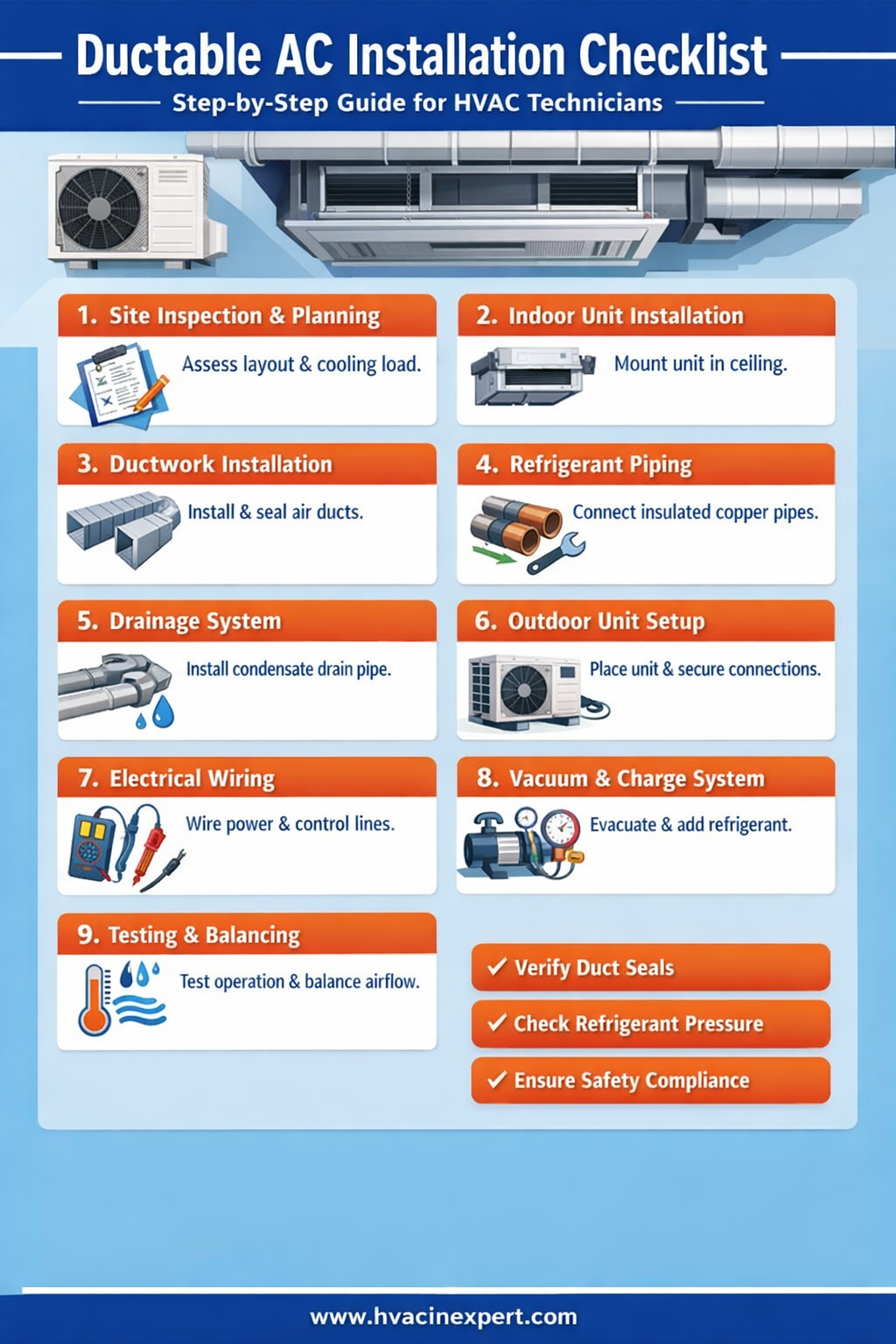
Common installation tools include:
-
Vacuum pump
-
Manifold gauge set
-
Drill machine
-
Pipe cutter
-
Flaring tool
-
Spirit level
-
Refrigerant leak detector
-
Electrical testing meter
Using proper tools ensures safe and accurate installation.
Step 1: Site Inspection and Planning
The first step in ductable AC installation is inspecting the installation site.
HVAC engineers must evaluate:
-
Building layout
-
Cooling load requirements
-
Indoor unit location
-
Duct routing
-
Outdoor unit placement
Proper planning ensures efficient installation and optimal airflow distribution.
Cooling load calculations should be performed to determine the required AC capacity.
Step 2: Selecting the Indoor Unit Location
The indoor unit should be installed in a location that allows efficient airflow distribution.
Common installation locations include:
-
False ceiling space
-
Mechanical rooms
-
Service corridors
Installation guidelines:
-
Ensure sufficient space for maintenance
-
Provide adequate return air path
-
Ensure proper drainage for condensate water
The indoor unit must be installed on a strong support frame or hanging rods.
Step 3: Installing the Indoor Unit
After selecting the location, the indoor unit can be installed.
Indoor Unit Installation Procedure
-
Install suspension rods in the ceiling.
-
Mount the indoor unit using brackets.
-
Use a spirit level to ensure horizontal alignment.
-
Secure mounting bolts.
Proper alignment prevents vibration and ensures smooth airflow.
Step 4: Ductwork Installation
Ductwork installation is one of the most important steps in ductable AC installation.
Poor duct design can significantly reduce system efficiency.
Types of Ducts
Common duct types include:
-
Supply air ducts
-
Return air ducts
-
Fresh air ducts
Duct Installation Guidelines
-
Use proper duct sizing based on airflow requirements.
-
Ensure smooth airflow without sharp bends.
-
Seal duct joints to prevent air leakage.
-
Support ducts properly to avoid sagging.
Proper duct installation improves airflow efficiency and system performance.
Step 5: Installing Air Diffusers and Grilles
Air diffusers distribute conditioned air evenly across the room.
Return air grilles allow air to circulate back to the indoor unit.
Diffuser Installation Guidelines
-
Install diffusers in central locations.
-
Maintain equal spacing between diffusers.
-
Avoid placing diffusers directly above occupants.
Proper diffuser placement ensures uniform cooling.
Step 6: Refrigerant Piping Installation
Refrigerant piping connects the indoor unit to the outdoor unit.
Proper piping installation is critical for system efficiency.
Piping Installation Steps
-
Measure pipe length.
-
Cut copper pipes using pipe cutter.
-
Remove burrs.
-
Perform flaring.
-
Install insulation.
Copper pipes must be insulated to prevent energy loss and condensation.
Step 7: Drain Pipe Installation
Condensate water produced by the indoor unit must be drained properly.
Drain pipes are usually made from PVC.
Drain Pipe Guidelines
-
Maintain downward slope.
-
Avoid sharp bends.
-
Provide insulation.
Proper drainage prevents water leakage inside the ceiling.
Step 8: Outdoor Unit Installation
The outdoor unit should be installed in a well-ventilated area.
Installation guidelines:
-
Install on a stable base.
-
Provide adequate clearance around the unit.
-
Avoid direct sunlight exposure when possible.
Outdoor units can be installed on:
-
Ground level
-
Rooftops
-
Wall brackets
Step 9: Electrical Wiring Installation
Electrical wiring connects the indoor and outdoor units and supplies power.
Electrical Installation Steps
-
Connect power supply to outdoor unit.
-
Connect control wiring between indoor and outdoor units.
-
Install circuit breaker protection.
All wiring must follow manufacturer guidelines.
Step 10: Vacuuming the Refrigerant System
Vacuuming removes air and moisture from the refrigerant lines.
Vacuum Procedure
-
Connect manifold gauge to service port.
-
Connect vacuum pump.
-
Run vacuum pump for 20–30 minutes.
-
Ensure vacuum pressure reaches required level.
Vacuuming prevents compressor damage and improves system efficiency.
Step 11: Refrigerant Charging
Most ductable AC systems come pre-charged with refrigerant.
If piping length exceeds standard limits, additional refrigerant may be required.
Refrigerant charging methods include:
-
Weight method
-
Superheat method
-
Subcooling method
Proper refrigerant charge ensures efficient cooling.
Step 12: Airflow Balancing
Air balancing ensures equal airflow across all rooms.
HVAC technicians adjust dampers to regulate airflow.
Air balancing ensures:
-
Uniform cooling
-
Comfortable indoor environment
-
Reduced energy consumption
Step 13: System Testing and Commissioning
After installation is completed, the system must be tested.
Testing Checklist
-
Check compressor operation
-
Verify fan operation
-
Measure airflow
-
Check refrigerant pressure
-
Inspect thermostat operation
Commissioning ensures the system operates according to design specifications.
Common Mistakes in Ductable AC Installation
Some common installation mistakes include:
Poor Duct Design
Improper duct sizing reduces airflow.
Improper Refrigerant Piping
Incorrect pipe size can affect refrigerant flow.
Incorrect Indoor Unit Placement
Poor placement reduces cooling efficiency.
Inadequate Insulation
Poor insulation causes energy loss.
Avoiding these mistakes improves system performance.
Ductable AC Installation Cost
Installation cost depends on several factors such as system capacity and duct length.
Typical costs include:
| Component | Cost Range |
|---|---|
| Indoor Unit | $1500 – $4000 |
| Outdoor Unit | $2000 – $5000 |
| Ductwork | $10 – $25 per meter |
| Labor | $500 – $2000 |
In India, ductable AC installation typically costs:
₹25,000 – ₹1,50,000 depending on project size.
Advantages of Ductable AC Systems
Ductable AC systems offer several benefits.
Uniform Cooling
Air is distributed evenly across rooms.
Better Aesthetics
Indoor units remain hidden in the ceiling.
Centralized Control
Temperature can be controlled centrally.
Quiet Operation
Noise levels are lower compared to split AC units.
Maintenance Tips for Ductable AC Systems
Regular maintenance ensures long-term performance.
Important maintenance tasks include:
- Clean air filters regularly
- Inspect ducts for leakage
- Check refrigerant pressure
- Clean condenser coil
Proper maintenance increases system lifespan.
Future Trends in Ductable HVAC Systems
Modern ductable HVAC systems are evolving with new technologies.
Examples include:
Smart HVAC Controls
Smart thermostats allow remote control.
Energy Efficient Compressors
Inverter technology improves efficiency.
IoT Based Monitoring
IoT sensors monitor system performance in real time.
These innovations are improving HVAC system efficiency.
Frequently Asked Questions
What is a ductable AC system?
A ductable AC system distributes cooled air through ducts connected to an indoor unit installed in the ceiling.
Where are ductable AC systems used?
They are commonly used in offices, hotels, restaurants, and large residential buildings.
How long does ductable AC installation take?
Installation usually takes 1–3 days depending on project complexity.
What capacity ductable AC should I choose?
AC capacity depends on cooling load calculations and building size.
How often should ductable AC be serviced?
Ductable AC systems should be serviced every 6 months.
Final Summary
Ductable air conditioning systems provide efficient cooling for large spaces.
Proper installation involves several steps including:
-
Indoor unit installation
-
Ductwork installation
-
Refrigerant piping
-
Electrical wiring
-
Airflow balancing
Following a professional ductable AC installation guide ensures efficient system performance and long equipment life.
Conclusion
Ductable AC systems are an excellent solution for centralized cooling in commercial and residential buildings.
However, proper installation is essential for achieving optimal performance and energy efficiency.
By following this complete ductable AC installation guide, HVAC technicians can ensure reliable system operation and comfortable indoor environments.