HVAC Refrigeration Cycle Explained
HVAC Refrigeration Cycle Explained
The HVAC refrigeration cycle is the fundamental process that allows air conditioners, refrigerators, and heat pumps to remove heat from indoor spaces and release it outdoors. This process is responsible for maintaining comfortable indoor temperatures in residential, commercial, and industrial buildings.
Modern HVAC systems rely on the refrigeration cycle to produce cooling efficiently. The cycle operates by circulating a special fluid known as refrigerant through several components that change its pressure, temperature, and state.
The refrigeration cycle includes four main components:
-
Compressor
-
Condenser
-
Expansion Device
-
Evaporator
These components work together continuously to transfer heat from one location to another.
Understanding the refrigeration cycle is essential for HVAC technicians, engineers, and students, as it forms the basis of air conditioning system operation.
What is the HVAC Refrigeration Cycle?
The refrigeration cycle is a thermodynamic process that removes heat from a low-temperature environment and transfers it to a high-temperature environment using refrigerant.
In simple terms:
The refrigeration cycle moves heat from inside a building to the outside environment.
This process happens through repeated changes in the refrigerant’s pressure, temperature, and physical state (liquid and vapor).
The refrigeration cycle is used in many HVAC systems including:
-
Split air conditioners
-
Window air conditioners
-
VRF and VRV systems
-
Chillers
-
Refrigerators
-
Cold storage systems
Without the refrigeration cycle, modern cooling technology would not exist.
Main Components of the HVAC Refrigeration Cycle
The refrigeration cycle consists of four primary components that continuously circulate refrigerant.
1. Compressor
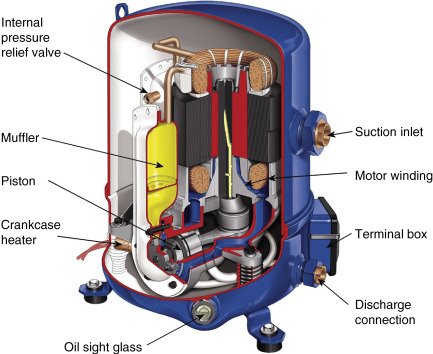
The compressor is the heart of the refrigeration system. It pumps refrigerant through the entire cycle and increases its pressure and temperature.
The compressor receives low-pressure refrigerant vapor from the evaporator and compresses it into high-pressure, high-temperature vapor.
Functions of the Compressor
-
Circulates refrigerant through the system
-
Increases refrigerant pressure
-
Raises refrigerant temperature
-
Enables heat rejection in the condenser
Types of HVAC Compressors
Several types of compressors are used in HVAC systems.
Reciprocating Compressor
Common in small air conditioners and refrigerators.
Scroll Compressor
Widely used in modern residential and commercial AC systems.
Rotary Compressor
Used in compact air conditioning systems.
Screw Compressor
Used in large chillers and industrial cooling systems.
Centrifugal Compressor
Used in large commercial HVAC systems.
A malfunctioning compressor can stop the entire refrigeration cycle.
2. Condenser
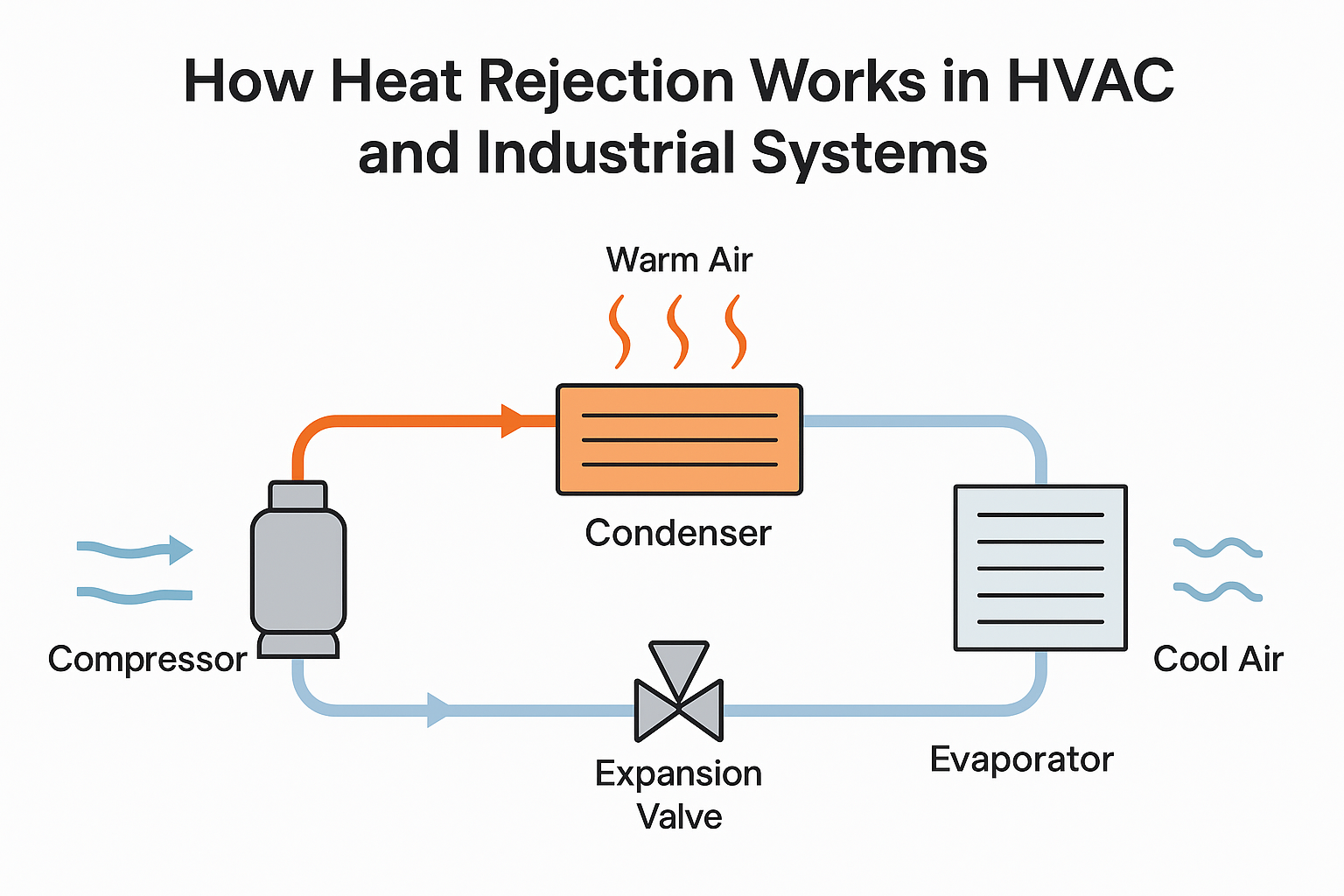
The condenser is responsible for releasing heat absorbed from indoor air.
When the high-pressure refrigerant vapor enters the condenser, it releases heat to the surrounding environment and condenses into a liquid.
This process is known as heat rejection.
Condenser Working Principle
The condenser works through heat exchange.
Hot refrigerant vapor passes through condenser coils while outdoor air flows over the coils. The heat transfers from the refrigerant to the outside air.
As heat is removed, the refrigerant changes from vapor to liquid.
Types of Condensers
Air-Cooled Condenser
Uses ambient air to remove heat.
Water-Cooled Condenser
Uses water to absorb heat.
Evaporative Condenser
Uses water spray and air flow for efficient cooling.
Most residential AC systems use air-cooled condensers.
3. Expansion Device
It reduces refrigerant pressure suddenly, causing the refrigerant temperature to drop significantly.
This pressure drop prepares the refrigerant to absorb heat in the evaporator.
Functions of Expansion Device
-
Controls refrigerant flow
-
Reduces refrigerant pressure
-
Creates low temperature refrigerant mixture
Types of Expansion Devices
Thermostatic Expansion Valve (TXV)
Common in modern air conditioning systems.
Electronic Expansion Valve (EEV)
Used in inverter AC and VRF systems.
Capillary Tube
Used in small refrigeration units.
Expansion devices are essential for maintaining proper system pressure balance.
4. Evaporator
Low-pressure refrigerant enters the evaporator and absorbs heat from indoor air.
As it absorbs heat, the refrigerant evaporates from liquid to vapor.
This process cools the air that circulates through the indoor space.
Evaporator Functions
-
Absorbs indoor heat
-
Converts refrigerant liquid into vapor
-
Produces cooled air
The indoor blower fan pushes warm room air over the evaporator coil, allowing heat transfer.
Step-by-Step HVAC Refrigeration Cycle Process
The refrigeration cycle operates continuously through four stages.
Step 1 – Compression
The compressor compresses low-pressure refrigerant vapor from the evaporator.
Result:
-
Pressure increases
-
Temperature increases
-
Refrigerant becomes high-pressure vapor
Step 2 – Condensation
The hot refrigerant enters the condenser.
Heat is released to the outdoor environment.
Result:
-
Refrigerant condenses into liquid
-
Pressure remains high
Step 3 – Expansion
The liquid refrigerant passes through the expansion device.
Result:
-
Pressure drops
-
Temperature drops
Refrigerant becomes a cold low-pressure liquid mixture.
Step 4 – Evaporation
The refrigerant enters the evaporator and absorbs heat from indoor air.
Result:
-
Refrigerant evaporates into vapor
-
Air becomes cool
The cycle then repeats continuously.
Refrigerants Used in HVAC Refrigeration Cycle
Refrigerants are special fluids designed to absorb and release heat efficiently.
Common HVAC refrigerants include:
R22
Previously widely used but being phased out due to environmental concerns.
R410A
Common in modern residential air conditioners.
R32
More environmentally friendly refrigerant.
R134a
Used in refrigerators and chillers.
R407C
Used in commercial HVAC systems.
Refrigerants are selected based on:
-
Cooling efficiency
-
Environmental impact
-
Safety
-
Operating pressure
Pressure and Temperature Changes in the Refrigeration Cycle
The refrigeration cycle relies on controlled pressure and temperature changes.
| Stage | Pressure | Temperature | Refrigerant State |
|---|---|---|---|
| Compressor | High | High | Vapor |
| Condenser | High | Medium | Liquid |
| Expansion Valve | Low | Low | Liquid mixture |
| Evaporator | Low | Medium | Vapor |
These changes allow refrigerant to absorb and release heat effectively.
Importance of the Refrigeration Cycle in HVAC Systems
The refrigeration cycle is essential for maintaining comfortable indoor conditions.
Benefits include:
Efficient Cooling
Removes heat effectively from indoor spaces.
Temperature Control
Maintains stable indoor temperatures.
Humidity Control
Reduces moisture levels in the air.
Energy Efficiency
Modern systems maximize cooling efficiency while reducing energy consumption.
Without the refrigeration cycle, air conditioning would not function.
Common Problems in the Refrigeration Cycle
Several issues can disrupt the refrigeration cycle.
Refrigerant Leak
Low refrigerant levels reduce cooling performance.
Compressor Failure
Stops refrigerant circulation.
Dirty Condenser Coil
Reduces heat rejection efficiency.
Blocked Expansion Valve
Prevents proper refrigerant flow.
Frozen Evaporator Coil
Caused by airflow restrictions.
Proper maintenance prevents these issues.
HVAC Technician Troubleshooting Tips
Professional technicians diagnose refrigeration cycle problems using several tools.
Common tools include:
-
Refrigerant manifold gauges
-
Digital thermometers
-
Clamp meters
-
Leak detectors
-
Vacuum pumps
Technicians analyze pressure readings to determine system faults.
HVAC Refrigeration Cycle Maintenance Tips
Regular maintenance improves system performance.
Recommended maintenance tasks include:
- Clean air filters regularly
- Inspect refrigerant piping
- Clean condenser coils
- Check refrigerant charge
- Inspect fan motors
Preventive maintenance reduces system breakdowns.
Applications of the Refrigeration Cycle
The refrigeration cycle is used in many systems.
Common applications include:
Residential air conditioning
Commercial HVAC systems
Cold storage facilities
Refrigerators and freezers
Industrial chillers
Food processing plants
These applications rely on the same basic thermodynamic principle.
Benefits of Understanding the Refrigeration Cycle
Learning the refrigeration cycle provides several advantages.
Better Troubleshooting
Technicians can quickly diagnose system problems.
Improved System Design
Engineers can design more efficient HVAC systems.
Energy Efficiency
Understanding the cycle helps optimize system performance.
Frequently Asked Questions
What is the HVAC refrigeration cycle?
The refrigeration cycle is a thermodynamic process that removes heat from indoor air and transfers it outdoors using refrigerant.
What are the four stages of the refrigeration cycle?
The four stages are compression, condensation, expansion, and evaporation.
What does the compressor do in the refrigeration cycle?
The compressor increases refrigerant pressure and circulates it through the system.
Why is the expansion valve important?
It reduces refrigerant pressure and controls refrigerant flow into the evaporator.
What happens in the evaporator coil?
The evaporator absorbs heat from indoor air and cools the room.
Conclusion
The HVAC refrigeration cycle is the core process that enables air conditioning and refrigeration systems to function effectively.
By circulating refrigerant through the compressor, condenser, expansion device, and evaporator, HVAC systems remove heat from indoor environments and maintain comfortable temperatures.
Understanding the refrigeration cycle is essential for HVAC technicians, engineers, and students involved in air conditioning technology.
Proper maintenance and troubleshooting ensure that the refrigeration cycle operates efficiently, delivering reliable cooling performance in residential, commercial, and industrial applications.