
Inverter AC vs Non-Inverter AC
Inverter AC vs Non-Inverter AC (Complete Air Conditioner Comparison Guide)
Air conditioners have become essential appliances for maintaining comfortable indoor environments, especially in regions with hot climates. When choosing an air conditioner, one of the most common questions buyers ask is:
What is the difference between an inverter AC and a non-inverter AC?
Both types of air conditioners are designed to cool indoor spaces effectively, but they differ significantly in technology, energy consumption, performance, and cost.
Understanding the Inverter AC vs Non-Inverter AC difference helps homeowners and HVAC professionals choose the right air conditioning system based on efficiency, budget, and usage requirements.
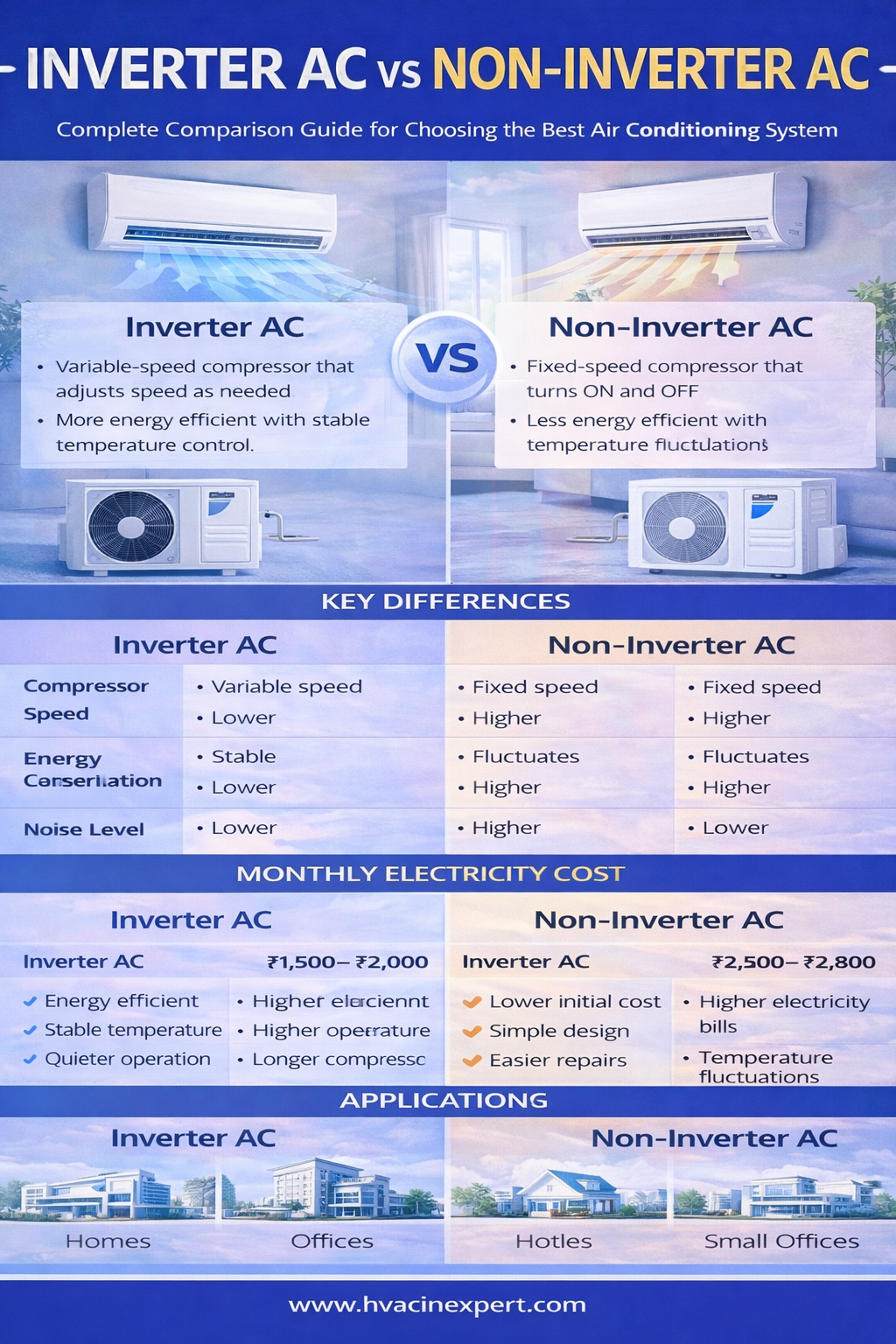
In this comprehensive guide, you will learn:
-
What inverter AC and non-inverter AC systems are
-
Working principles of both technologies
-
Key differences between inverter and non-inverter AC
-
Energy efficiency comparison
-
Cost comparison
-
Advantages and disadvantages
-
Which AC is better for different applications
By the end of this guide, you will clearly understand which AC type is best for your home or office.
What Is an Inverter Air Conditioner?
An inverter air conditioner is a modern air conditioning system that uses variable-speed compressor technology to control cooling capacity.
Unlike traditional air conditioners that turn the compressor ON and OFF repeatedly, inverter ACs adjust the compressor speed based on the cooling demand.
This allows the air conditioner to maintain a stable room temperature while consuming less electricity.
Inverter AC technology is widely used in:
-
Homes
-
Offices
-
Apartments
-
Hotels
-
Commercial spaces
These systems are popular due to their energy efficiency and quiet operation.
How Inverter AC Works
The key feature of an inverter AC is the variable-speed compressor.
The working process includes:
-
The thermostat detects the room temperature.
-
The compressor starts at high speed to achieve the desired temperature.
-
Once the temperature is reached, the compressor slows down instead of shutting off.
-
The compressor continuously adjusts speed to maintain the temperature.
This variable-speed operation reduces energy consumption and improves cooling efficiency.
Components of an Inverter AC System
Inverter AC systems include several components.
Inverter Compressor
The compressor adjusts speed using inverter technology.
Indoor Unit
The indoor unit contains the evaporator coil and blower fan.
Outdoor Unit
The outdoor unit contains the inverter compressor and condenser coil.
Electronic Control System
Advanced electronics control compressor speed and system performance.
What Is a Non-Inverter Air Conditioner?
A non-inverter air conditioner is a traditional AC system that uses a fixed-speed compressor.
The compressor operates using an ON/OFF cycle.
When the room reaches the desired temperature, the compressor shuts off. When the temperature rises again, the compressor restarts.
This repeated cycling can increase electricity consumption and cause temperature fluctuations.
Non-inverter AC systems are still widely used due to their lower initial cost.
How Non-Inverter AC Works
The working principle of a non-inverter AC includes the following steps:
-
The thermostat senses room temperature.
-
The compressor turns ON to cool the room.
-
Once the set temperature is reached, the compressor turns OFF.
-
When the temperature rises again, the compressor restarts.
This cycle repeats continuously.
Key Differences Between Inverter AC and Non-Inverter AC
Below is a comparison table explaining the Inverter AC vs Non-Inverter AC difference.
| Feature | Inverter AC | Non-Inverter AC |
|---|---|---|
| Compressor Speed | Variable speed | Fixed speed |
| Energy Consumption | Lower | Higher |
| Temperature Stability | Stable | Fluctuates |
| Noise Level | Lower | Higher |
| Initial Cost | Higher | Lower |
Inverter AC systems are generally more efficient and comfortable.
Energy Consumption Comparison
Energy efficiency is one of the biggest differences between inverter and non-inverter AC systems.
Inverter AC Energy Efficiency
Inverter AC systems adjust compressor speed according to cooling demand.
This reduces electricity consumption by 20–40% compared to non-inverter AC systems.
Non-Inverter AC Energy Consumption
Non-inverter AC systems repeatedly start and stop the compressor.
This increases electricity consumption.
Cooling Performance Comparison
Cooling performance also differs between the two systems.
Inverter AC Cooling
Inverter AC systems provide consistent cooling with minimal temperature fluctuations.
Non-Inverter AC Cooling
Non-inverter AC systems may cause temperature variations due to compressor cycling.
This can affect comfort levels.
Noise Level Comparison
Noise levels depend on compressor operation.
Inverter AC Noise Level
Inverter AC systems operate quietly because the compressor runs continuously at lower speeds.
Non-Inverter AC Noise Level
Non-inverter AC systems may produce more noise due to compressor start-stop cycles.
Installation Requirements
Installation procedures for both systems are similar.
Fitting steps include:
-
Indoor unit installation
-
Outdoor unit installation
-
Refrigerant piping
-
Electrical wiring
However, inverter AC systems require advanced electronic controls.
Cost Comparison: Inverter AC vs Non-Inverter AC
Cost is an important factor for many buyers.
Inverter AC Cost
Typical inverter AC price in India:
₹35,000 – ₹70,000
depending on capacity and brand.
Non-Inverter AC Cost
Typical non-inverter AC price:
₹25,000 – ₹50,000
depending on capacity.
Inverter AC systems have higher initial costs but lower electricity bills.
Electricity Bill Comparison
Electricity consumption significantly affects long-term costs.
Example for a 1.5 ton AC used 8 hours daily:
| AC Type | Monthly Electricity Cost |
|---|---|
| Inverter AC | ₹1,500 – ₹2,000 |
| Non-Inverter AC | ₹2,200 – ₹2,800 |
Inverter AC systems can save substantial electricity over time.
Maintenance Requirements
Maintenance is essential for reliable AC operation.
Inverter AC Maintenance
Maintenance tasks include:
-
Cleaning filters
-
Inspecting electronic components
-
Checking refrigerant pressure
Non-Inverter AC Maintenance
Maintenance tasks include:
-
Cleaning filters
-
Inspecting compressor
-
Cleaning condenser coils
Maintenance requirements are similar for both systems.
Advantages of Inverter AC
Inverter AC systems offer several benefits.
Energy Efficiency
Lower electricity consumption.
Stable Temperature
Better temperature control.
Quiet Operation
Reduced noise levels.
Longer Compressor Life
Reduced compressor stress.
Advantages of Non-Inverter AC
Non-inverter AC systems also have advantages.
Lower Initial Cost
More affordable purchase price.
Simple Technology
Simpler system design.
Easy Repairs
Repair costs may be lower.
Disadvantages of Inverter AC
Inverter AC systems also have some limitations.
Higher Initial Cost
Inverter AC units are more expensive.
Complex Electronics
Repairs may require specialized technicians.
Disadvantages of Non-Inverter AC
Non-inverter AC systems also have drawbacks.
Higher Electricity Consumption
Energy bills may be higher.
Temperature Fluctuations
Cooling may not be consistent.
Applications of Inverter AC
Inverter AC systems are commonly used in:
-
Homes
-
Offices
-
Hotels
-
Commercial spaces
These environments benefit from energy efficiency and comfort.
Applications of Non-Inverter AC
Non-inverter AC systems are used in:
-
Budget residential installations
-
Rooms with occasional AC usage
-
Small offices
These systems are suitable for users with limited budgets.
Future Trends in Air Conditioning Technology
Air conditioning technology continues to evolve.
Smart Inverter AC
Smart AC systems allow remote control via mobile apps.
AI-Based Cooling
AI technology optimizes cooling performance.
Eco-Friendly Refrigerants
New refrigerants reduce environmental impact.
These innovations improve AC efficiency.
Frequently Asked Questions
Which AC is better inverter or non-inverter?
Inverter AC systems are generally better due to their energy efficiency, stable temperature control, and lower electricity consumption.
Does inverter AC save electricity?
Yes, inverter AC systems can reduce electricity consumption by 20–40% compared to non-inverter AC systems.
Is inverter AC more expensive?
Yes, inverter AC units have higher initial costs but lower operating costs.
How long do inverter AC systems last?
With proper maintenance, inverter AC systems typically last 15–20 years.
Can inverter AC run continuously?
Yes, inverter AC systems are designed to run continuously while adjusting compressor speed.
Final Summary
Understanding the Inverter AC vs Non-Inverter AC comparison helps buyers choose the right air conditioning system.
Key differences include:
-
Inverter AC uses variable-speed compressors.
-
Non-inverter AC uses fixed-speed compressors.
-
Inverter AC consumes less electricity.
-
Non-inverter AC has lower initial cost.
Selecting the right AC depends on budget, usage pattern, and energy efficiency requirements.
Conclusion
Inverter AC and non-inverter AC systems both provide effective cooling but differ significantly in technology and efficiency.
Inverter AC systems are ideal for users who want energy savings, stable cooling, and quiet operation, while non-inverter AC systems are suitable for budget-conscious buyers with occasional cooling needs.
Choosing the right system ensures comfortable indoor environments and optimal energy efficiency.