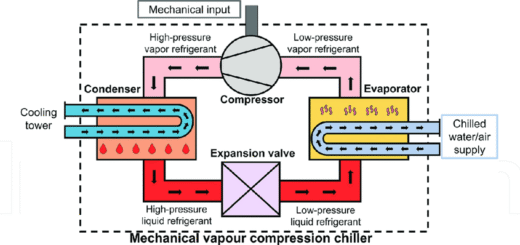
Vapour Absorption Heat Pump
Vapour Absorption Heat Pump (VAHP) – Working Principle, Types, Advantages & Applications (Complete Guide)
One such powerful technology is the Vapour Absorption Heat Pump (VAHP).
In this fully guide, you will learn:
-
What a vapour absorption heat pump is
-
How it works step-by-step
-
Main components
-
Types of absorption heat pumps
-
Lithium bromide vs ammonia systems
-
Difference between absorption chiller and heat pump
-
Energy efficiency (COP explained)
-
Industrial and commercial applications
-
Advantages and disadvantages
-
When to choose vapour absorption heat pump
Let’s begin with the fundamentals.
What Is a Vapour Absorption Heat Pump?
A Vapour Absorption Heat Pump (VAHP) is a heat-driven system.
It moves heat from a low-temperature source to a higher-temperature output.
It uses an absorption refrigeration cycle.
Unlike conventional electric heat pumps, VAHP uses:
-
Steam
-
Hot water
-
Gas
-
Industrial waste heat
Instead of mechanical compression.
In simple terms:
A vapour absorption heat pump upgrades low-grade waste heat into useful high-temperature heat.
Basic Difference: Heat Pump vs Chiller
| Feature | Absorption Chiller | Absorption Heat Pump |
|---|---|---|
| Main Output | Cooling | Heating |
| Heat Source | Steam/Hot water | Steam/Hot water |
| Application | HVAC cooling | Waste heat recovery |
| Goal | Produce chilled water | Produce hot water |
An absorption heat pump focuses on heating rather than cooling.
Working Principle of Vapour Absorption Heat Pump
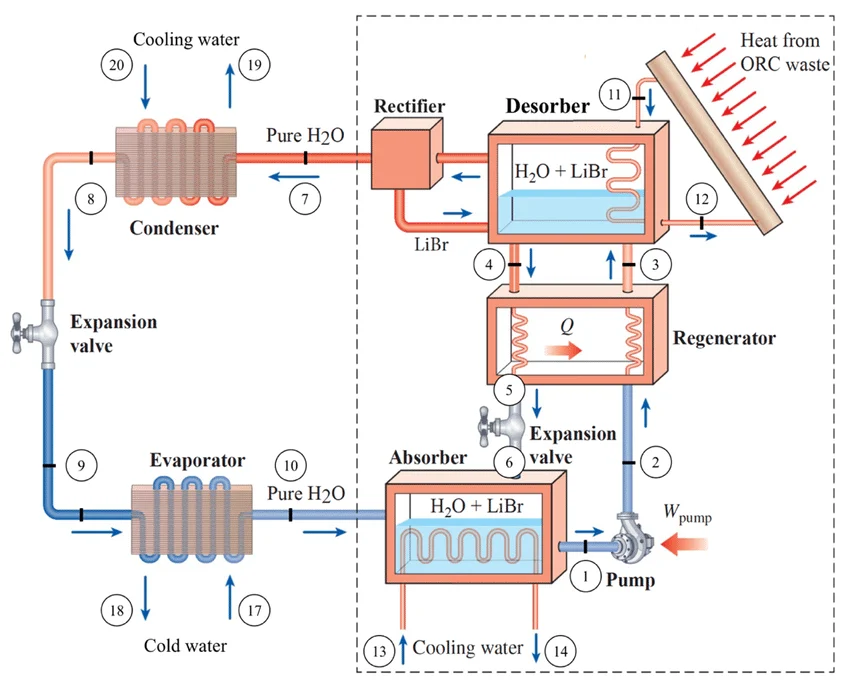
The vapour absorption heat pump works on the absorption refrigeration cycle, replacing the mechanical compressor with a thermal process.
Main stages:
- Generator
- Condenser
- Evaporator
- Absorber
- Solution Pump
- Expansion Device
Let’s break it down step by step.
Step 1: Heat Input (Generator)
External heat (steam or hot water) is supplied to the generator.
The refrigerant separates from the absorbent solution.
Step 2: Condensation
Refrigerant vapour moves to the condenser and releases heat, becoming liquid.
This released heat can be used for heating applications.
Step 3: Evaporation
Liquid refrigerant evaporates at low pressure, absorbing heat from a low-temperature source (like waste water or exhaust gases).
Step 4: Absorption
The refrigerant vapour is absorbed into the absorbent solution.
Heat released during absorption is also recovered.
Step 5: Solution Pump
The absorbent solution is pumped back to the generator.
This completes the cycle.
Main Components of Vapour Absorption Heat Pump
- Generator
- Condenser
- Evaporator
- Absorber
- Heat exchangers
- Solution pump
- Expansion valves
Unlike electric heat pumps, VAHP has very low electricity consumption.
Types of Vapour Absorption Heat Pumps
1. Single-Effect Absorption Heat Pump
-
One generator
-
Lower efficiency
-
Suitable for low-pressure steam
COP: 1.3 – 1.6 (for heating)
2.Double-Effect Absorption Heat Pump
-
Two generators
-
Higher efficiency
-
Requires higher temperature heat source
COP: 1.6 – 2.0
3. Direct-Fired Absorption Heat Pump
-
Uses gas burner directly
-
No external steam required
-
Suitable where natural gas is available
Lithium Bromide vs Ammonia Absorption Systems
Lithium Bromide (LiBr + Water)
- Common in HVAC
- Water as refrigerant
- Used for heating and cooling
- Operates under vacuum
Limitation: Not suitable below 0°C
Ammonia + Water System
- Used in industrial heating
- Can operate below 0°C
- Higher pressure system
- Ammonia is toxic
Best for industrial applications.
How Vapour Absorption Heat Pump Improves Energy Efficiency
VAHP recovers low-grade waste heat from:
-
Industrial exhaust
-
Process water
-
Cooling tower water
-
Boiler flue gases
Instead of discarding this heat, it upgrades it to useful heating energy.
This significantly reduces:
-
Boiler fuel consumption
-
Electricity usage
-
Carbon emissions
Coefficient of Performance (COP) Explained
For heat pumps:
COP = Heat Output / Heat Input
Typical VAHP COP:
-
Single Effect: 1.3 – 1.6
-
Double Effect: 1.6 – 2.0
This means:
For every 1 kW heat input, you get up to 2 kW heating output.
Applications of Vapour Absorption Heat Pump
VAHP is widely used in:
- District heating systems
- Chemical plants
- Oil refineries
- Food processing plants
- Textile industries
- Pharmaceutical plants
- Cogeneration (CHP) systems
- Power plants
It is especially beneficial in facilities with continuous waste heat.
Vapour Absorption Heat Pump vs Electric Heat Pump
| Feature | Absorption Heat Pump | Electric Heat Pump |
|---|---|---|
| Energy Source | Heat | Electricity |
| Electricity Use | Very Low | High |
| Initial Cost | High | Moderate |
| Maintenance | Complex | Moderate |
| Best For | Industrial plants | Residential & commercial |
Advantages of Vapour Absorption Heat Pump
- Uses waste heat
- Low electricity consumption
- Reduces fuel cost
- Lower carbon emissions
- Quiet operation
- Long lifespan (20+ years)
- Suitable for large-scale heating
Disadvantages
- High initial investment
- Large installation space
- Complex system design
- Requires cooling tower (in some systems)
- Skilled maintenance required
Installation Considerations
Before installing VAHP:
- Evaluate waste heat availability
- Check heat source temperature
- Ensure space for large equipment
- Assess cooling water availability
- Conduct detailed energy audit
Improper design can reduce efficiency.
Cost of Vapour Absorption Heat Pump (India 2026)
| Capacity | Approx Cost |
|---|---|
| 100 kW | ₹50 – 80 Lakhs |
| 300 kW | ₹1 – 2 Crore |
| 500+ kW | ₹3 Crore+ |
Costs vary based on design and customization.
Maintenance Requirements
- Monitor lithium bromide concentration
- Check vacuum pressure
- Clean heat exchangers
- Inspect solution pump
- Annual performance audit
Proper maintenance ensures 20–25 years lifespan.
Environmental Benefits
VAHP systems:
-
Reduce electricity demand
-
Utilize renewable or waste heat
-
Lower greenhouse gas emissions
-
Improve overall plant efficiency
They support green building certifications and energy-saving programs.
When Should You Choose Vapour Absorption Heat Pump?
Choose VAHP if:
- Continuous waste heat available
- Large industrial facility
- High heating demand
- Long-term energy savings desired
- Sustainability is priority
Avoid VAHP if:
- Small residential building
- No waste heat source
- Limited installation space
Real-World Example
A textile factory produces hot exhaust gases at 90°C.
Instead of wasting heat:
-
VAHP upgrades heat to 120°C hot water
-
Used for process heating
-
Reduces boiler fuel consumption by 30%
This results in major cost savings.
Frequently Asked Questions (FAQ)
What is a vapour absorption heat pump?
A heat-driven system that upgrades low-temperature waste heat into useful high-temperature heat.
Where is VAHP used?
In industrial plants, power stations, district heating systems, and large commercial facilities.
What is the COP of absorption heat pump?
Typically 1.3 to 2.0 depending on design.
Is absorption heat pump better than electric heat pump?
It is better where waste heat is available and electricity cost is high.
What refrigerant is used in VAHP?
Commonly lithium bromide-water or ammonia-water systems.
Final Summary
A (VAHP) is an advanced thermal technology that:
-
Uses heat instead of electricity
-
Recovers waste heat
-
Produces useful heating energy
-
Improves overall plant efficiency
Although the initial investment is high, long-term operational savings and environmental benefits make it ideal for industrial applications.
Conclusion
Vapour absorption heat pumps represent the future of sustainable industrial heating.
By converting low-grade waste heat into high-value energy, VAHP systems:
- Reduce operating costs
- Lower carbon footprint
- Improve plant efficiency
- Support energy conservation goals
If your facility creates waste heat and needs constant heating, a vapor absorption heat pump may be the right solution.
Always consult an experienced HVAC or energy engineer before implementing such systems.
Stay efficient. Stay sustainable.