VRF vs VRV System Difference
VRF vs VRV System Difference (Complete HVAC Comparison Guide)
Modern commercial buildings require highly efficient air conditioning systems that provide flexible temperature control, energy efficiency, and reliable operation. Two of the most advanced HVAC technologies used today are VRF systems and VRV systems.
Many HVAC engineers, technicians, and building owners often ask the question:
What is the difference between VRF and VRV systems?
Although these terms are often used interchangeably, there are important distinctions related to branding, technology, and system design.
Understanding the VRF vs VRV system difference helps HVAC professionals select the most suitable air conditioning solution for commercial projects.
This guide explains the complete comparison between VRF and VRV systems, including:
-
Definition of VRF and VRV systems
-
Technology and working principles
-
Key differences between VRF and VRV
-
Advantages and disadvantages
-
Cost comparison
-
Installation differences
-
Applications in commercial HVAC
This comprehensive guide will help you understand which system is best for your HVAC project.
What Is a VRF System?
VRF (Variable Refrigerant Flow) is an advanced air conditioning system that uses refrigerant as the cooling and heating medium.
In a VRF system, a single outdoor unit can connect to multiple indoor units using a network of refrigerant piping.
The system automatically adjusts the amount of refrigerant flowing to each indoor unit depending on cooling demand.
This allows precise temperature control for different zones in a building.
VRF systems are commonly used in:
-
Office buildings
-
Hotels
-
Hospitals
-
Shopping malls
-
Educational institutions
-
Residential complexes
VRF technology offers superior energy efficiency compared to traditional HVAC systems.
What Is a VRV System?
VRV (Variable Refrigerant Volume) is a trademarked technology developed by the company Daikin.
VRV systems operate on the same basic principle as VRF systems, where refrigerant flow is adjusted based on cooling demand.
The term VRV specifically refers to systems manufactured by Daikin.
In simple terms:
VRV = Daikin’s branded VRF system
VRV technology was first introduced in 1982, revolutionizing the HVAC industry by enabling flexible multi-zone air conditioning.
Today, VRV systems are widely used in commercial buildings around the world.
Working Principle of VRF and VRV Systems
Both VRF and VRV systems operate using the same refrigeration cycle.
The system includes:
-
Outdoor condensing units
-
Multiple indoor units
-
Refrigerant piping network
-
Electronic expansion valves
-
Intelligent control systems
The compressor adjusts its speed using inverter technology to control refrigerant flow.
This allows the system to match cooling output with actual demand.
As a result, VRF and VRV systems achieve high energy efficiency.
Key Differences Between VRF and VRV Systems
Although VRF and VRV systems are similar, there are some key differences.
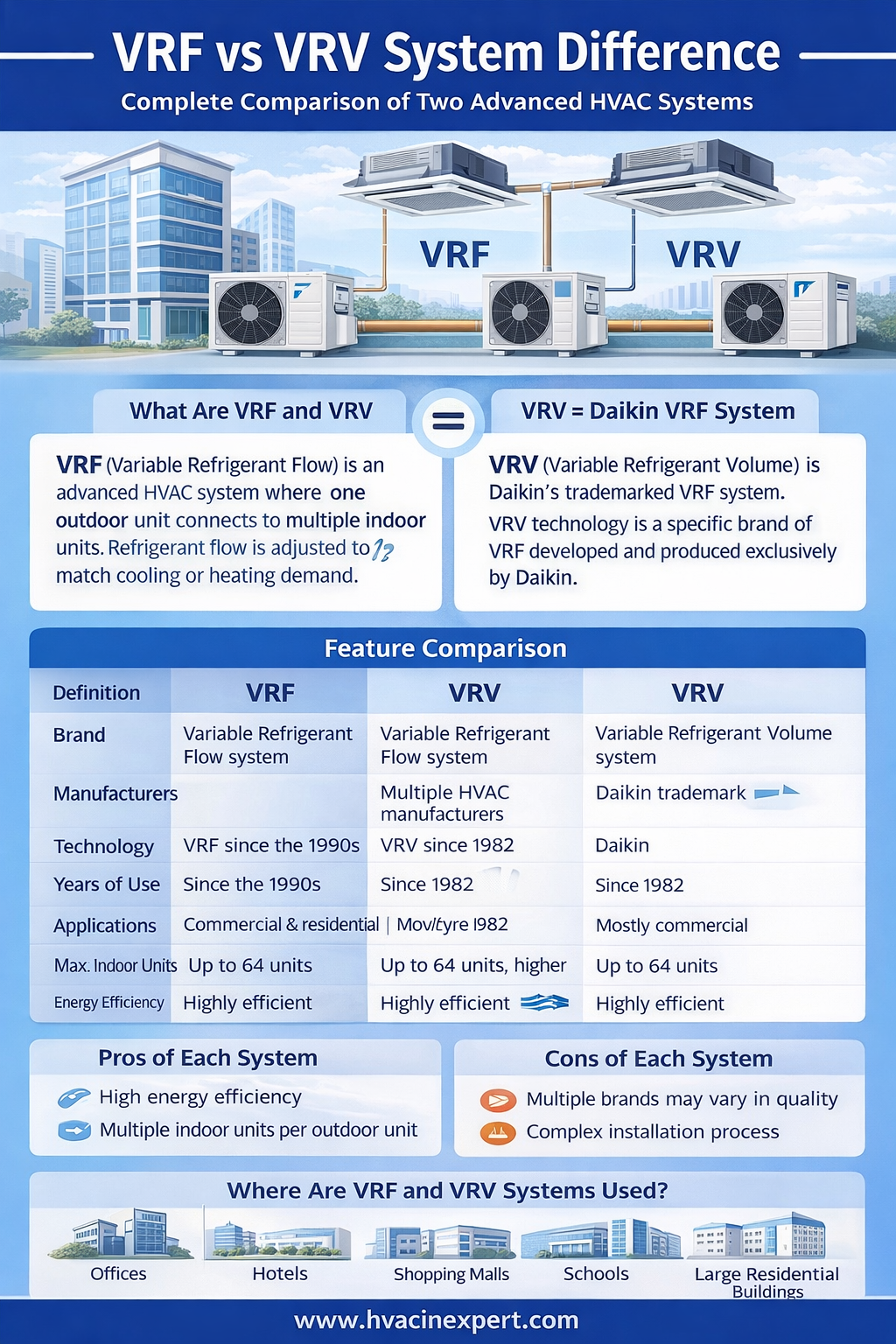
VRF vs VRV Comparison Table
| Feature | VRF System | VRV System |
|---|---|---|
| Definition | Variable Refrigerant Flow system | Variable Refrigerant Volume system |
| Brand | Generic HVAC technology | Trademark of Daikin |
| Manufacturers | Many manufacturers | Only Daikin |
| Technology | Multi-zone refrigerant control | Same technology with Daikin branding |
| Applications | Commercial and residential | Mostly commercial projects |
In practical applications, VRF and VRV systems operate in the same way.
History of VRF and VRV Technology
Understanding the development of these technologies helps clarify their differences.
Development of VRV Systems
The VRV system was invented by Daikin in 1982.
It was the first HVAC system capable of controlling refrigerant flow to multiple indoor units.
This innovation allowed individual temperature control for different rooms.
Development of VRF Systems
After the success of VRV systems, other manufacturers developed similar technologies.
Since VRV was a trademark, other companies used the term VRF.
Today, VRF has become the generic name for these systems.
Major VRF System Manufacturers
Several HVAC companies manufacture VRF systems.
Some of the leading VRF manufacturers include:
-
Mitsubishi Electric
-
LG
-
Samsung
-
Toshiba
-
Panasonic
-
Carrier
-
Hitachi
Each manufacturer offers different VRF system models with advanced features.
Major VRV System Manufacturer
VRV systems are manufactured exclusively by Daikin.
Daikin is considered one of the pioneers in VRF technology and continues to innovate VRV systems.
Daikin VRV systems are widely used in large commercial projects.
Advantages of VRF Systems
VRF systems offer several advantages compared to traditional HVAC systems.
High Energy Efficiency
VRF systems use inverter compressors that adjust capacity based on cooling demand.
This significantly reduces electricity consumption.
Flexible Installation
VRF systems allow multiple indoor units to connect to one outdoor unit.
Individual Temperature Control
Each room can maintain its own temperature.
Reduced Ductwork
VRF systems require minimal ductwork compared to central HVAC systems.
Advantages of VRV Systems
VRV systems offer similar advantages with additional benefits.
Advanced Technology
Daikin VRV systems incorporate advanced control technology.
High Reliability
VRV systems are known for reliable performance.
Intelligent Control Systems
VRV systems include advanced building management integration.
Disadvantages of VRF and VRV Systems
Despite their advantages, these systems have some limitations.
Higher Initial Cost
VRF and VRV systems are more expensive than split AC systems.
Complex Installation
Installation requires trained HVAC technicians.
Specialized Maintenance
Maintenance requires professional expertise.
VRF vs VRV Installation Differences
Installation procedures for VRF and VRV systems are almost identical.
The installation process includes:
-
Indoor unit installation
-
Outdoor unit placement
-
Refrigerant piping installation
-
Electrical wiring
-
System commissioning
However, VRV systems often require certified Daikin installers.
VRF vs VRV Cost Comparison
Cost is an important factor when selecting HVAC systems.
Typical installation costs include:
| System Type | Cost per Square Meter |
|---|---|
| VRF System | $40 – $120 |
| VRV System | $60 – $140 |
VRV systems may cost slightly more due to premium brand value.
Applications of VRF and VRV Systems
These systems are widely used in modern buildings.
Common applications include:
Commercial Buildings
Office buildings often use VRF systems for zone control.
Hotels
Hotels require individual room temperature control.
Hospitals
Hospitals require precise temperature management.
Shopping Malls
Large commercial spaces benefit from VRF systems.
Energy Efficiency Comparison
Both VRF and VRV systems are highly energy efficient.
Energy savings can reach:
30–40% compared to traditional HVAC systems
This makes them ideal for large commercial buildings.
VRF vs VRV Maintenance Requirements
Both systems require regular maintenance.
Typical maintenance tasks include:
-
Cleaning air filters
-
Checking refrigerant pressure
-
Inspecting electrical connections
-
Cleaning condenser coils
Regular maintenance ensures reliable system performance.
Future Trends in VRF and VRV Technology
HVAC technology continues to evolve.
New innovations include:
Smart HVAC Controls
Smart thermostats and IoT systems allow remote HVAC monitoring.
Energy Optimization
Advanced algorithms optimize system efficiency.
Eco-Friendly Refrigerants
New refrigerants reduce environmental impact.
These innovations will further improve HVAC efficiency.
Frequently Asked Questions
What is the main difference between VRF and VRV systems?
VRF is a general term used for variable refrigerant flow systems, while VRV is a trademarked technology developed by Daikin.
Are VRF and VRV systems the same?
Technically they operate on the same principle, but VRV refers specifically to Daikin’s VRF technology.
Which is better VRF or VRV?
Both systems are highly efficient. VRV systems are known for premium technology, while VRF systems offer more manufacturer options.
Why are VRF systems expensive?
VRF systems include advanced inverter compressors, electronic expansion valves, and complex control systems.
How long do VRF systems last?
With proper maintenance, VRF systems can last 15 to 20 years.
Final Summary
Understanding the VRF vs VRV system difference is important when selecting HVAC solutions.
Key differences include:
-
VRF is a generic HVAC technology
-
VRV is a Daikin trademark
-
Both systems operate using similar technology
-
VRV systems are manufactured only by Daikin
Both systems offer excellent energy efficiency and flexible cooling solutions.
Conclusion
VRF and VRV systems represent some of the most advanced HVAC technologies available today.
While the terms are often used interchangeably, the primary difference lies in branding and manufacturer.
Both systems provide efficient, flexible, and reliable air conditioning for modern commercial buildings.
Choosing the right system depends on project requirements, budget, and manufacturer preference.