What Is the Difference Between VCM and VAM
What Is the Difference Between VCM and VAM? (Complete HVAC Guide)
-
VCM (Vapour Compression Machine)
-
VAM (Vapour Absorption Machine)
If you are planning a commercial HVAC project, you need to know the difference between VCM and VAM.
This also applies if you are planning an industrial cooling plant.
It also applies if you are designing an energy-efficient facility.
In this fully guide, we’ll explain:
-
What VCM is
-
What VAM is
-
Working principles
-
Key components
-
Energy source comparison
-
COP (efficiency) comparison
-
Advantages and disadvantages
-
Industrial and commercial applications
-
Cost comparison
-
Which system is better for your project
Let’s start with the basics.
What Is VCM (Vapour Compression Machine)?
A Vapour Compression Machine (VCM) is a refrigeration system that uses a mechanical compressor powered by electricity to circulate refrigerant and produce cooling.
VCM is the most common cooling technology used in:
-
Split air conditioners
-
VRF systems
-
Central air conditioning
-
Industrial chillers
In simple terms:
VCM uses electricity and a compressor to produce cooling.
Main Components of VCM
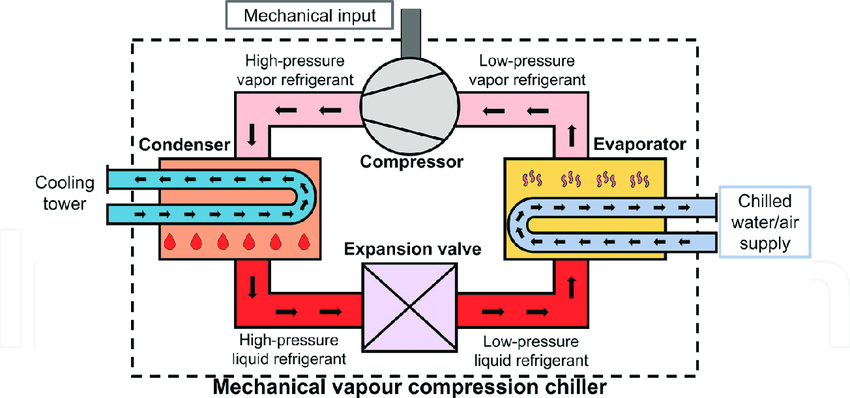
- Compressor
- Condenser
- Expansion Valve
- Evaporator
Working Principle of VCM
Step 1: Compression
Low-pressure refrigerant vapour is compressed by the compressor.
Step 2: Condensation
High-pressure vapour releases heat and becomes liquid.
Step 3: Expansion
Liquid refrigerant passes through expansion valve.
Step 4: Evaporation
Refrigerant absorbs heat and produces cooling.
This cycle repeats continuously.
What Is VAM (Vapour Absorption Machine)?
A Vapour Absorption Machine (VAM) is a refrigeration system. It uses heat energy to create cooling. It does not use mechanical compression.
VAM is commonly used in:
-
Power plants
-
Refineries
-
Large industrial plants
-
District cooling systems
In simple words:
VAM uses heat (steam or hot water) instead of electricity to produce cooling.
Main Components of VAM
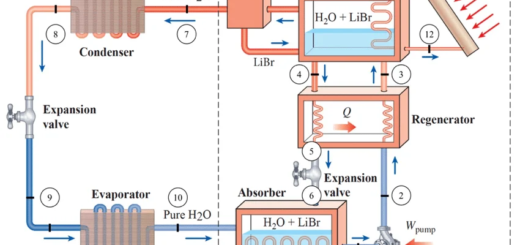
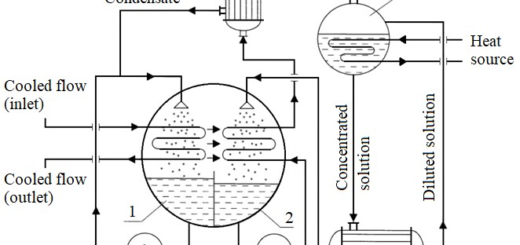
- Generator
- Condenser
- Evaporator
- Absorber
- Solution Pump
- Expansion Device
Working Principle of VAM
Instead of a compressor, VAM uses:
-
Absorbent (Lithium Bromide or Ammonia)
-
Heat source
The heat separates refrigerant from absorbent, and the cycle continues.
Key Differences Between VCM and VAM
1. Energy Source
| Feature | VCM | VAM |
|---|---|---|
| Energy Type | Electricity | Heat (Steam/Hot Water) |
| Electricity Consumption | High | Very Low |
VCM is ideal where electricity is affordable.
VAM is suitable where waste heat is available.
2. Main Driving Component
-
VCM → Mechanical Compressor
-
VAM → Thermal Generator
VCM relies on moving parts.
VAM relies on thermal processes.
3. Efficiency (COP Comparison)
COP = Cooling Output / Energy Input
-
VCM COP: 3 – 6
-
VAM COP: 0.6 – 1.2
VCM is more efficient in terms of energy ratio.
VAM becomes economical if heat is free.
4. Initial Cost
-
VCM → Moderate
-
VAM → High
Absorption systems are larger and costlier.
5. Operating Cost
-
VCM → Higher electricity cost
-
VAM → Lower electricity cost (if waste heat used)
6. Maintenance
-
VCM → Regular compressor servicing
-
VAM → Complex chemical monitoring
7. Environmental Impact
VAM reduces:
-
Electrical load
-
Carbon emissions
-
Fossil fuel consumption
Especially when waste heat is reused.
Detailed Comparison Table
| Parameter | VCM | VAM |
|---|---|---|
| Energy Source | Electricity | Heat |
| Main Component | Compressor | Generator |
| COP | High (3–6) | Low (0.6–1.2) |
| Initial Cost | Lower | Higher |
| Electricity Use | High | Very Low |
| Size | Compact | Large |
| Maintenance | Moderate | Complex |
| Noise | Higher | Lower |
| Best For | Commercial AC | Industrial plants |
Applications of VCM
VCM systems are widely used in:
- Residential AC
- Office buildings
- Shopping malls
- Hospitals
- Data centers
- Hotels
Applications of VAM
VAM systems are ideal for:
- Power plants
- Refineries
- Chemical plants
- Textile industries
- District cooling
- Cogeneration plants
When Should You Choose VCM?
Choose VCM if:
- Small to medium project
- No waste heat available
- Electricity supply stable
- Space limited
- Budget moderate
When Should You Choose VAM?
Choose VAM if:
- Waste steam available
- Large industrial facility
- Electricity cost high
- Sustainability priority
- Continuous cooling demand
Cost Comparison (India)
| Capacity | VCM Cost | VAM Cost |
|---|---|---|
| 100 TR | ₹25–35 Lakhs | ₹60–90 Lakhs |
| 300 TR | ₹70 Lakhs+ | ₹1.5–2.5 Crore |
| 500+ TR | ₹1.5 Crore+ | ₹3 Crore+ |
VAM has higher initial cost but lower electricity consumption.
Advantages of VCM
- High efficiency
- Compact design
- Lower initial cost
- Easy installation
- Widely available
Disadvantages of VCM
- High electricity consumption
- Compressor wear & tear
- Sensitive to voltage fluctuations
Advantages of VAM
- Low electricity use
- Uses waste heat
- Lower carbon emissions
- Quiet operation
- Long lifespan (20+ years)
Disadvantages of VAM
- Large installation space
- High capital investment
- Complex maintenance
- Requires cooling tower
Environmental Perspective
In large industrial setups, VAM reduces:
-
Peak electricity demand
-
Grid load
-
Carbon footprint
VCM is more energy efficient per kW input, but VAM is more sustainable if waste heat is available.
Real-World Example
A refinery produces excess steam.
Option 1: Use VCM → High electricity cost
Option 2: Use VAM → Steam used for cooling
Result: Significant cost savings over 5–7 years.
Frequently Asked Questions (FAQ)
What is the main difference between VCM and VAM?
VCM uses electricity and a compressor, while VAM uses heat and an absorption process.
Which is more efficient, VCM or VAM?
VCM has higher COP, but VAM is economical when waste heat is available.
Is VAM suitable for small buildings?
No, VAM is typically used in large industrial facilities.
Does VAM require electricity?
Yes, but very minimal compared to VCM.
Which is more expensive?
VAM has higher initial cost.
Final Summary
The main difference between VCM and VAM lies in:
-
Energy source
-
Driving mechanism
-
Efficiency
-
Application type
-
Initial investment
VCM = Electricity-driven cooling
VAM = Heat-driven cooling
Each system has its own advantages depending on project requirements.
Conclusion
Choosing between VCM and VAM depends on:
- Project size
- Energy availability
- Budget
- Sustainability goals
- Long-term operating cost
For residential and commercial buildings, VCM is usually the best choice.
For large industrial plants with waste heat, VAM offers long-term energy savings and environmental benefits.
Always consult an experienced HVAC engineer before selecting the system.
Stay efficient. Stay sustainable.