
Can Normal AC Run on Solar Power? (Complete Guide)
Introduction
With rising electricity costs and increasing awareness of renewable energy, many homeowners and businesses are asking a crucial question: Can a normal air conditioner run on solar power?
The short answer is yes, but with conditions.
Air conditioners are among the highest electricity-consuming appliances, especially in hot regions like India. Running them on solar power can significantly reduce electricity bills and dependency on the grid—but it requires proper system design, correct sizing, and understanding of limitations.
In this comprehensive guide, we’ll explore everything you need to know—from working principles to cost, system design, challenges, and expert recommendations.
What Does It Mean to Run an AC on Solar Power?
Running an AC on solar power means using electricity generated from solar panels instead of relying entirely on grid electricity.
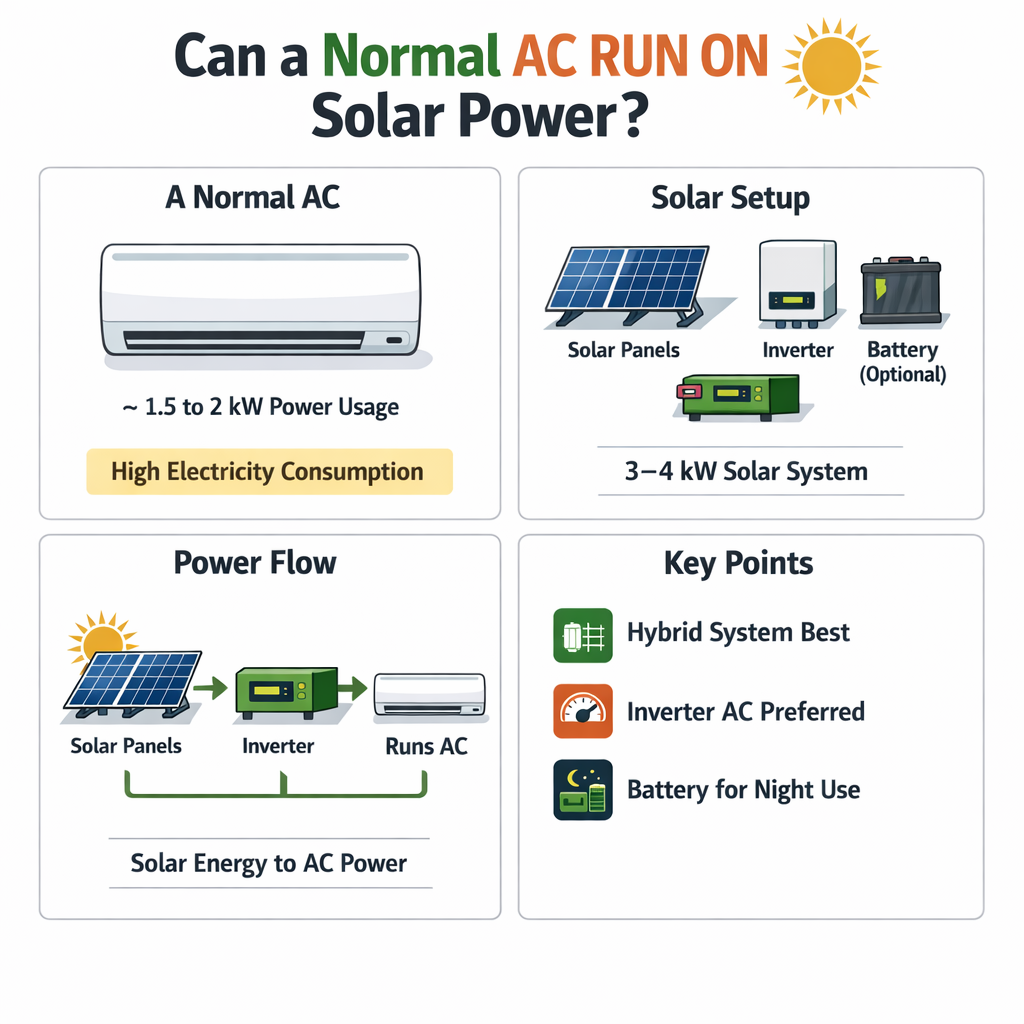
A solar-powered AC system typically includes:
- Solar panels
- Inverter
- Battery (optional but recommended)
- AC unit (normal or solar-compatible)
There are three main ways to run an AC on solar:
1. On-grid solar system
Connected to the electricity grid.
2. Off-grid solar system
Fully independent, uses batteries.
3. Hybrid solar system
Combination of both (most practical solution).
Can a Normal AC Run on Solar Power?
Yes, But Here’s the Reality
A normal air conditioner (Split or Window AC) can run on solar power, but:
- It requires high solar panel capacity
- Needs a powerful inverter
- Works best with hybrid systems
Example:
A typical 1.5 Ton AC consumes:
- ~1.5 kW to 2 kW per hour
To run this using solar, you need:
- 2 kW to 3 kW solar system (minimum)
Types of ACs and Their Solar Compatibility
1. Non-Inverter AC
- High starting current
- Not ideal for solar
- Requires heavy inverter & battery
2. Inverter AC (Recommended)
- Variable speed compressor
- Lower power consumption
- Solar-friendly
3. Solar AC (Dedicated Systems)
- Designed specifically for solar
- Can run on DC or hybrid power
Solar System Required to Run AC
Load Calculation Example
Let’s calculate for a 1.5 Ton Inverter AC:
- Power consumption: 1.6 kW
- Daily usage: 8 hours
- Total consumption:
1.6 × 8 = 12.8 kWh/day
Solar System Required:
| Component | Requirement |
|---|---|
| Solar Panels | 3–4 kW |
| Inverter | 3 kVA |
| Battery | Optional (for night use) |
Components Required for Solar AC System
1. Solar Panels
Convert sunlight into electricity.
2. Solar Inverter
Converts DC to AC power.
3. Battery Storage
Stores energy for night usage.
4. Mounting Structure
For panel installation.
5. Wiring & Protection
Includes MCBs, earthing, surge protection.
How Solar AC System Works
- Solar panels generate DC electricity
- Inverter converts DC to AC
- AC runs using solar power
- Excess power:
- Stored in battery OR
- Sent to grid (net metering)
Can AC Run Directly on Solar Panels?
Short Answer: No (in most cases)
Normal AC requires:
- Stable voltage
- Continuous power supply
Solar panels alone cannot provide stable power without:
- Inverter
- Controller
Exception:
- DC solar AC systems (specialized units)
Solar Panel Requirement for Different AC Sizes
| AC Size | Power Consumption | Solar Required |
|---|---|---|
| 1 Ton | 1.2 kW | 2–3 kW |
| 1.5 Ton | 1.5–2 kW | 3–4 kW |
| 2 Ton | 2–2.5 kW | 4–5 kW |
Cost of Running AC on Solar in India (2026)
Approximate Cost Breakdown
| System Size | Cost (₹) |
|---|---|
| 2 kW | ₹1.2 – ₹1.8 lakh |
| 3 kW | ₹1.8 – ₹2.5 lakh |
| 5 kW | ₹2.8 – ₹4 lakh |
With Battery:
Add ₹80,000 – ₹2 lakh depending on capacity
Government Subsidy in India
Under MNRE solar subsidy schemes:
- Up to 40% subsidy (residential)
- Available through DISCOM
Advantages of Running AC on Solar
1. Huge Electricity Savings
Reduce electricity bills by 70–90%.
2. Eco-Friendly
Reduces carbon footprint.
3. Energy Independence
Less reliance on grid power.
4. Long-Term Investment
ROI within 4–6 years.
Disadvantages & Challenges
1. High Initial Cost
Solar setup is expensive upfront.
2. Space Requirement
Needs sufficient rooftop area.
3. Weather Dependency
Less efficient during cloudy days.
4. Battery Cost
Batteries are expensive and require maintenance.
Best Solar Setup for AC (Expert Recommendation)
For Indian conditions:
Ideal System:
- 3–5 kW hybrid solar system
- Inverter AC (5-star rated)
- Lithium battery (optional but better)
Tips to Reduce AC Load on Solar
1. Use Inverter AC
Consumes less power.
2. Improve Insulation
Reduces cooling load.
3. Use Ceiling Fans
Supports airflow.
4. Maintain AC Regularly
Improves efficiency.
5. Use Temperature Wisely
Set at 24–26°C.
Solar vs Electricity Cost Comparison
| Factor | Grid AC | Solar AC |
|---|---|---|
| Monthly Cost | ₹3000–₹8000 | ₹0–₹1000 |
| Initial Cost | Low | High |
| Long-term Savings | Low | Very High |
Is Solar AC Worth It?
YES, if:
- You use AC regularly
- You have rooftop space
- You want long-term savings
NO, if:
- Occasional AC use
- Budget is limited
Hybrid Solar AC System (Best Choice)
A hybrid system:
- Uses solar during day
- Uses grid at night
- Reduces battery dependency
This is the most practical solution in India.
Real-Life Example
Case Study: Residential House in Gujarat
- 1.5 Ton Inverter AC
- 3 kW solar system
- 8 hours usage daily
Result:
- Electricity bill reduced from ₹6000 → ₹800
- Payback in 4 years
Future of Solar AC
With advancements in:
- Solar efficiency
- Battery technology
- Smart inverters
Solar-powered cooling will become the standard solution in India.
Frequently Asked Questions (FAQs)
1. Can a normal AC run on solar power?
Yes, a normal air conditioner can run on solar power if you have a properly sized solar system, inverter, and optionally a battery. Inverter ACs are more efficient and better suited for solar setups.
2. How many solar panels are required for a 1.5 ton AC?
A 1.5 ton AC typically requires a 3–4 kW solar system, which means around 8 to 12 solar panels depending on panel wattage.
3. Can I run AC on solar without a battery?
Yes, you can run an AC without a battery using an on-grid or hybrid solar system. However, it will only work during daytime unless connected to the grid.
4. Which type of AC is best for solar power?
Inverter ACs are best for solar systems because they consume less electricity and adjust power usage based on cooling demand.
5. Can a solar system run AC at night?
Yes, but only if you have a battery storage system. Without a battery, the AC will not run at night using solar alone.
6. What is the cost of running AC on solar in India?
The cost depends on system size. A 3 kW solar system suitable for a 1.5 ton AC can cost between ₹1.8 lakh to ₹2.5 lakh, excluding battery.
7. Is solar AC worth it in India?
Yes, solar AC is worth it if you use air conditioning regularly. It reduces electricity bills and offers a return on investment within 4–6 years.
8. Can I convert my existing AC to solar?
You cannot directly convert an AC, but you can install a solar power system to supply electricity to your existing AC.
Conclusion
So, can a normal AC run on solar power?
Yes—but it requires proper system design.
If done correctly, solar can:
- Cut electricity bills drastically
- Provide long-term savings
- Make your HVAC system sustainable
For HVAC professionals and homeowners alike, integrating solar with air conditioning is no longer optional—it’s the future.
Want to Install Solar-Powered HVAC System?
Vipul HVAC Solution Pvt. Ltd. provides:
- HVAC Design + Solar Integration
- Energy-efficient system planning
- Commercial & Residential solutions
- 📱 Call / WhatsApp: +91-9825636606
- 🌐 Website: www.vipulhvacsolution.in
📧 Email: info@vipulhvacsolution.in