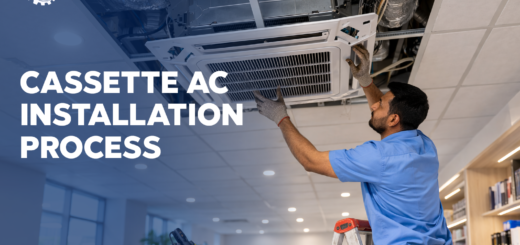
3-Ton Cassette AC Area Coverage
3-Ton Cassette AC Area Coverage: Complete Guide for Cooling Capacity, Room Size & Installation
Cassette air conditioners are widely used in commercial buildings, offices, restaurants, showrooms, hotels, and large residential spaces. Among different capacities available in the market, the 3-ton cassette AC is one of the most popular choices for medium to large spaces.
However, many HVAC buyers and building owners often ask an important question:
What area can a 3-ton cassette AC cover?
Understanding the cooling coverage of a 3-ton cassette air conditioner is essential for selecting the right HVAC system. If the AC capacity is too small, the room will not cool properly. If it is too large, it can lead to unnecessary energy consumption and higher installation costs.
This comprehensive guide explains everything about 3-ton cassette AC coverage, including room size calculation, factors affecting cooling performance, commercial applications, and tips for choosing the right system.
What Is a 3-Ton Cassette AC?
A 3-ton cassette AC is a ceiling-mounted air conditioning system designed to provide powerful cooling for large spaces. It is called “cassette” because the indoor unit is installed inside the ceiling, with only the decorative panel visible.
The cooling capacity of an AC is measured in tons of refrigeration (TR).
One ton of refrigeration equals 12,000 BTU per hour.
Using the relationship:
1 , \text{Ton} = 12000 ; \text{BTU/hour}
Therefore:
-
3-ton AC = 36,000 BTU per hour
This cooling capacity determines how much heat the AC system can remove from a room.
3-Ton Cassette AC Area Coverage
The area coverage of a 3-ton cassette AC depends on several factors including insulation, ceiling height, sunlight exposure, occupancy, and climate.
However, HVAC professionals generally estimate cooling coverage using standard guidelines.
Typical Coverage Range
A 3-ton cassette AC typically covers:
-
1,500 sq ft to 1,800 sq ft under ideal conditions
This estimate assumes:
-
Standard ceiling height (9–10 feet)
-
Moderate insulation
-
Normal occupancy
-
Average climate conditions
For commercial buildings with higher heat loads, the coverage may be slightly lower.
Cooling Area Calculation for AC Capacity
The cooling requirement of a space is usually calculated using the BTU per square foot method.
A common HVAC rule is:
-
20–25 BTU per square foot
Using this formula:
\text{Cooling Capacity (BTU)} = \text{Area} \times \text{BTU per sq ft}
For a 3-ton AC:
-
Cooling capacity = 36,000 BTU
Now dividing by 20–25 BTU per sq ft gives an estimated coverage area.
Approximate result:
-
36,000 ÷ 20 = 1,800 sq ft
-
36,000 ÷ 25 = 1,440 sq ft
Therefore the average coverage becomes:
1,400–1,800 sq ft
Factors That Affect 3-Ton Cassette AC Coverage
The actual cooling coverage can vary depending on several environmental and architectural factors.
Ceiling Height
Higher ceilings increase the volume of air that needs cooling.
If ceiling height exceeds 10–12 feet, the effective coverage area may decrease.
For example:
-
Standard ceiling (10 ft): 1,600–1,800 sq ft
-
High ceiling (15 ft): 1,200–1,400 sq ft
Sunlight Exposure
Rooms exposed to direct sunlight require more cooling.
Large glass windows or west-facing buildings increase heat gain, reducing the effective coverage of the AC system.
Number of People
Each person inside a room produces heat.
High occupancy spaces like restaurants or conference rooms may require additional cooling capacity.
Electrical Equipment
Computers, lighting, kitchen equipment, and other electrical devices generate heat.
Commercial spaces with many appliances may require higher tonnage.
Insulation Quality
Well-insulated buildings retain cool air better.
Poor insulation allows heat to enter easily, increasing cooling load.
Typical Room Sizes for a 3-Ton Cassette AC
Below are common room sizes suitable for a 3-ton cassette AC.
| Space Type | Typical Area |
|---|---|
| Office floor | 1,400–1,800 sq ft |
| Restaurant dining area | 1,200–1,600 sq ft |
| Retail showroom | 1,300–1,700 sq ft |
| Conference hall | 1,400–1,800 sq ft |
| Large living room | 1,300–1,600 sq ft |
These are general estimates used in HVAC planning.
Advantages of 3-Ton Cassette Air Conditioners
Cassette AC systems offer several benefits compared to wall-mounted split AC units.
Uniform Air Distribution
Cassette AC systems distribute air in four directions, providing uniform cooling throughout the room.
This prevents hot spots and ensures consistent comfort.
Space-Saving Design
The indoor unit is installed inside the ceiling, leaving walls free.
This design is ideal for modern commercial interiors.
Quiet Operation
Cassette AC systems are generally quieter because the compressor is located outside and the indoor unit is insulated.
Suitable for Large Spaces
Unlike wall-mounted units, cassette AC systems can handle large areas efficiently.
Applications of 3-Ton Cassette AC Systems
3-ton cassette AC units are commonly used in commercial HVAC applications.
Offices
Open office spaces require uniform cooling across multiple workstations.
Cassette AC systems provide even air distribution.
Restaurants
Restaurants generate heat from kitchens and lighting.
A 3-ton cassette AC helps maintain comfortable temperatures for customers.
Retail Stores
Retail showrooms often have large open spaces with lighting and electronic displays.
Cassette AC systems help maintain stable cooling.
Conference Rooms
Large meeting rooms with many occupants require strong cooling capacity.
Cassette AC systems are commonly installed in such spaces.
3-Ton Cassette AC vs Split AC
Understanding the difference between cassette AC and split AC systems helps buyers choose the right option.
| Feature | Cassette AC | Split AC |
|---|---|---|
| Installation | Ceiling | Wall |
| Airflow | 4-way airflow | Single direction |
| Coverage | Large area | Small to medium rooms |
| Aesthetics | Hidden unit | Visible unit |
| Applications | Commercial spaces | Homes |
Cassette AC systems are generally better for large open spaces.
Energy Consumption of a 3-Ton Cassette AC
Energy consumption depends on compressor efficiency, inverter technology, and usage hours.
A typical 3-ton cassette AC consumes:
-
3–4 kW per hour (approximate)
However, modern inverter models reduce energy consumption significantly.
Energy efficiency ratings such as EER and COP help evaluate system performance.
Popular 3-Ton Cassette AC Brands
Several global HVAC manufacturers produce high-quality cassette AC systems.
Popular brands include:
-
Daikin
-
Mitsubishi Electric
-
Carrier
-
Toshiba
-
LG
-
Panasonic
-
Blue Star
These brands offer advanced inverter cassette systems with high efficiency.
Installation Requirements for 3-Ton Cassette AC
Proper installation is essential for optimal cooling performance.
Ceiling Space
Cassette AC units require sufficient ceiling space for installation.
Typically 250–350 mm ceiling clearance is required.
Drainage System
Condensate water must be drained through a proper piping system.
Refrigerant Piping
Copper pipes connect the indoor cassette unit to the outdoor compressor unit.
Electrical Supply
A 3-ton AC usually requires single phase or three phase power supply depending on the model.
Maintenance Tips for Cassette AC Systems
Regular maintenance ensures efficient performance.
Important maintenance tasks include:
-
Cleaning air filters
-
Checking refrigerant levels
-
Inspecting drainage pipes
-
Cleaning evaporator coils
-
Checking fan motors
Regular servicing helps maintain cooling performance.
Common Mistakes When Choosing AC Capacity
Many building owners make mistakes when selecting AC capacity.
Undersized AC
If the AC capacity is too small:
-
Cooling becomes insufficient
-
Compressor works harder
-
Electricity consumption increases
Oversized AC
If the AC capacity is too large:
-
Frequent compressor cycling
-
Higher installation cost
-
Reduced efficiency
Proper HVAC load calculation prevents these problems.
HVAC Load Calculation for Large Spaces
Professional HVAC engineers perform detailed load calculations using software tools.
Load calculations consider:
-
Room dimensions
-
Insulation
-
Occupancy
-
Equipment heat load
-
Climate conditions
Accurate load calculation ensures optimal cooling performance.
Future Trends in Cassette Air Conditioning
Modern cassette AC systems are becoming more advanced.
New technologies include:
-
AI-based climate control
-
Smart thermostats
-
Wi-Fi connectivity
-
Energy monitoring systems
These features improve both comfort and energy efficiency.
Frequently Asked Questions (FAQ)
How much area can a 3-ton cassette AC cover?
A 3-ton cassette AC can typically cover around 1,400 to 1,800 square feet under standard conditions. The exact coverage depends on factors such as ceiling height, insulation quality, sunlight exposure, and the number of occupants in the room.
What room size is suitable for a 3-ton cassette AC?
A 3-ton cassette AC is ideal for large rooms or commercial spaces such as offices, restaurants, showrooms, and conference halls with an area between 1,400 and 1,800 square feet.
How many BTU does a 3-ton cassette AC produce?
A 3-ton air conditioner provides approximately 36,000 BTU per hour of cooling capacity. This level of cooling is suitable for medium to large commercial spaces.
Is a 3-ton cassette AC suitable for offices?
Yes, a 3-ton cassette AC is commonly used in offices, retail stores, and commercial buildings because it distributes air evenly in four directions and can efficiently cool large open areas.
What factors affect the cooling coverage of a 3-ton cassette AC?
The cooling coverage depends on several factors including ceiling height, room insulation, sunlight exposure, occupancy levels, electrical equipment heat load, and overall building design.
Can a 3-ton cassette AC cool multiple rooms?
A standard 3-ton cassette AC is usually designed to cool a single large open area. For multiple rooms, systems like VRF or ducted air conditioning are typically more suitable.
Conclusion
A 3-ton cassette AC is an excellent choice for medium to large spaces such as offices, restaurants, showrooms, and conference rooms.
Under standard conditions, a 3-ton cassette air conditioner can effectively cool approximately 1,400 to 1,800 square feet.
However, actual coverage depends on factors such as ceiling height, insulation, sunlight exposure, occupancy, and internal heat loads.
Choosing the correct AC capacity and ensuring proper installation are essential for maximizing cooling efficiency and reducing electricity consumption.
For commercial spaces and large rooms, a 3-ton cassette AC provides powerful cooling, uniform air distribution, and a space-saving design, making it one of the most reliable HVAC solutions available today.