Energy Recovery Ventilators
Energy Recovery Ventilators (ERV): Complete Guide for Efficient Ventilation
Introduction
Indoor air quality has become a major concern in modern buildings due to:
- Airtight construction
- Increasing pollution levels
- Higher occupancy density
- Energy efficiency demands
Traditional ventilation systems often waste energy by exhausting conditioned air and bringing in untreated fresh air.
This is where Energy Recovery Ventilators (ERVs) play a crucial role.
ERV systems provide fresh air ventilation while recovering energy from exhaust air, making them one of the most efficient solutions in modern HVAC design.
What is an Energy Recovery Ventilator (ERV)?
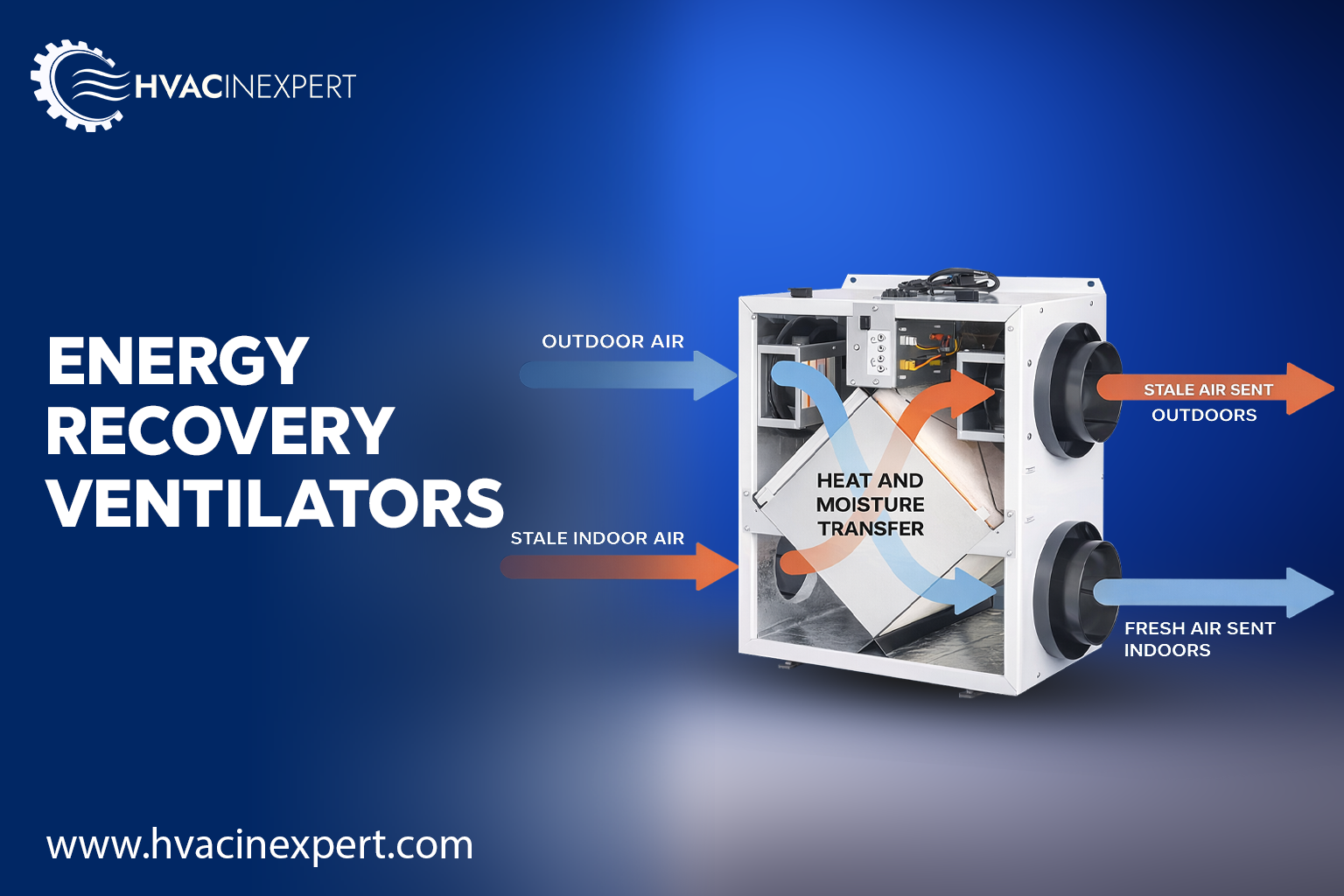
An Energy Recovery Ventilator (ERV) is a mechanical ventilation system that exchanges indoor stale air with fresh outdoor air while transferring heat and moisture between the two air streams.
Key Functions
- Supplies fresh air
- Removes stale air
- Transfers heat energy
- Controls humidity
How ERV Works
Basic Working Principle
- Exhaust air leaves the building
- Fresh air enters from outside
- Heat exchanger transfers energy
- Fresh air is pre-conditioned
Energy Transfer Process
- Summer: Heat is removed from incoming air
- Winter: Heat is added to incoming air
This reduces HVAC load significantly.
Types of Energy Recovery Ventilators
1. Plate Heat Exchanger ERV
- Fixed plates
- No moving parts
- Low maintenance
2. Rotary Wheel ERV
- Rotating heat exchanger
- Higher efficiency
3. Heat Pipe ERV
- Uses refrigerant
- Moderate efficiency
4. Run-around Coil System
- Uses fluid loop
- Flexible installation
Applications of ERV Systems
- Residential buildings
- Offices
- Hospitals
- Hotels
- Shopping malls
- Schools
Benefits of ERV System
1. Energy Saving
Reduces HVAC energy consumption by 20–40%
2. Improved Indoor Air Quality
Removes pollutants and CO₂
3. Humidity Control
Maintains comfort levels
4. Reduced HVAC Load
Less cooling/heating required
5. Eco-Friendly Solution
Supports green building standards
ERV vs HRV (Important Comparison)
| Feature | ERV | HRV |
|---|---|---|
| Heat Transfer | Yes | Yes |
| Moisture Transfer | Yes | No |
| Best for | Humid climate | Cold climate |
ERV is ideal for India and tropical regions
ERV Design Considerations
Airflow Requirement
Measured in CFM or CMH.
Efficiency
Typical: 60–80%
Pressure Drop
Affects fan selection.
ERV Sizing Calculation
Basic Formula
Airflow (CFM) = Occupancy × Fresh Air Requirement
Example:
- 50 people × 10 CFM = 500 CFM
ERV System Design Process
Step 1: Calculate Fresh Air Requirement
Based on:
- Occupancy
- Area
- ASHRAE standards
Need Accurate ERV Design?
Step 2: Select ERV Capacity
Match airflow requirement.
Step 3: Duct Design
- Supply duct
- Exhaust duct
Step 4: Integration with HVAC
- VRF system
- AHU
Step 5: Control System
- Timer
- CO₂ sensor
- BMS integration
ERV for Different Applications
Residential
Small units
Commercial
Medium capacity
Industrial
Large capacity systems
Installation Guidelines
- Proper duct sealing
- Insulation
- Correct placement
Maintenance
- Filter cleaning
- Core cleaning
Cost Analysis
Initial Cost
Medium
Savings
High over time
Common Mistakes
- Wrong sizing
- Poor duct design
Latest Trends
- Smart ERV
- IoT monitoring
FAQ – Energy Recovery Ventilator (ERV) System
1. What is an Energy Recovery Ventilator (ERV)?
An Energy Recovery Ventilator (ERV) is a ventilation system that exchanges stale indoor air with fresh outdoor air while transferring heat and moisture to improve energy efficiency and indoor comfort.
2. How does an ERV system work?
An ERV system works by passing exhaust air and fresh air through a heat exchanger, where energy (heat and moisture) is transferred between the two air streams without mixing them.
3. What are the benefits of using an ERV system?
ERV systems improve indoor air quality, reduce HVAC energy consumption, control humidity levels, and provide continuous fresh air ventilation.
4. What is the difference between ERV and HRV?
ERV transfers both heat and moisture, while HRV (Heat Recovery Ventilator) transfers only heat. ERV is better suited for humid climates like India.
5. Does an ERV system save energy?
Yes, ERV systems can reduce energy consumption by 20–40% by pre-conditioning incoming fresh air using the energy from exhaust air.
6. Is ERV necessary for modern buildings?
Yes, ERV systems are important for modern airtight buildings to maintain indoor air quality and meet ventilation standards.
Conclusion
ERV systems are essential for:
- Energy efficiency
- Indoor air quality
Professional
Energy Recovery Ventilators (ERV) Consultancy for large buildings
We offer complete HVAC design solutions including load calculation, zoning, piping design and equipment selection.
Our expert team ensures energy-efficient, cost-effective and reliable VRF systems for your hotel projects.
Contact us today for expert consultation.
 Call: +91 9825636606
 Email: vipulaircondition@gmail.com
 Visit: www.vipulac.in