What is the Main Function of AHU
What is the Main Function of AHU (Air Handling Unit)? Complete Guide for HVAC Professionals
Introduction
In modern HVAC systems, one component plays a central role in maintaining indoor comfort, air quality, and energy efficiency—the Air Handling Unit (AHU). Whether it’s a commercial building, hospital, shopping mall, data center, or industrial plant, AHUs are the backbone of air distribution systems.
But what exactly is the main function of an AHU? Is it just cooling? Or does it do much more?
This comprehensive guide will break down everything you need to know—from basic functionality to advanced working principles, components, applications, and expert insights.
What is an AHU (Air Handling Unit)?
An Air Handling Unit (AHU) is a centralized HVAC equipment used to condition and circulate air as part of a heating, ventilation, and air conditioning system.
It is typically installed in:
- Rooftops
- Mechanical rooms
- Basements
- Service areas
AHUs connect to ductwork and distribute conditioned air throughout the building.
Main Function of AHU (Core Purpose Explained)
The Primary Function
The main function of an AHU is:
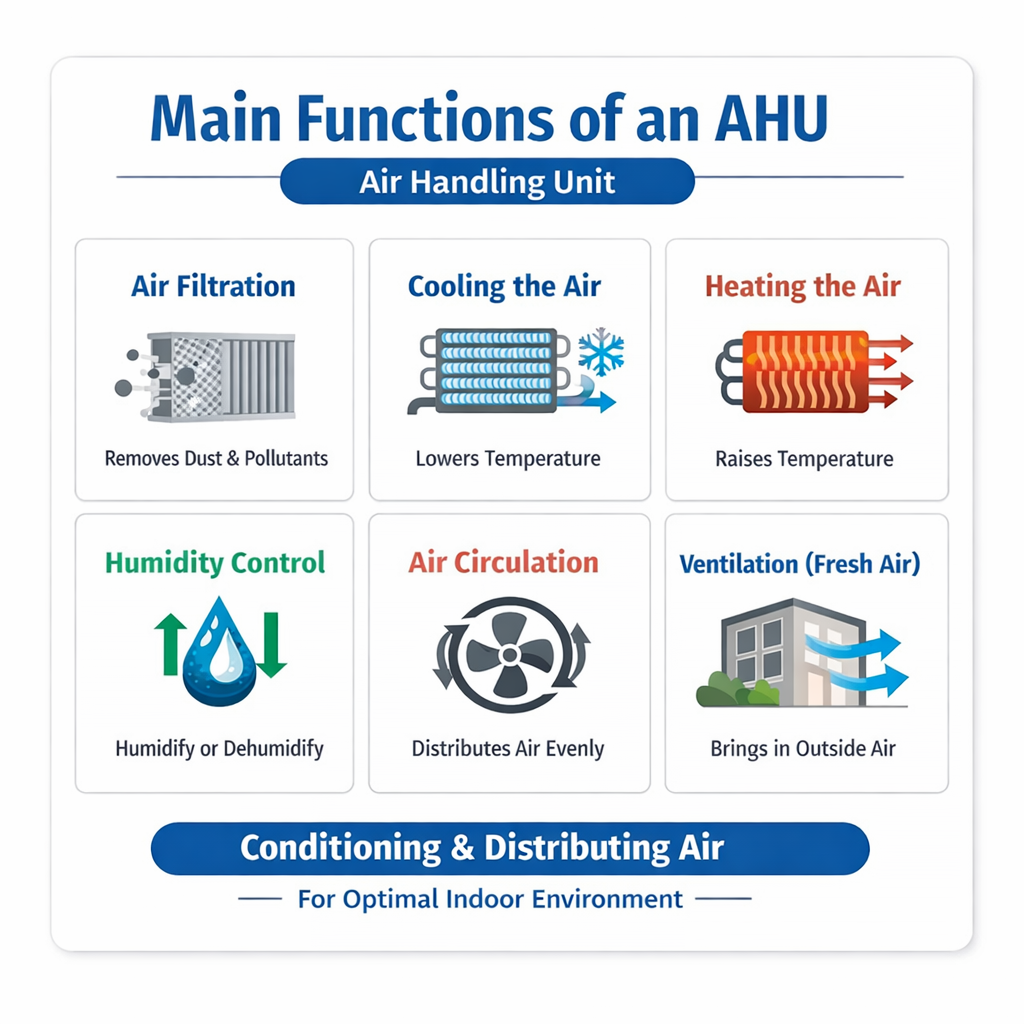
To condition air (cool, heat, humidify, dehumidify, and filter) and distribute it throughout a building.
Breaking Down the Main Function
1. Air Filtration
AHU removes:
- Dust
- Dirt particles
- Pollutants
- Bacteria (in advanced systems)
Ensures clean and healthy indoor air quality (IAQ)
2. Cooling the Air
Using chilled water coils or DX coils:
- Hot air is cooled
- Temperature is maintained as per setpoint
Essential for comfort in hot climates like India
3. Heating the Air
In winter or specific processes:
- Hot water or electric heaters are used
Maintains thermal comfort
4. Air Circulation
AHU fans:
- Supply conditioned air
- Return air back to system
Maintains proper airflow balance
5. Humidity Control
AHU helps:
- Add moisture (humidification)
- Remove moisture (dehumidification)
Critical for:
- Hospitals
- Pharma industries
- Data centers
6. Ventilation (Fresh Air Supply)
AHU mixes:
- Fresh outdoor air
- Return indoor air
Maintains oxygen levels and removes CO₂
Working Principle of AHU
Step-by-Step Process
Step 1: Air Intake
- Fresh air + return air enters AHU
Step 2: Filtration
- Air passes through filters
Step 3: Conditioning
- Cooling/heating coils adjust temperature
Step 4: Humidity Control
- Moisture level adjusted
Step 5: Air Distribution
- Supply fan pushes air through ducts
Major Components of AHU
1. Filters
Types:
- Pre-filter
- Fine filter
- HEPA filter
Function:
Remove airborne contaminants
2. Cooling Coil
- Uses chilled water or refrigerant
- Removes heat from air
3. Heating Coil
- Hot water or electric
- Adds heat when needed
4. Blower/Fan
- Drives airflow
- Key for air distribution
5. Dampers
- Control airflow direction
- Regulate fresh vs return air
6. Humidifier
- Adds moisture to air
7. Dehumidifier
- Removes excess moisture
8. Mixing Box
- Mixes fresh air and return air
9. Control System
- Sensors + automation
- Maintains temperature, humidity, airflow
Types of AHU
1. Packaged AHU
- Compact
- Factory-assembled
2. Modular AHU
- Customizable sections
- Widely used in large projects
3. Rooftop AHU
- Installed on roof
- Saves indoor space
4. DX AHU (Direct Expansion)
- Uses refrigerant directly
5. Chilled Water AHU
- Uses chilled water from chiller
AHU vs FCU (Fan Coil Unit)
| Feature | AHU | FCU |
|---|---|---|
| Coverage | Large area | Small rooms |
| Fresh Air | Yes | Limited |
| Complexity | High | Low |
| Application | Commercial | Residential |
Applications of AHU
Commercial Buildings
- Offices
- Shopping malls
- Hotels
Healthcare
- Hospitals
- Operation theatres
Industrial Use
- Pharma
- Food processing
Data Centers
- Cooling servers
- Humidity control
Clean Rooms
- Dust-free environment
Importance of AHU in HVAC System
1. Indoor Air Quality (IAQ)
AHU ensures:
- Clean air
- Reduced pollutants
2. Energy Efficiency
Modern AHUs:
- Use VFD fans
- Optimize airflow
3. Comfort Control
Maintains:
- Temperature
- Humidity
4. System Reliability
Centralized system:
- Easy monitoring
- Better control
Advantages of AHU
- Centralized air management
- Better air quality
- Energy efficient
- Flexible design
- Suitable for large spaces
Disadvantages of AHU
- High initial cost
- Requires maintenance
- Space requirement
- Skilled operation needed
AHU Maintenance Guide
Daily Checks
- Airflow
- Noise
Weekly Checks
- Filter condition
- Drain pan cleaning
Monthly Checks
- Coil cleaning
- Belt inspection
Annual Maintenance
- Complete servicing
- Performance testing
Common AHU Problems
1. Low Airflow
Cause:
- Dirty filters
2. Cooling Issue
Cause:
- Coil blockage
- Low chilled water flow
3. High Energy Consumption
Cause:
- Fan imbalance
- Dirty components
4. Noise Problem
Cause:
- Loose parts
- Bearing failure
AHU Design Considerations
1. Airflow (CFM)
- Based on room size
2. Static Pressure
- Duct resistance
3. Cooling Load
- Heat load calculation
4. Filtration Level
- Depends on application
5. Energy Efficiency
- Use EC fans, VFD
AHU in Modern Smart Buildings
Modern AHUs are integrated with:
- BMS (Building Management System)
- IoT sensors
- AI-based control
Result:
- Energy saving
- Predictive maintenance
Future of AHU Technology
- Energy recovery systems
- Smart sensors
- AI-driven optimization
- Green HVAC systems
Expert Recommendation (HVAC Industry Insight)
From practical HVAC field experience:
Always select AHU based on:
- Actual load calculation
- Not rule-of-thumb
Use:
- Double skin panels for insulation
- High-quality filters for IAQ
For Indian climate:
- Focus on dehumidification
Why AHU is Critical in Indian Climate
India has:
- High temperature
- High humidity
AHU helps in:
- Cooling + dehumidification
- Fresh air ventilation
Essential for comfort and health
Frequently Asked Questions (FAQs)
1. What is the main function of AHU?
The main function of an Air Handling Unit (AHU) is to condition and circulate air within a building. It controls temperature, humidity, and air quality by filtering, cooling, heating, and distributing air through duct systems.
2. What does an AHU do in an HVAC system?
An AHU performs multiple functions such as:
- Air filtration
- Cooling and heating
- Humidity control
- Air circulation and ventilation
It ensures comfortable and healthy indoor air conditions.
3. Is AHU used only for cooling?
No, AHU is not limited to cooling. It can:
- Cool air
- Heat air
- Control humidity
- Supply fresh air
It is a complete air conditioning and air management unit.
4. Where are AHUs commonly used?
AHUs are widely used in:
- Commercial buildings (offices, malls)
- Hospitals and clean rooms
- Industrial facilities
- Hotels and airports
They are essential for large-scale air distribution systems.
5. What is the difference between AHU and HVAC?
- HVAC is the complete system (Heating, Ventilation, Air Conditioning)
- AHU is a component of HVAC responsible for air handling and distribution
6. How does an AHU improve indoor air quality?
AHU improves indoor air quality by:
- Removing dust and pollutants using filters
- Introducing fresh outdoor air
- Controlling humidity levels
This ensures a healthy indoor environment.
7. What are the main components of an AHU?
Key components include:
- Filters
- Cooling coil
- Heating coil
- Blower/fan
- Dampers
- Humidifier
Each part plays a role in conditioning air.
8. What type of AHU is best for commercial buildings?
For commercial buildings, modular or chilled water AHUs are commonly preferred due to:
- High efficiency
- Flexibility
- Better performance for large spaces
Conclusion
The main function of an AHU (Air Handling Unit) goes far beyond simple cooling. It is a multi-functional system responsible for:
- Air filtration
- Temperature control
- Humidity regulation
- Air circulation
- Ventilation
In short:
AHU is the heart of any central HVAC system
For HVAC contractors, engineers, and building owners, understanding AHU functionality is essential for:
- Better system design
- Energy efficiency
- Indoor air quality
- Long-term performance
Need Expert AHU Design & Installation?
Vipul HVAC Solution Pvt Ltd offers:
- AHU Design & Selection
- Installation & Commissioning
- Maintenance Services
- Industrial & Commercial HVAC Solutions
📱 Call / WhatsApp: +91-9825636606
🌐 Website: www.vipulhvacsolution.in
📧 Email: info@vipulhvacsolution.in