A2L Refrigerants in VRF Systems
What Engineers Need to Know: A2L Refrigerants in VRF Systems Design and Installation
Introduction
The HVAC industry is undergoing one of its most significant transformations in decades. Driven by environmental regulations, sustainability goals, and technological advancements, refrigerants are evolving rapidly. Among these changes, the transition to A2L refrigerants is at the forefront—especially in Variable Refrigerant Flow (VRF) systems.
For engineers, contractors, and HVAC designers, understanding A2L refrigerants is no longer optional—it’s critical. These mildly flammable refrigerants are replacing traditional high-GWP refrigerants like R-410A, impacting everything from system design to installation, safety protocols, and maintenance.
This guide provides a complete, in-depth understanding of A2L refrigerants and their impact on VRF systems, helping engineers adapt, design safely, and stay compliant with global standards.
What Are A2L Refrigerants?
A2L refrigerants belong to a classification defined by ASHRAE Standard 34, where:
- A = Low toxicity
- 2L = Mild flammability with low burning velocity
Key Characteristics of A2L Refrigerants
- Low Global Warming Potential (GWP)
- Mild flammability (not highly flammable like propane)
- Lower environmental impact
- Slightly different thermodynamic properties
Common A2L Refrigerants in VRF Systems
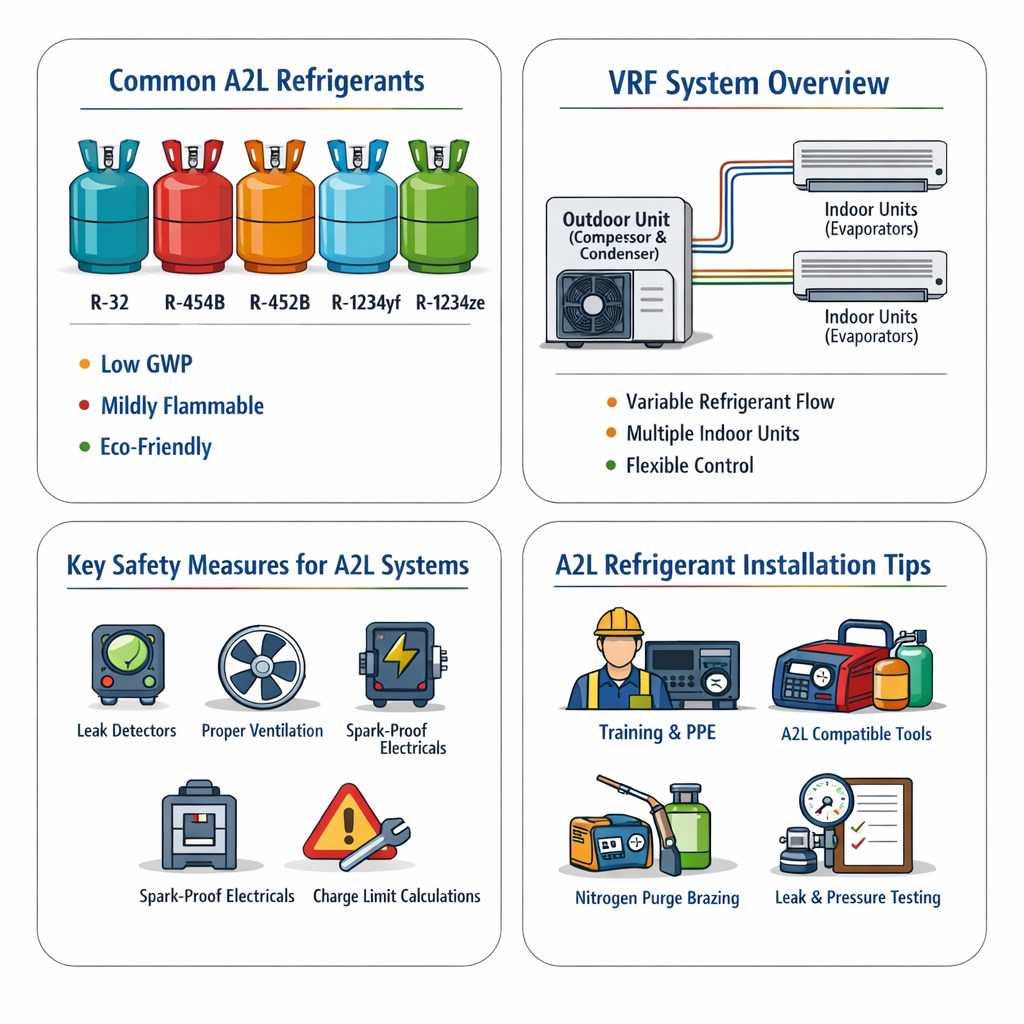
- R-32
- R-454B
- R-452B
- R-1234yf
- R-1234ze
Why the Shift to A2L Refrigerants?
1. Environmental Regulations
Governments worldwide are enforcing stricter rules to reduce greenhouse gas emissions.
- Kigali Amendment to the Montreal Protocol
- European F-Gas Regulation
- India’s HFC phase-down strategy
2. High GWP Problem
Traditional refrigerants like R-410A have:
- GWP ≈ 2088
A2L refrigerants offer:
- GWP < 750 (many even below 500)
3. Energy Efficiency Improvements
Some A2L refrigerants offer:
- Better heat transfer
- Lower compressor load
- Improved system efficiency
Understanding VRF Systems
Before diving deeper, let’s recap VRF systems.
What is a VRF System?
A VRF system is a type of HVAC system that:
- Uses refrigerant as the cooling/heating medium
- Allows variable flow depending on demand
- Serves multiple indoor units from a single outdoor unit
Key Components
- Outdoor unit (compressor + condenser)
- Indoor units (evaporators)
- Refrigerant piping network
- Electronic expansion valves
How A2L Refrigerants Impact VRF System Design
The introduction of A2L refrigerants fundamentally changes design practices.
1. Refrigerant Charge Limit Considerations
Because A2L refrigerants are mildly flammable, charge limits are critical.
Key Factors Affecting Charge Limits
- Room size
- Occupancy type
- System configuration
- Installation height
Design Implication
Engineers must:
- Calculate allowable refrigerant charge
- Divide systems into smaller circuits if needed
- Use additional safety systems
2. Room Volume and Safety Calculations
For A2L systems, room volume plays a major role.
Why It Matters
If a leak occurs, refrigerant concentration must stay below the Lower Flammability Limit (LFL).
Design Requirement
- Ensure minimum room size
- Use safety formulas for concentration
- Install leak detection if limits are exceeded
3. Refrigerant Piping Design Changes
Piping design becomes more complex with A2L refrigerants.
Changes Include
- Reduced pipe lengths (to limit charge)
- Optimized pipe diameters
- Strategic routing to avoid confined spaces
Engineering Considerations
- Avoid piping through small enclosed areas
- Ensure proper ventilation
- Use approved materials
4. Ventilation Requirements
Ventilation is crucial in A2L systems.
Why?
To dilute refrigerant in case of leakage.
Design Guidelines
- Natural or mechanical ventilation
- Minimum airflow requirements
- Placement of vents at appropriate heights
5. Leak Detection Systems
Leak detection is often mandatory.
Types of Leak Detection
- Fixed refrigerant sensors
- Integrated VRF system sensors
Design Integration
- Connect sensors to alarm systems
- Integrate with Building Management Systems (BMS)
- Automatic shutdown capability
6. Electrical System Considerations
A2L refrigerants require stricter electrical safety.
Requirements
- Spark-proof components
- Sealed electrical enclosures
- Proper grounding
7. Equipment Placement Restrictions
Outdoor and indoor unit placement must consider safety.
Key Points
- Avoid installation in confined spaces
- Maintain clearance distances
- Ensure airflow
Installation Challenges with A2L Refrigerants
1. Skilled Workforce Requirement
Technicians must be trained in:
- Handling mildly flammable refrigerants
- Leak detection
- Safe charging procedures
2. Specialized Tools and Equipment
Standard tools may not be sufficient.
Required Tools
- A2L-compatible recovery machines
- Spark-proof vacuum pumps
- Leak detectors calibrated for A2L
3. Refrigerant Handling Procedures
Charging Process
- Use proper weighing scales
- Avoid overcharging
- Follow manufacturer guidelines
Recovery Process
- Use approved recovery cylinders
- Avoid venting refrigerant
4. Brazing and Welding Safety
Brazing near refrigerant lines requires caution.
Safety Measures
- Purge with nitrogen
- Ensure no refrigerant presence
- Maintain ventilation
5. Commissioning Procedures
Commissioning becomes more detailed.
Steps Include
- Leak testing
- Pressure testing
- Functional safety checks
Safety Standards and Codes
Engineers must comply with international and local standards.
Key Standards
- ASHRAE 15
- ASHRAE 34
- IEC 60335-2-40
- ISO 5149
Indian Context
India is gradually adopting global standards, making compliance essential for future projects.
Risk Assessment for A2L Systems
Hazard Identification
- Refrigerant leaks
- Ignition sources
- Confined spaces
Risk Mitigation Strategies
- Proper system design
- Leak detection
- Ventilation
Safety Classification Zones
Define zones based on:
- Risk level
- Occupancy
- Refrigerant concentration
Advantages of A2L Refrigerants in VRF Systems
1. Lower Environmental Impact
- Reduced GWP
- Supports sustainability goals
2. Improved Energy Efficiency
- Better system performance
- Reduced energy consumption
3. Future-Proof Technology
- Compliance with future regulations
- Long-term viability
Challenges and Limitations
1. Flammability Concerns
Even though mild, safety cannot be ignored.
2. Higher Initial Costs
- Equipment upgrades
- Safety systems
3. Training Requirements
Industry-wide skill gap exists.
Design Best Practices for Engineers
1. Early Stage Planning
- Consider refrigerant type from the start
- Perform load calculations
2. Detailed Safety Analysis
- Conduct risk assessments
- Calculate refrigerant charge limits
3. Collaboration
- Work with architects
- Coordinate with electrical engineers
4. Use of Simulation Tools
- CFD analysis
- Refrigerant leak modeling
5. Documentation
- Maintain detailed design records
- Ensure compliance documentation
Installation Best Practices
1. Pre-Installation Checks
- Verify site conditions
- Confirm ventilation
2. Safe Installation Techniques
- Proper pipe insulation
- Secure fittings
3. Post-Installation Testing
- Leak testing
- Performance testing
Maintenance Considerations
Routine Maintenance
- Inspect piping
- Check leak detectors
Preventive Maintenance
- Replace worn components
- Clean filters
Emergency Response Plan
- Leak response procedures
- Evacuation plan
Future Trends in A2L and VRF Technology
1. Smart Leak Detection Systems
AI-based detection systems are emerging.
2. Improved Refrigerant Blends
New low-GWP refrigerants are being developed.
3. Automation Integration
Integration with smart buildings and IoT.
Get a Free VRF System Consultation
Planning to upgrade to A2L refrigerant VRF systems or need expert guidance on design, installation, or compliance?
Our HVAC specialists are ready to help you with safe, efficient, and future-proof solutions tailored to your project.
What You Get:
- Expert consultation on A2L refrigerant systems
- VRF system design support
- Refrigerant charge & safety calculations
- Compliance with latest standards (ASHRAE, IEC)
- Cost estimation & project planning
📱 Call / WhatsApp: +91-9825636606
🌐 Website: www.vipulhvacsolution.in
📧 Email: info@vipulhvacsolution.in
FAQ – A2L Refrigerants in VRF Systems
1. What are A2L refrigerants in HVAC systems?
A2L refrigerants are low-toxicity, mildly flammable refrigerants classified under ASHRAE Standard 34. They have lower Global Warming Potential (GWP) compared to traditional refrigerants like R-410A.
2. Why are A2L refrigerants used in VRF systems?
A2L refrigerants are used in VRF systems because they:
- Reduce environmental impact
- Meet global regulatory requirements
- Improve energy efficiency
- Support future-ready HVAC designs
3. Are A2L refrigerants safe to use?
Yes, A2L refrigerants are safe when proper design and installation guidelines are followed. They are mildly flammable, so safety measures like leak detection, ventilation, and charge limits must be implemented.
4. What is the difference between A1 and A2L refrigerants?
- A1 refrigerants: Non-flammable, low toxicity
- A2L refrigerants: Mildly flammable, low toxicity
A2L refrigerants require additional safety considerations compared to A1 refrigerants.
5. How do A2L refrigerants impact VRF system design?
They affect:
- Refrigerant charge limits
- Room size calculations
- Ventilation requirements
- Leak detection systems
- Electrical safety design
Engineers must redesign systems to ensure compliance and safety.
6. What safety measures are required for A2L VRF systems?
Key safety measures include:
- Refrigerant leak detectors
- Proper ventilation systems
- Spark-proof electrical components
- Compliance with standards like ASHRAE 15 and IEC standards
7. Do A2L refrigerants improve energy efficiency?
Yes, many A2L refrigerants such as R-32 provide:
- Better heat transfer
- Higher efficiency
- Lower energy consumption
8. What are common A2L refrigerants used in VRF systems?
Common A2L refrigerants include:
- R-32
- R-454B
- R-452B
- R-1234yf
- R-1234ze
9. Are A2L refrigerants mandatory in the future?
Yes, due to global regulations like the Kigali Amendment, A2L refrigerants are expected to replace high-GWP refrigerants in most HVAC applications.
10. What training is required for handling A2L refrigerants?
Technicians and engineers should be trained in:
- Safe refrigerant handling
- Leak detection techniques
- Installation best practices
- Emergency response procedures
Conclusion
The transition to A2L refrigerants represents a major shift in HVAC system design—especially for VRF systems. While these refrigerants bring clear environmental and efficiency benefits, they also introduce new complexities in safety, installation, and engineering practices.
For engineers, the key to success lies in:
- Understanding refrigerant behavior
- Designing with safety in mind
- Following updated codes and standards
- Investing in training and tools
As regulations tighten and sustainability becomes a priority, A2L refrigerants will soon become the new industry standard. Engineers who adapt early will not only ensure compliance but also gain a competitive advantage in the evolving HVAC market.