Brazing vs Soldering vs Welding
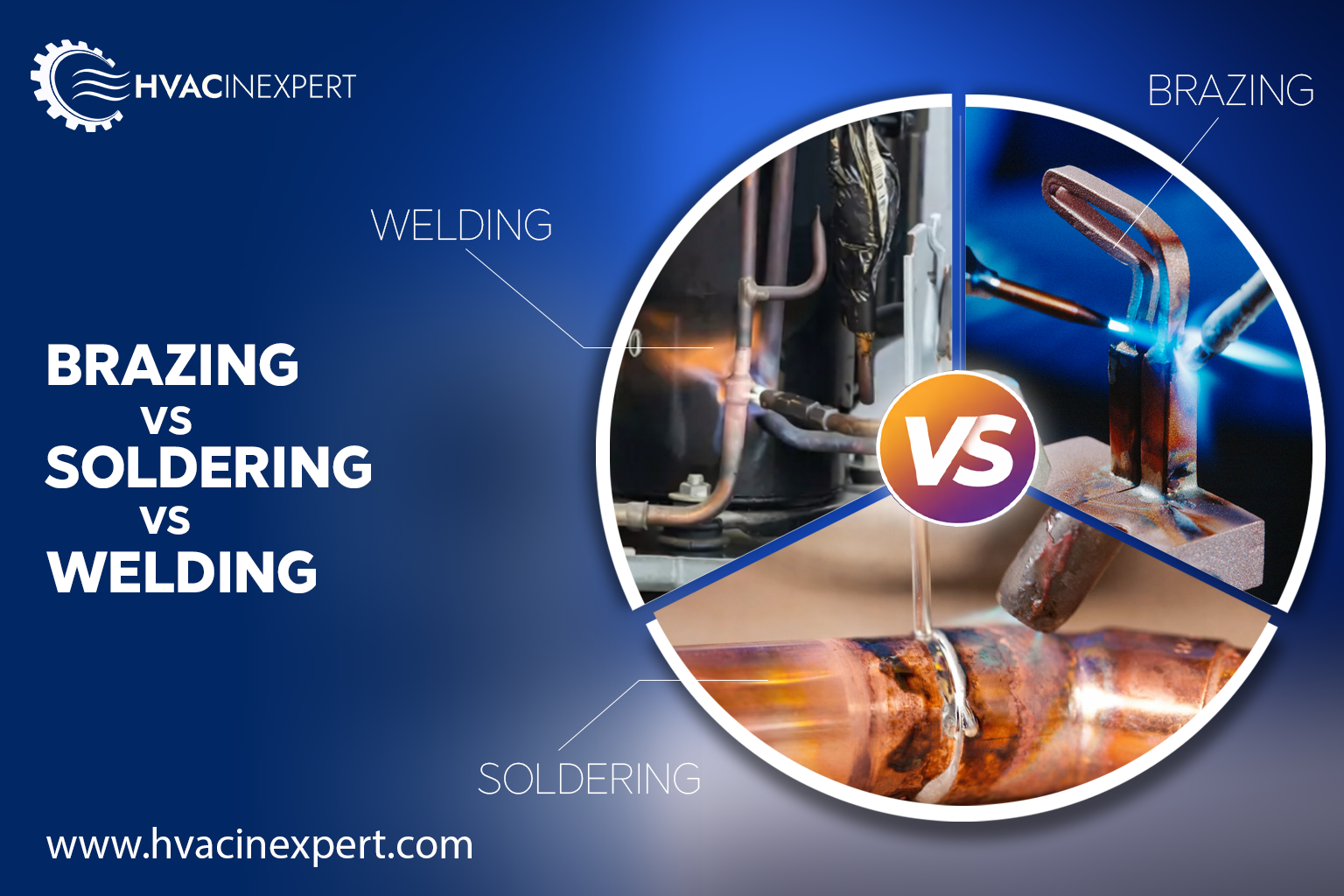
Brazing vs Soldering vs Welding: The Ultimate HVAC & Metal Joining Guide
Metal joining is a core skill in industries like HVAC, plumbing, automotive, and manufacturing. Whether you’re installing copper piping, repairing coils, or fabricating structures, choosing the right joining method is critical.
Three of the most common techniques are:
- Brazing
- Soldering
- Welding
While they may seem similar, they differ significantly in strength, temperature, applications, and cost.
In this , we’ll break down brazing vs soldering vs welding in depth — with real HVAC use cases, expert tips, and comparison insights tailored for professionals like you.
1. What is Brazing?
Brazing is a metal-joining process where two base metals are joined using a filler metal that melts above 450°C but below the melting point of the base metals.
The filler flows into the joint through capillary action, creating a strong bond.
Key Characteristics:
- Temperature: 450°C – 900°C
- Uses filler metal (like silver alloys)
- Base metals do NOT melt
- Requires flux (or controlled atmosphere)
Common HVAC Use:
- Copper pipe joints
- Refrigeration lines
- AC installation and repair
Advantages:
- Stronger than soldering
- Ideal for high-pressure systems
- Works with dissimilar metals
Disadvantages:
- Requires high heat
- Needs skilled handling
- More expensive than soldering
2. What is Soldering?
Definition
Soldering is a low-temperature metal joining process where a filler metal (solder) melts below 450°C.
Key Characteristics:
- Temperature: 180°C – 350°C
- Base metals do NOT melt
- Uses soft filler metals (tin-based)
Common Uses:
- Electrical connections
- Plumbing (low-pressure systems)
- Electronics repair
Advantages:
- Easy to perform
- Low cost
- Minimal heat distortion
Disadvantages:
- Weak joints
- Not suitable for high pressure
- Limited temperature resistance
3. What is Welding?
Definition
Welding is a high-temperature process where base metals are melted and fused together, often with or without filler material.
Key Characteristics:
- Temperature: 3000°C+
- Base metals melt
- Strongest joint type
Types of Welding:
- Arc welding
- MIG welding
- TIG welding
- Gas welding
Common Uses:
- Structural fabrication
- Heavy machinery
- Automotive industry
Advantages:
- Extremely strong joints
- Permanent bonding
- Suitable for thick metals
Disadvantages:
- Requires high skill
- Expensive equipment
- Heat distortion risk
4. Key Differences: Brazing vs Soldering vs Welding
Comparison Table
| Feature | Brazing | Soldering | Welding |
|---|---|---|---|
| Temperature | Medium | Low | Very High |
| Base Metal Melting | No | No | Yes |
| Strength | High | Low | Very High |
| Cost | Medium | Low | High |
| Skill Level | Medium | Low | High |
| HVAC Use | Yes (common) | Limited | Rare |
| Pressure Handling | High | Low | Very High |
5. HVAC Perspective: Which One Should You Use?
Brazing (Most Recommended in HVAC)
Ideal for:
- Refrigerant lines
- Copper tubing
- High-pressure systems
Why? Because HVAC systems operate under high pressure and temperature, requiring strong leak-proof joints.
Soldering (Limited Use)
Suitable for:
- Drain lines
- Low-pressure plumbing
- Electrical connections
Welding (Rare in HVAC)
Used for:
- Structural frames
- Large duct systems (sometimes)
6. Brazing in HVAC: Deep Dive
Why Brazing is Preferred in HVAC
- Handles high refrigerant pressure
- Leak-proof joints
- Durable under vibration
Common Materials:
- Copper to copper
- Copper to brass
- Copper to steel
Important Tip:
Always use nitrogen purging during brazing to prevent oxidation inside pipes.
7. Soldering in HVAC
Soldering is rarely used for refrigerant lines.
Where It’s Used:
- Electrical connections
- Control wiring
- PCB repairs
8. Welding in HVAC Systems
Welding is not commonly used in refrigerant piping but is used in:
- Structural supports
- Industrial ductwork
- Chillers and heavy equipment
9. Strength Comparison
- Welding → Strongest (base metal fusion)
- Brazing → Strong (ideal for HVAC)
- Soldering → Weak (light-duty only)
10. Cost Comparison
| Process | Equipment Cost | Labor Cost |
|---|---|---|
| Soldering | Low | Low |
| Brazing | Medium | Medium |
| Welding | High | High |
11. Safety Considerations
Brazing:
- Use protective goggles
- Handle torch carefully
Soldering:
- Avoid lead exposure
- Use ventilation
Welding:
- Full PPE required
- Eye protection critical
- Fire hazards high
12. Tools Required
Brazing Tools:
- Oxy-acetylene torch
- Brazing rods
- Flux
- Nitrogen cylinder
Soldering Tools:
- Soldering iron
- Solder wire
- Flux
Welding Tools:
- Welding machine
- Electrodes
- Shielding gas
13. Real-World HVAC Example
Installing Split AC:
- Refrigerant lines → Brazing
- Electrical wiring → Soldering
- Outdoor unit frame → Welding
14. When NOT to Use Each Method
- Avoid soldering for refrigerant lines
- Avoid welding for thin copper pipes
- Avoid brazing for electronics
15. Environmental Impact
- Soldering: Low energy
- Brazing: Moderate energy
- Welding: High energy
16. Skill Level Comparison
- Beginner → Soldering
- Intermediate → Brazing
- Expert → Welding
17. Common Mistakes to Avoid
Brazing Mistakes:
- No nitrogen purge
- Overheating joints
Soldering Mistakes:
- Cold joints
- Poor flux application
Welding Mistakes:
- Incorrect current
- Poor penetration
18. Future Trends
- Lead-free soldering
- Eco-friendly brazing alloys
- Automated welding systems
19. FAQs
Q1. Which is stronger: brazing or soldering?
Brazing is significantly stronger.
Q2. Can soldering be used for HVAC?
Only for electrical parts, not refrigerant lines.
Q3. Why is brazing used in AC installation?
Because it provides strong, leak-proof joints.
Q4. Is welding better than brazing?
Depends on application — welding is stronger but not suitable for HVAC pipes.
Q5. What temperature is used in brazing?
Above 450°C.
Q6. Do HVAC technicians use welding?
Rarely, mostly for structural parts.
Q7. What gas is used in brazing?
Oxy-acetylene or air-acetylene.
Q8. Is brazing expensive?
Moderately priced.
Q9. Can beginners learn brazing?
Yes, with practice.
Q10. What is the safest method?
Soldering is safest due to low heat.
20. Final Verdict
If you’re an HVAC professional:
- Use Brazing → For refrigerant piping (BEST choice)
- Use Soldering → For electrical work
- Use Welding → For heavy structural work
Conclusion
Understanding the difference between brazing, soldering, and welding is essential for every HVAC technician, contractor, and engineer. Each method has its own strengths, limitations, and ideal applications.
For HVAC specifically, brazing dominates due to its strength, durability, and reliability under pressure.