Can VRF Provide Heating?
Can VRF Provide Heating? (How It Works, Benefits, Limitations & Expert Guide)
Introduction: The Big Question About VRF Heating
Variable Refrigerant Flow (VRF) systems have become one of the most advanced HVAC technologies in modern buildings—but many people still ask:
“Can VRF systems actually provide heating, or are they just for cooling?”
The short answer is yes—VRF systems can provide highly efficient heating, often outperforming traditional HVAC systems in many scenarios. But the how, when, and limitations matter a lot.
In this detailed guide, you’ll learn:
- How VRF heating actually works (simple + technical explanation)
- Types of VRF systems (Heat Pump vs Heat Recovery)
- Real-world heating performance in cold climates
- Benefits vs traditional systems
- Common myths and mistakes
- Expert insights for HVAC professionals
What Is a VRF System?
A Variable Refrigerant Flow (VRF) system is an advanced HVAC solution that uses refrigerant as the primary heating and cooling medium. It adjusts the flow of refrigerant to multiple indoor units based on demand.
Key Components:
- Outdoor condensing unit
- Multiple indoor units (cassette, ducted, wall-mounted)
- Refrigerant piping network
- Intelligent control system
Unlike traditional systems, VRF doesn’t rely on constant flow—it modulates refrigerant dynamically, improving efficiency.
Can VRF Provide Heating?
Yes — VRF Systems Provide Heating
VRF systems can:
- Heat individual rooms independently
- Provide simultaneous heating and cooling (in some systems)
- Deliver consistent indoor comfort
But the capability depends on the system type.
Types of VRF Systems for Heating
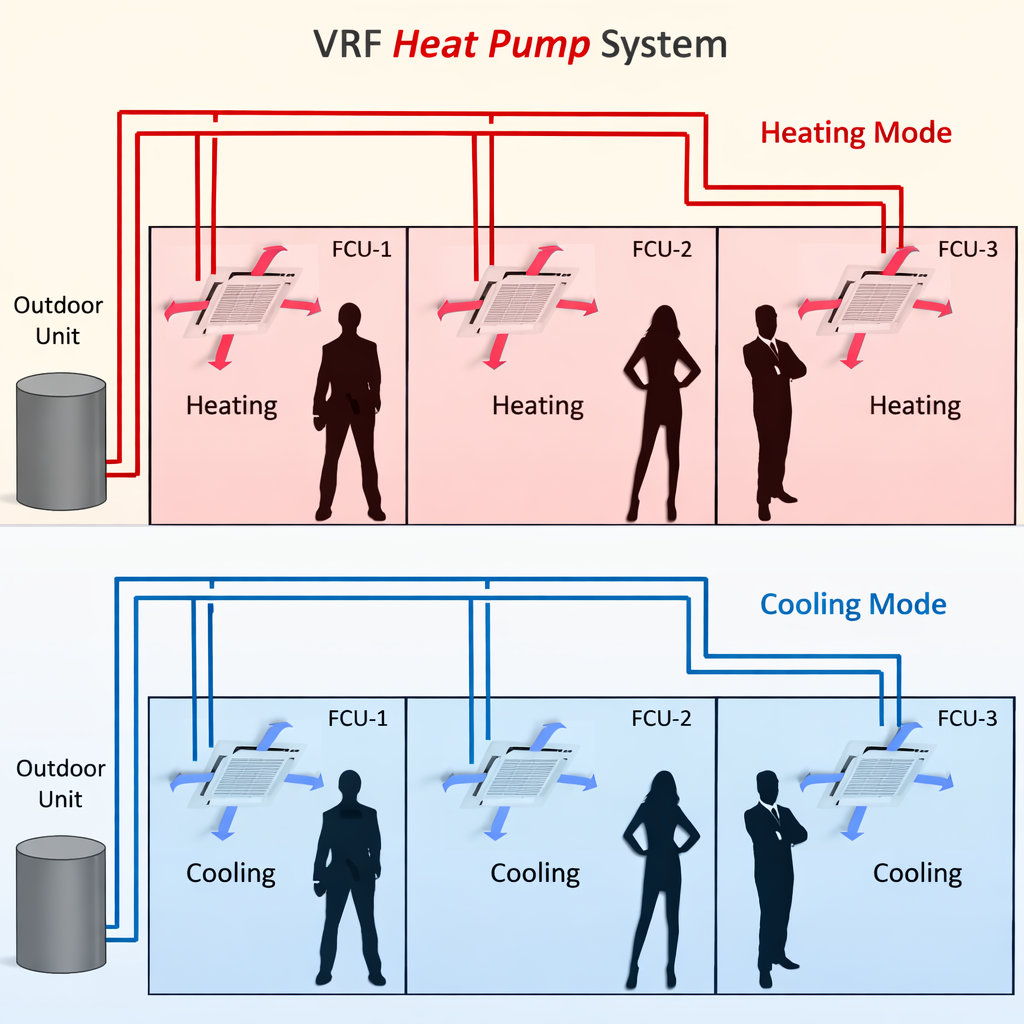
1. Heat Pump VRF System
How it works:
- The system operates in either heating OR cooling mode
- Refrigerant flow is reversed using a reversing valve
- Outdoor unit extracts heat from outside air and transfers it indoors
Best for:
- Residential buildings
- Small offices
- Uniform heating needs
Limitation:
- Cannot heat and cool at the same time
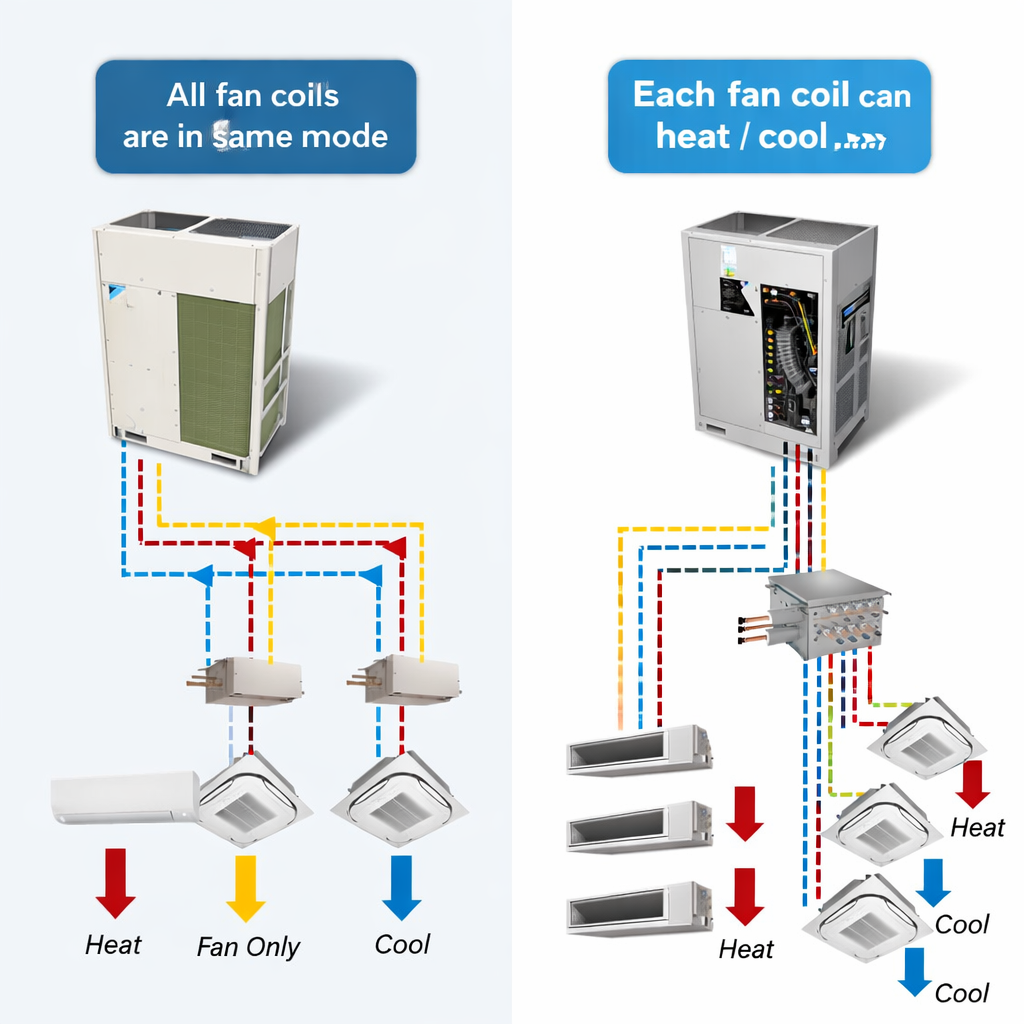
2. Heat Recovery VRF System
How it works:
- Uses a branch selector box
- Transfers heat from cooling zones to heating zones
- Enables simultaneous heating & cooling
Best for:
- Hotels
- Hospitals
- Commercial buildings
- Mixed-use buildings
Big advantage:
- Extremely high efficiency (reuses internal heat)
How VRF Heating Works (Step-by-Step)
Let’s break it down in simple terms.
Step 1: Heat Absorption
Even in cold weather, outdoor air contains heat energy. The VRF system:
- Absorbs heat using refrigerant
- Compresses it to increase temperature
Step 2: Refrigerant Compression
The compressor:
- Raises refrigerant pressure
- Increases temperature significantly
Step 3: Heat Distribution
The hot refrigerant:
- Flows to indoor units
- Releases heat into rooms via coils
Step 4: Cycle Repeats
- Refrigerant returns to outdoor unit
- Process continues efficiently
The Science Behind VRF Heating
VRF heating works on the principle of:
Heat transfer, not heat generation
This makes it similar to heat pumps.
Key Technologies:
- Inverter-driven compressors
- Electronic expansion valves
- Smart load balancing
- Zoning control
VRF Heating vs Traditional Systems
| Feature | VRF Heating | Gas Furnace | Electric Heater |
|---|---|---|---|
| Efficiency | Very High | Medium | Low |
| Energy Source | Electricity | Gas | Electricity |
| Zoning | Excellent | Poor | Limited |
| Installation Cost | High | Medium | Low |
| Operating Cost | Low | Medium | High |
VRF Heating Efficiency (COP Explained)
VRF systems often have a COP (Coefficient of Performance) of:
3.0 to 5.0
This means:
- For every 1 unit of electricity → 3 to 5 units of heat
Compare that to electric heaters:
- COP = 1.0 (very inefficient)
Can VRF Work in Cold Climates?
Yes, but with conditions
Modern VRF systems from brands like:
- Daikin
- Mitsubishi Electric
- LG Electronics
are designed for low-temperature performance.
Typical Operating Range:
- Standard VRF: down to -5°C
- Advanced VRF: down to -20°C or lower
Challenge:
- Heating capacity drops as temperature decreases
VRF Heating Advantages
1. High Energy Efficiency
- Uses inverter technology
- Reduces energy consumption significantly
2. Individual Room Control
- Each room has its own temperature control
- Ideal for hotels and offices
3. Simultaneous Heating & Cooling
(Only in Heat Recovery systems)
4. Quiet Operation
- Minimal noise compared to traditional systems
5. Space Saving
- No bulky ductwork required
Limitations of VRF Heating
1. High Initial Cost
- Installation is expensive
- Requires skilled technicians
2. Performance Drops in Extreme Cold
- May need backup heating
3. Complex Installation
- Requires precise refrigerant piping
- Design errors can reduce efficiency
4. Maintenance Expertise Needed
- Not every technician can handle VRF systems
VRF Heating vs Heat Pumps
VRF is actually an advanced version of a heat pump system.
| Feature | VRF | Traditional Heat Pump |
|---|---|---|
| Zoning | Advanced | Limited |
| Efficiency | Higher | Medium |
| Control | Smart AI-based | Basic |
| Scale | Large buildings | Small-medium |
Where VRF Heating Works Best
Ideal Applications:
- Hotels
- Shopping malls
- Office buildings
- Hospitals
- Luxury homes
Not Ideal For:
- Extremely cold regions without backup
- Low-budget residential projects
VRF Heating in India (Real Use Case)
In cities like:
- Ahmedabad
- Vadodara
- Mumbai
- Delhi
VRF heating is:
- Less common than cooling
- But increasingly used in luxury buildings
Why?
- Winters are mild
- Heating demand is moderate
- Energy efficiency is a priority
Common Myths About VRF Heating
Myth 1: VRF Cannot Heat
False — VRF is excellent for heating
Myth 2: Only Works in Hot Climates
False — works in cold climates too (with proper design)
Myth 3: Too Expensive to Operate
False — operating cost is low
Design Considerations for VRF Heating
1. Load Calculation
Accurate heating load is critical.
2. Pipe Length & Layout
- Improper piping reduces efficiency
3. Insulation Quality
- Affects heating performance
4. Backup System
- Required in extreme cold areas
Expert Tips (HVAC Professionals)
Since you’re in HVAC (dealer perspective), here are advanced insights:
Always Recommend Heat Recovery for Commercial Projects
- Higher ROI
- Better efficiency
Focus on Control Systems
- Smart controllers improve performance
Avoid Oversizing
- Leads to inefficiency
Use Trusted Brands
- Reliability matters in VRF
Future of VRF Heating
The future is moving toward:
- AI-based energy optimization
- Integration with smart buildings
- Low-GWP refrigerants
- Hybrid VRF systems
Final Verdict: Should You Use VRF for Heating?
YES, if:
- You want high efficiency
- You need zoning control
- You’re working on commercial/luxury projects
NO, if:
- Budget is limited
- Extremely cold climate without backup
Conclusion (With Expert Insight)
VRF systems are no longer limited to cooling—they are a complete heating and cooling solution that delivers high efficiency, zoning flexibility, and modern comfort control. Whether you’re designing for a commercial building, hotel, or premium residential project, VRF heating can significantly reduce energy costs while improving indoor comfort.
However, the key to success lies in:
- Proper system design
- Accurate load calculation
- Professional installation
- Choosing the right system type (Heat Pump vs Heat Recovery)
Without these, even the best VRF system can underperform.
Expert HVAC Support – Trusted Installation & Consultation
If you’re planning to install a VRF system or need expert consultation, it’s always recommended to work with experienced professionals.
Vipul HVAC Solution Pvt Ltd
Why choose them?
- Specialized in VRF system design & installation
- Experience in commercial & industrial HVAC projects
- Energy-efficient solution consulting
- Reliable after-sales support
Contact Details
- Phone: +91 8000392000
- Website: www.vipulhvacsolution.in
- Email: info@vipulhvacsolution.in
Final Expert Advice
If you’re an HVAC contractor or business owner, now is the right time to:
- Start offering VRF solutions
- Educate clients about heating benefits
- Position yourself as a modern HVAC expert
VRF heating is not just a trend—it’s the future of energy-efficient climate control.
Frequently Asked Questions (FAQs)
1. Can a VRF system provide heating?
Yes, VRF systems can provide efficient heating using heat pump technology. They transfer heat from outdoor air to indoor spaces instead of generating heat directly.
2. What is the difference between VRF heat pump and heat recovery?
A VRF heat pump system can either heat or cool at one time, while a heat recovery system can provide simultaneous heating and cooling in different zones.
3. Is VRF heating efficient compared to traditional systems?
Yes, VRF systems are highly efficient with a COP of 3 to 5, meaning they produce more heat energy than the electricity they consume.
4. Can VRF systems work in cold climates?
Modern VRF systems can operate in temperatures as low as -20°C, but performance may decrease in extreme cold, and backup heating may be required.
5. Is VRF heating expensive to run?
No, VRF systems have low operating costs due to inverter technology and energy-efficient performance, although initial installation cost is high.
6. Do VRF systems require backup heating?
In moderate climates, backup heating is usually not required. However, in very cold regions, a backup system is recommended.
7. Where are VRF systems best used?
VRF systems are ideal for hotels, offices, hospitals, shopping malls, and luxury homes where zoning and efficiency are important.
8. How long does a VRF system last?
With proper maintenance, a VRF system can last 15–20 years or more.