How to Calculate Friction Loss in Ducts
How to Calculate Friction Loss in Ducts (Complete HVAC Engineering Guide)
Introduction
Friction loss in ducts is one of the most critical factors in HVAC system design. Whether you are designing a residential air conditioning system or a large commercial ventilation network, understanding duct friction loss directly impacts:
- Airflow efficiency
- Fan selection
- Energy consumption
- Noise levels
- Overall system performance
If friction loss is too high, your system will struggle to deliver air. If it’s too low, you may oversize equipment and waste energy.
This detailed guide will teach you everything—from basic concepts to advanced calculations—so you can confidently design and optimize duct systems like a professional HVAC engineer.
What is Friction Loss in Ducts?
Friction loss is the resistance that air experiences as it flows through ducts due to:
- Contact with duct surfaces
- Turbulence inside the duct
- Obstructions like bends, dampers, and fittings
It is typically measured in:
- Pa/m (Pascal per meter) – SI unit
- in. w.g. per 100 ft – Imperial unit
Visual Understanding of Airflow Resistance
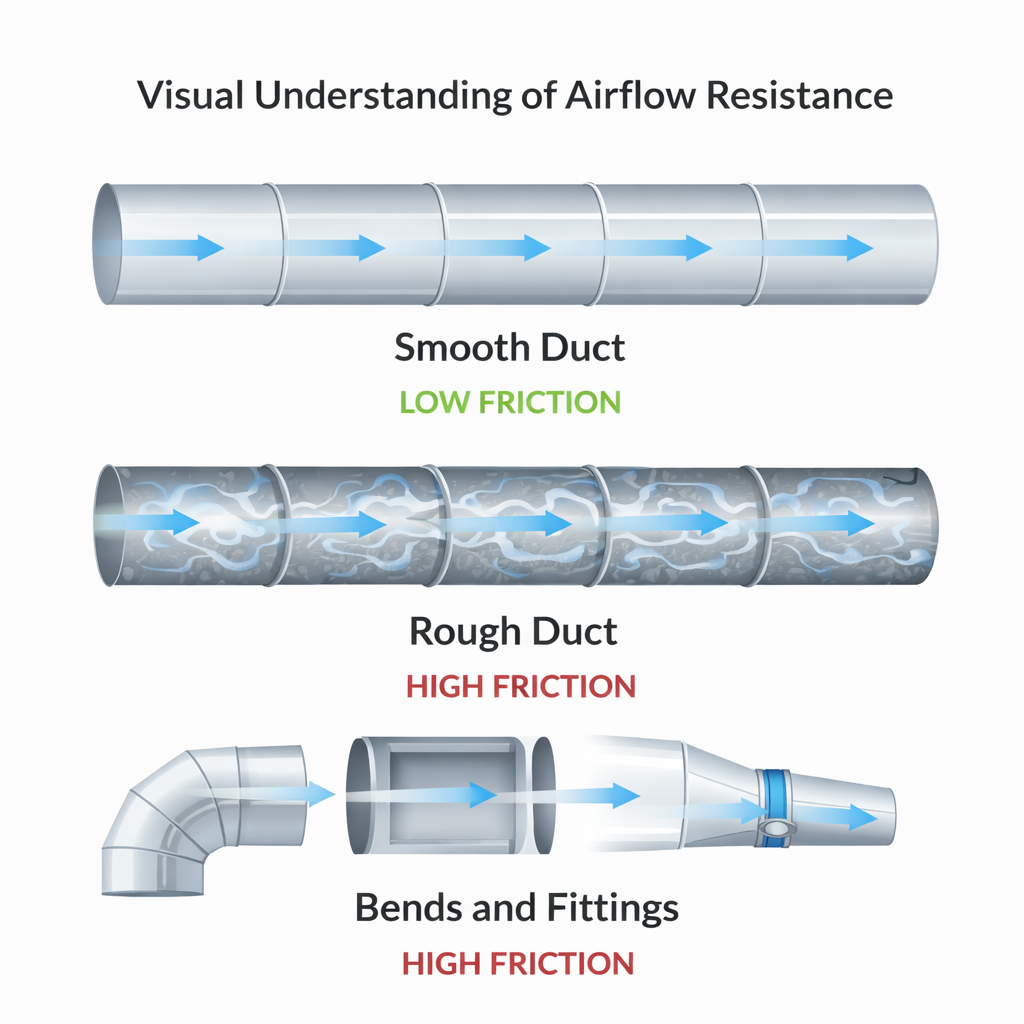
As air moves through ducts:
- Smooth ducts → less friction
- Rough or dirty ducts → more friction
- Higher velocity → higher resistance
Why Friction Loss is Important
1. Fan Selection
Higher friction loss = more powerful fan required.
2. Energy Efficiency
More resistance = more energy consumption.
3. Air Distribution
Incorrect calculations lead to uneven airflow in rooms.
4. Noise Control
High friction increases turbulence → more noise.
Types of Losses in Duct Systems
1. Friction Loss (Major Loss)
Occurs due to straight duct length.
2. Dynamic Loss (Minor Loss)
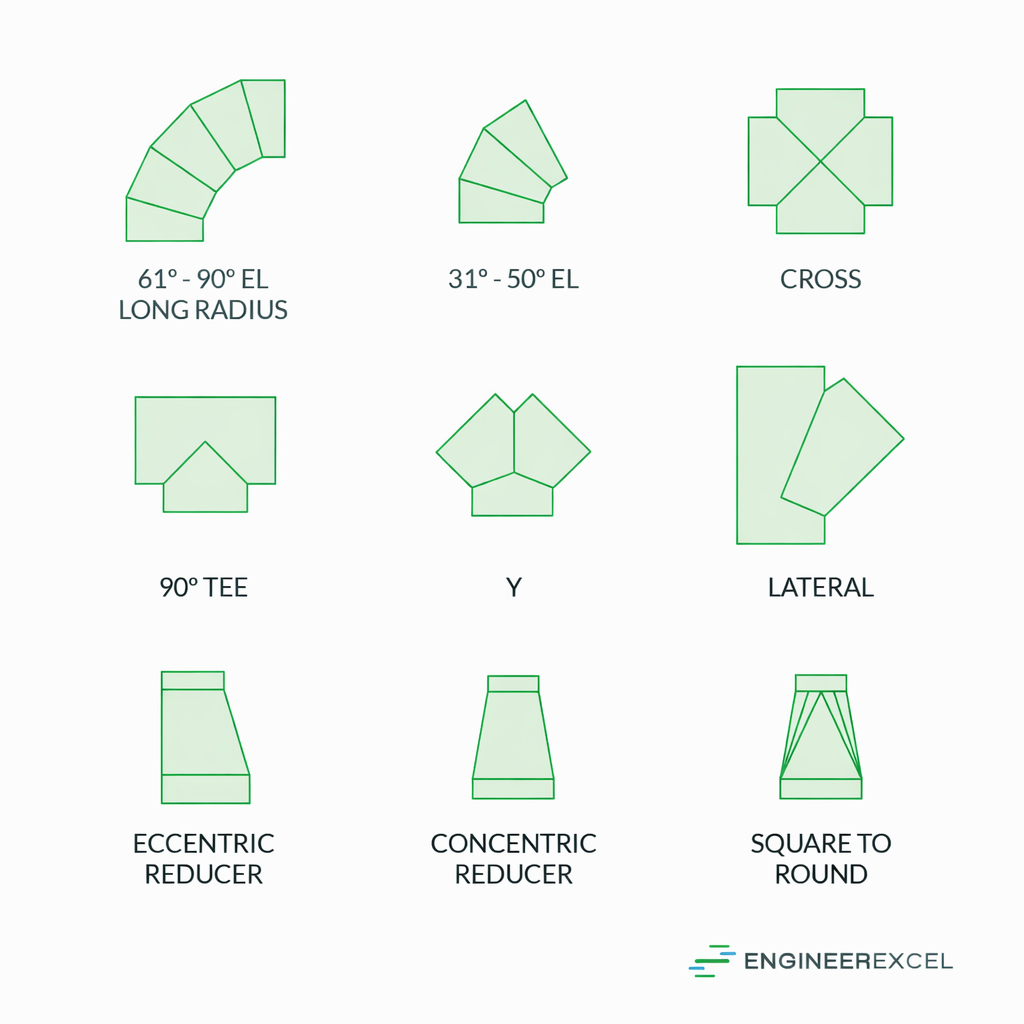
Occurs due to fittings:
- Elbows
- Tees
- Dampers
- Transitions
Duct Components That Affect Friction
Basic Formula for Friction Loss
The most commonly used equation is:
Friction Loss = ΔP / L
Where:
- ΔP = Pressure drop
- L = Length of duct
Darcy-Weisbach Equation (Advanced)
Where:
- f = friction factor
- L = duct length
- D = hydraulic diameter
- ρ = air density
- V = velocity
Step-by-Step Calculation of Friction Loss
Step 1: Determine Airflow (CFM)
Example:
- Room airflow = 1000 CFM
Step 2: Select Duct Size
Use duct sizing charts or rules:
- Example duct size = 12 inch diameter
Step 3: Calculate Air Velocity
Step 4: Find Friction Rate
Using duct friction chart:
- Typical value = 0.08 in. w.g./100 ft
Step 5: Calculate Total Friction Loss
Total Loss=Friction Rate×Duct Length
Example Calculation
Given:
- Airflow = 1000 CFM
- Duct length = 50 ft
- Friction rate = 0.08 in. w.g./100 ft
Solution:
Loss=0.08 × (50/100) =0.04 in. w.g.
Friction Loss Chart (Ductulator Concept)
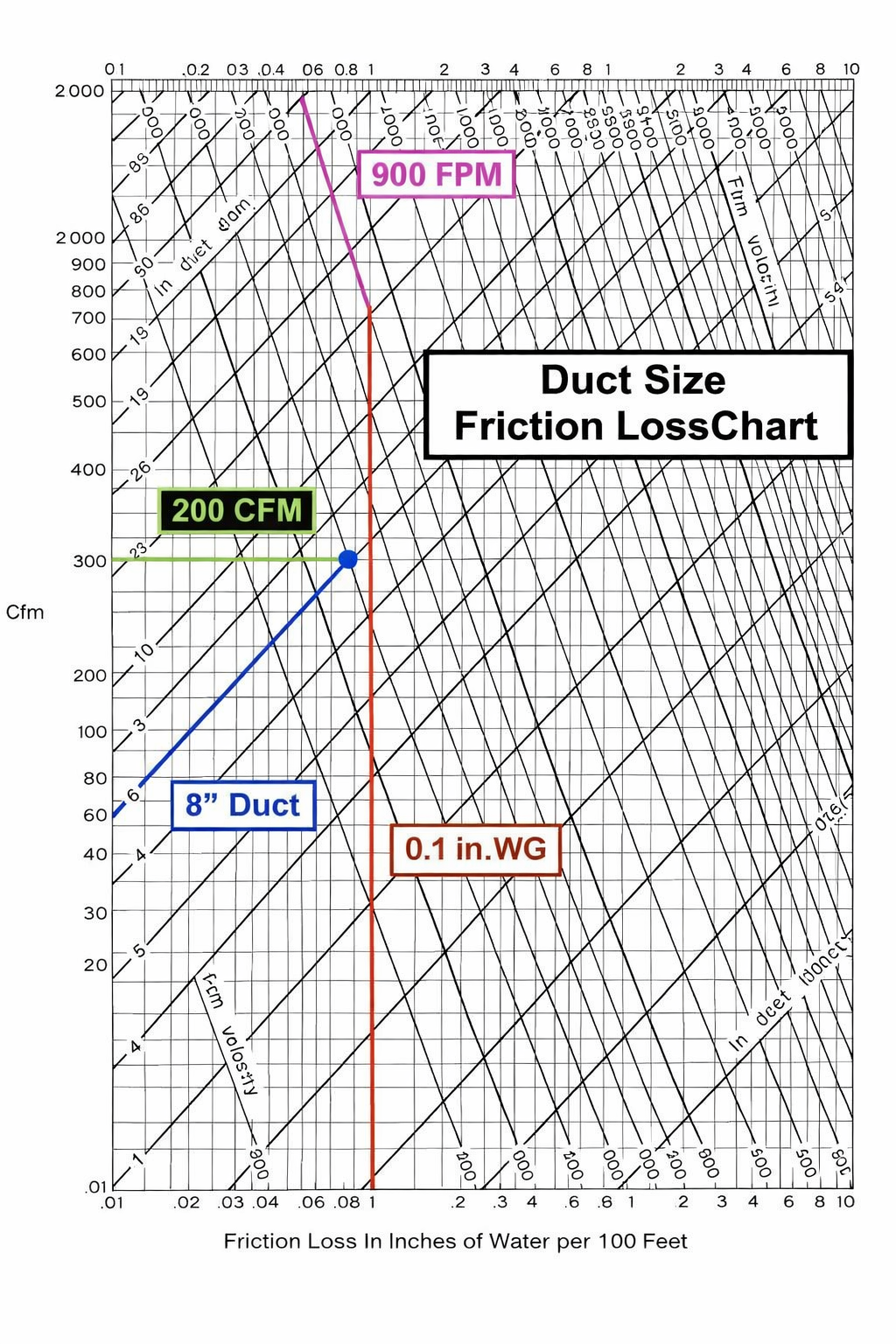
A ductulator helps you quickly determine:
- Duct size
- Velocity
- Friction loss
Equivalent Length Method
Instead of calculating complex dynamic losses, engineers convert fittings into equivalent length.
Example:
| Fitting | Equivalent Length |
|---|---|
| Elbow 90° | 10–30 ft |
| Tee | 20–50 ft |
| Damper | 10–20 ft |
Total Effective Length
Total Length=Straight Length+Equivalent Length
Factors Affecting Friction Loss
1. Air Velocity (Most Important Factor)
Explanation:
- Higher velocity → more turbulence → higher friction loss
- Lower velocity → smoother airflow → lower friction
Key Insight:
- Friction loss ∝ Velocity² (approximately)
Recommended Range:
- Supply ducts: 700–900 FPM
- Return ducts: 500–700 FPM
2. Duct Material & Surface Roughness
Explanation:
Different materials have different roughness:
| Material | Friction Level |
|---|---|
| Aluminum | Low |
| GI Sheet | Medium |
| Flexible Duct | High |
Why It Matters:
- Rough surfaces create turbulence
- Dust and dirt increase friction over time
3. Duct Length
Explanation:
- Longer duct = more resistance
- Friction accumulates over distance
Formula Concept:
Friction Loss∝Length
- Keep duct runs as short as possible
4. Duct Fittings (Dynamic Losses)
Includes:
- Elbows
- Tees
- Dampers
- Transitions
Impact:
Each fitting adds resistance equivalent to extra duct length.
Example:
- 90° elbow = 10–30 ft equivalent length
5. Duct Shape
Comparison:
| Shape | Friction |
|---|---|
| Round | Lowest |
| Rectangular | Higher |
| Flat Oval | Medium |
Why Round is Better:
- Less surface area
- Uniform airflow
- Lower turbulence
6. Duct Size (Diameter)
Explanation:
- Larger ducts → lower velocity → lower friction
- Smaller ducts → higher velocity → higher friction
Key Rule:
Increasing duct diameter reduces friction loss significantly.
7. Air Density & Temperature
Explanation:
- Hot air = less dense → lower friction
- Cold air = more dense → higher friction
Real Impact:
- Industrial systems must consider temperature variations
8. Flow Type (Laminar vs Turbulent)
Types:
| Flow Type | Friction |
|---|---|
| Laminar | Low |
| Turbulent | High |
Key Concept:
- Most HVAC systems operate in turbulent flow
9. Reynolds Number
Explanation:
Determines flow type:
- Low Re → laminar
- High Re → turbulent
Why Important:
- Used in advanced calculations (Darcy-Weisbach)
10. Duct Cleanliness & Maintenance
Explanation:
- Dust buildup increases roughness
- Blockages reduce airflow
Result:
- Higher friction loss
- Reduced efficiency
11. Leakage in Duct System
Explanation:
- Air leaks reduce effective airflow
- System compensates → higher fan load
12. System Design & Layout
Poor Design Includes:
- Too many bends
- Sharp turns
- Long runs
Good Design:
- Straight ducts
- Smooth transitions
- Balanced layout
Friction Loss in Rectangular Ducts
Use equivalent diameter:
Where:
- a = width
- b = height
Static Pressure Calculation
Total static pressure includes:
- Friction loss
- Dynamic loss
- Equipment loss
TSP=Friction Loss+Dynamic Loss+Equipment Loss
Velocity Pressure
Friction Loss in Flexible Ducts
Flexible ducts can have:
- 2–3 times more friction than rigid ducts
- Sharp bends increase loss drastically
Common Mistakes in Friction Loss Calculation
- Ignoring fittings
- Using wrong duct size
- Not considering velocity
- Overusing flexible ducts
- Ignoring leakage
HVAC Design Best Practices
1. Keep Velocity Balanced
- Supply duct: 700–900 FPM
- Return duct: 500–700 FPM
2. Use Round Ducts Where Possible
Better airflow, lower friction.
3. Minimize Bends
Every bend increases resistance.
4. Use Proper Duct Insulation
Prevents condensation and improves efficiency.
Real-World HVAC Example
Office Project
- Airflow: 5000 CFM
- Duct length: 100 ft
- 5 elbows
Calculation:
- Equivalent length = 5 × 20 = 100 ft
- Total length = 200 ft
If friction rate = 0.1:
Loss = 0.1 × (200 / 100) = 0.2 in. w.g.
Software Tools for Calculation
- HAP (Carrier)
- Duct Sizer Apps
- Excel HVAC Calculators
Advanced Engineering Concepts
Reynolds Number
Determines airflow type:
- Laminar
- Turbulent
Moody Chart
Used to find friction factor.
Computational Fluid Dynamics (CFD)
Used for high-level simulations.
Energy Impact of Friction Loss
Higher friction loss results in:
- Increased fan power
- Higher electricity bills
- Reduced equipment life
Optimization Techniques
1. Increase Duct Size
Reduces velocity → reduces friction.
2. Improve Layout
Shorter ducts = less resistance.
3. Use Smooth Interior Ducts
Less turbulence.
4. Regular Maintenance
Clean ducts = lower friction.
HVAC Industry Standards
- ASHRAE Guidelines
- SMACNA Duct Design Manual
Quick Reference Formula Summary
- Friction Loss = ΔP / L
- Darcy-Weisbach Equation
- Velocity = CFM / Area
- Equivalent Length Method
Conclusion
Understanding how to calculate friction loss in ducts is essential for designing efficient HVAC systems. By mastering:
- Airflow calculations
- Friction charts
- Equivalent length method
- Proper duct sizing
You can significantly improve system performance, reduce energy consumption, and deliver better comfort.
Expert Recommendation (HVAC Industry Insight)
For real-world projects, always:
- Combine theoretical calculations with practical experience
- Use ductulators or software for accuracy
- Avoid over-complicating small systems
- Focus on balanced airflow rather than just minimizing friction
Frequently Asked Questions (Friction Loss in Ducts)
1. What is friction loss in HVAC ducts?
Friction loss in HVAC ducts refers to the resistance air experiences while flowing through ductwork due to surface roughness, turbulence, and obstacles like bends and fittings. It results in pressure drop and affects system efficiency.
2. How do you calculate friction loss in ducts?
Friction loss is calculated using formulas like:
- Friction Loss = Pressure Drop ÷ Duct Length
- Or using the Darcy-Weisbach equation
Engineers also use ductulators or friction charts for practical calculations.
3. What is the ideal friction loss rate for duct design?
The recommended friction loss rate is typically:
- 0.08 to 0.1 in. w.g. per 100 ft
This ensures efficient airflow without excessive energy consumption.
4. What factors affect friction loss in ducts?
Key factors include:
- Duct size and shape
- Air velocity
- Surface roughness
- Number of bends and fittings
- Duct material (flexible vs rigid)
5. Why are round ducts better than rectangular ducts?
Round ducts have lower friction loss because:
- They have less surface area
- Airflow is smoother
- Turbulence is reduced
6. How do duct fittings affect friction loss?
Duct fittings like elbows, dampers, and tees increase resistance. These are calculated using the equivalent length method, which adds extra duct length to account for fittings.
7. Does air velocity increase friction loss?
Yes. Higher air velocity increases turbulence and friction loss, leading to higher pressure drop and energy consumption.
8. What is equivalent length in duct design?
Equivalent length is the additional duct length used to represent pressure losses caused by fittings like bends, transitions, and dampers.
9. How can you reduce friction loss in ducts?
You can reduce friction loss by:
- Increasing duct size
- Using smooth interior ducts
- Minimizing bends and fittings
- Keeping ducts clean
10. Why is friction loss important in HVAC systems?
Friction loss impacts:
- Fan selection
- Energy efficiency
- Air distribution
- System performance
Proper calculation ensures optimal HVAC operation.
Get Expert HVAC Design Support
Need help calculating duct friction loss for your project?
Get professional consultation for:
- Duct design & sizing
- HVAC system optimization
- Energy-efficient solutions
📱 Call / WhatsApp: +91-9825636606
🌐 Website: www.vipulhvacsolution.in
📧 Email: info@vipulhvacsolution.in