How to Calculate Treated Fresh Air Capacity
How to Calculate Treated Fresh Air Capacity in HVAC
Introduction
Treated Fresh Air (TFA) is one of the most critical components in modern HVAC system design—especially in commercial buildings, hospitals, cleanrooms, malls, and offices. With increasing awareness about indoor air quality (IAQ), ventilation standards, and energy efficiency, calculating the correct TFA capacity is no longer optional—it’s essential.
Whether you are an HVAC contractor, consultant, or student, understanding how to calculate TFA accurately will help you design efficient, compliant, and high-performance systems.
In this complete guide, you will learn:
- What is Treated Fresh Air (TFA)
- Why TFA calculation is important
- Step-by-step calculation methods
- Formula-based approach
- Practical examples
- Indian standards & best practices
- Common mistakes to avoid
What is Treated Fresh Air (TFA)?
Treated Fresh Air (TFA) refers to outdoor air that is:
- Filtered
- Cooled or heated
- Dehumidified
- Supplied into the conditioned space
It is typically handled by a TFA Unit (TFAU) or FAHU (Fresh Air Handling Unit).
Why TFA is Important in HVAC Systems
1. Indoor Air Quality (IAQ)
Fresh air dilutes pollutants, CO₂, and odors.
2. Regulatory Compliance
Standards like:
- ASHRAE 62.1
- NBC India
require minimum fresh air ventilation.
3. Humidity Control
TFA removes latent heat (moisture).
4. Positive Pressure Maintenance
Prevents dust infiltration.
Key Terms You Must Understand
Before calculation, understand these basics:
1. CFM (Cubic Feet per Minute)
Airflow rate
2. ACH (Air Changes per Hour)
Number of air replacements per hour
3. Sensible Heat
Temperature-related heat
4. Latent Heat
Moisture-related heat
5. Occupancy Load
Number of people in a space
Methods to Calculate TFA Capacity
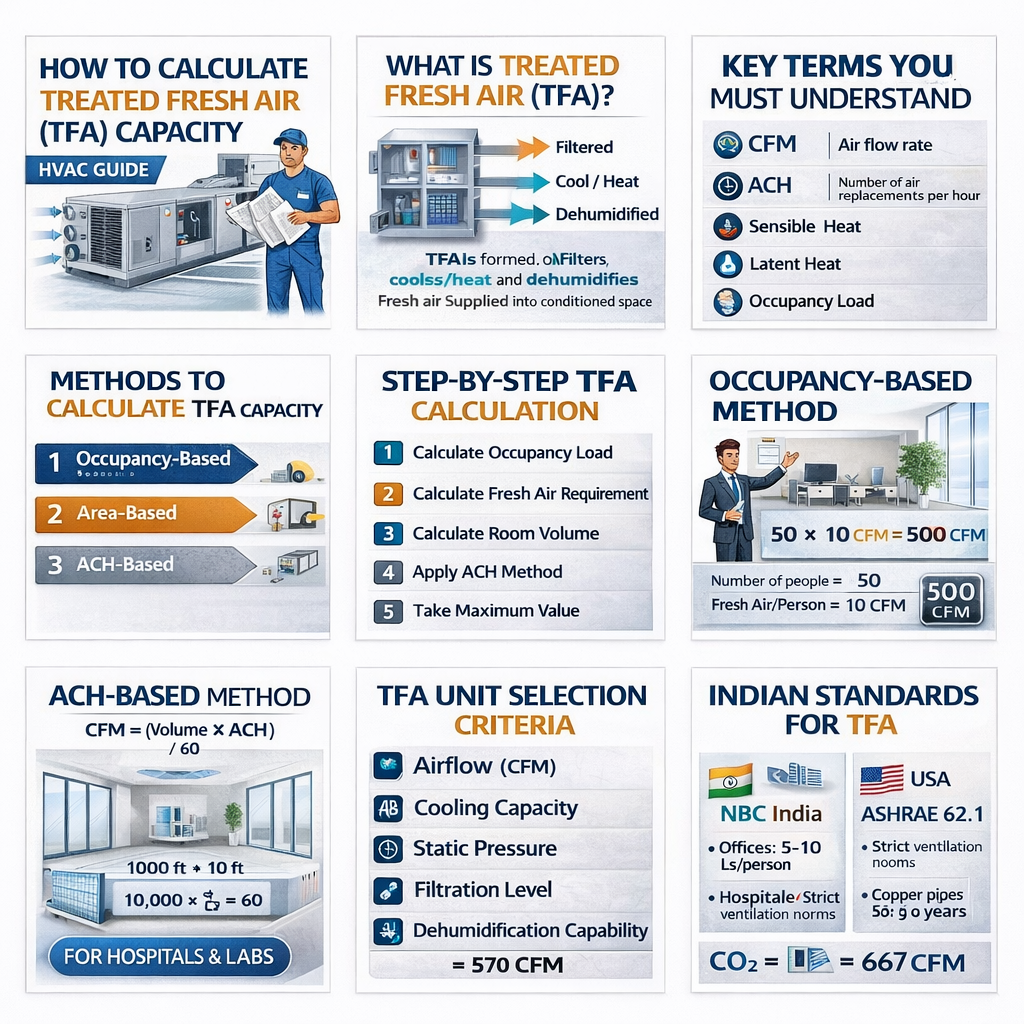
There are 3 main methods used in HVAC:
Method 1: Based on Occupancy (Most Common)
Formula:
TFA=Number of People×Fresh Air per Person
Standard Fresh Air Values (ASHRAE)
| Space Type | Fresh Air (CFM/Person) |
|---|---|
| Office | 5–10 |
| Restaurant | 15–20 |
| Hospital | 15–25 |
| Auditorium | 10–15 |
Example Calculation
- Number of people = 50
- Fresh air/person = 10 CFM
TFA = 50 × 10 = 500 CFM
Method 2: Based on Area (CFM per Sq.ft)
Formula:
TFA=Area×CFM per Sq.ft
Typical Values:
| Space Type | CFM/sq.ft |
|---|---|
| Office | 0.06–0.12 |
| Mall | 0.15–0.25 |
| Hospital | 0.2–0.3 |
Example
- Area = 2000 sq.ft
- Factor = 0.1
TFA = 2000 × 0.1 = 200 CFM
Method 3: Based on Air Changes (ACH Method)
Formula:
Where:
- Volume = Area × Height
- ACH = Air changes per hour
Example
- Area = 1000 sq.ft
- Height = 10 ft
- ACH = 4
Volume = 1000 × 10 = 10,000 ft³
CFM = (10,000 × 4) / 60 = 667 CFM
Which Method is Best?
| Method | Accuracy | Use Case |
|---|---|---|
| Occupancy | High | Offices, malls |
| Area-based | Medium | Quick estimation |
| ACH | Very High | Hospitals, labs |
Best Practice: Use combination of all three and take the highest value.
Step-by-Step TFA Calculation (Professional Method)
Step 1: Calculate Occupancy Load
Use:
- 1 person per 100 sq.ft (office)
- Or actual data
Step 2: Calculate Fresh Air Requirement
Using ASHRAE standards
Step 3: Calculate Room Volume
Volume=Area×Height
Step 4: Apply ACH Method
For critical spaces
Step 5: Take Maximum Value
Always choose the highest airflow requirement
Step 6: Add Safety Factor
Add 10–20% buffer
Advanced TFA Calculation (Including Heat Load)
TFA also contributes to cooling load:
Sensible Heat Formula:
Q=1.08×CFM×ΔT
Latent Heat Formula:
Q=0.68×CFM×ΔW
These are critical when selecting:
- AHU
- TFA Unit
- Cooling Coil
Real Project Example (Commercial Office)
Given:
- Area = 5000 sq.ft
- Height = 10 ft
- Occupancy = 50 people
Step 1: Occupancy Method
50 × 10 = 500 CFM
Step 2: Area Method
5000 × 0.1 = 500 CFM
Step 3: ACH Method
Volume = 5000 × 10 = 50,000
ACH = 4
CFM = (50,000 × 4) / 60 = 3333 CFM
Final TFA:
3333 CFM (Highest Value Selected)
TFA vs Ventilation vs Exhaust
| Type | Function |
|---|---|
| TFA | Conditioned fresh air |
| Ventilation | Raw fresh air |
| Exhaust | Removes stale air |
TFA Unit Selection Criteria
- Airflow (CFM)
- Cooling capacity
- Static pressure
- Filtration level
- Dehumidification capability
Indian Standards for TFA
NBC (National Building Code)
- Offices: 5–10 L/s/person
- Hospitals: Strict ventilation norms
ASHRAE 62.1 (Global Standard)
Most widely used
Common Mistakes in TFA Calculation
- Ignoring occupancy
- Not considering humidity
- Using only area method
- No safety factor
- Wrong ACH values
Pro Tips (Expert HVAC Insight)
- Always oversize slightly (10–15%)
- Use energy recovery ventilators (ERV)
- Combine TFA with VRF/Chiller system
- Use CO₂ sensors for demand control
Latest Trends in TFA Systems
1. Demand Controlled Ventilation (DCV)
Adjusts fresh air based on occupancy
2. Energy Recovery Ventilation (ERV)
Reduces energy consumption
3. Smart IAQ Monitoring
Sensors for CO₂, humidity
Frequently Asked Questions (Treated Fresh Air Calculation)
Q1: What is Treated Fresh Air (TFA) in HVAC?
Treated Fresh Air (TFA) is outdoor air that is filtered, cooled or heated, and dehumidified before being supplied into indoor spaces to maintain air quality and comfort.
Q2: How do you calculate treated fresh air capacity?
Treated fresh air capacity is calculated using three main methods: occupancy-based method, area-based method, and air changes per hour (ACH) method. The highest calculated value is selected for design.
Q3: What is the formula for TFA calculation using ACH?
The formula is:
CFM = (Room Volume × ACH) ÷ 60
This method is widely used in hospitals, cleanrooms, and laboratories.
Q4: How much fresh air is required per person?
Typically, 5 to 20 CFM per person is required depending on the application. Offices require around 5 to 10 CFM per person, while hospitals and restaurants need higher values.
Q5: Which method is best for TFA calculation?
The most accurate approach is to calculate using all three methods (occupancy, area, and ACH) and select the highest airflow value.
Q6: What is the difference between fresh air and treated fresh air?
Fresh air is untreated outdoor air, while treated fresh air is conditioned air that is filtered, cooled or heated, and dehumidified before entering the space.
Q7: Why is treated fresh air important in HVAC systems?
Treated fresh air improves indoor air quality, removes pollutants, controls humidity, and ensures compliance with ventilation standards like ASHRAE and NBC India.
Q8: What is ACH in HVAC?
ACH stands for Air Changes per Hour, which indicates how many times the air inside a room is replaced in one hour.
Q9: What happens if TFA is not calculated properly?
Improper TFA calculation can lead to poor air quality, high humidity, discomfort, increased energy consumption, and system inefficiency.
Q10: What safety factor should be added in TFA calculation?
A safety factor of 10 to 20 percent is typically added to ensure proper ventilation and system performance.
Conclusion
Treated Fresh Air calculation is a crucial part of HVAC design that directly impacts indoor air quality, comfort, and system efficiency. By using proper methods like occupancy, area, and ACH calculations—and always selecting the highest value—you can ensure your system is both compliant and high-performing.
Need Accurate Treated Fresh Air (TFA) Calculation for Your Project?
Get Expert HVAC Design Support from Vipul HVAC Solution Pvt Ltd
Stop guessing airflow requirements. Ensure your HVAC system is efficient, compliant, and future-ready with professional TFA calculation and system design.
What You Get:
- Accurate TFA Calculation (Occupancy + ACH + Area Method)
- Complete HVAC Design & Load Calculation
- FAHU / TFA Unit Selection Guidance
- Energy-Efficient System Design
- On-Site & Remote Consultation
📞 Talk to HVAC Experts Today
📱 Call / WhatsApp: +91-9825636606
🌐 Website: www.vipulhvacsolution.in
📧 Email: info@vipulhvacsolution.in
Perfect For:
- Commercial Buildings
- Hospitals & Cleanrooms
- Malls & Offices
- Industrial HVAC Projects