
How to Measure Airflow in HVAC?
How to Measure Airflow in HVAC? (Register & Duct)
Introduction
Airflow measurement is one of the most critical tasks in HVAC commissioning, balancing, troubleshooting, and performance optimization. Whether you’re working on a residential split AC system, a VRF setup, or a large chilled water plant, accurate airflow measurement ensures:
- Proper cooling and heating performance
- Energy efficiency
- Indoor air quality (IAQ)
- Equipment longevity
In this complete guide, you’ll learn:
- What airflow means in HVAC
- How to measure airflow at registers and ducts
- Tools used in airflow measurement
- Step-by-step calculation methods
- Practical field examples
- Common mistakes and expert tips
What is Airflow in HVAC?
Airflow refers to the volume of air moving through a system per unit time, usually measured in:
- CFM (Cubic Feet per Minute)
- L/s (Liters per second)
- m³/h (Cubic meters per hour)
Why Airflow Measurement is Important
1. System Performance
Incorrect airflow = poor cooling or heating
2. Energy Efficiency
Low airflow increases compressor load
3. Comfort
Uneven airflow causes hot/cold spots
4. Equipment Protection
Improper airflow can damage coils and compressors
Types of Airflow Measurement
1. Register (Grille/Diffuser) Airflow
Measured at supply or return outlets
2. Duct Airflow
Measured inside ducts
Tools Used for Airflow Measurement
1. Anemometer
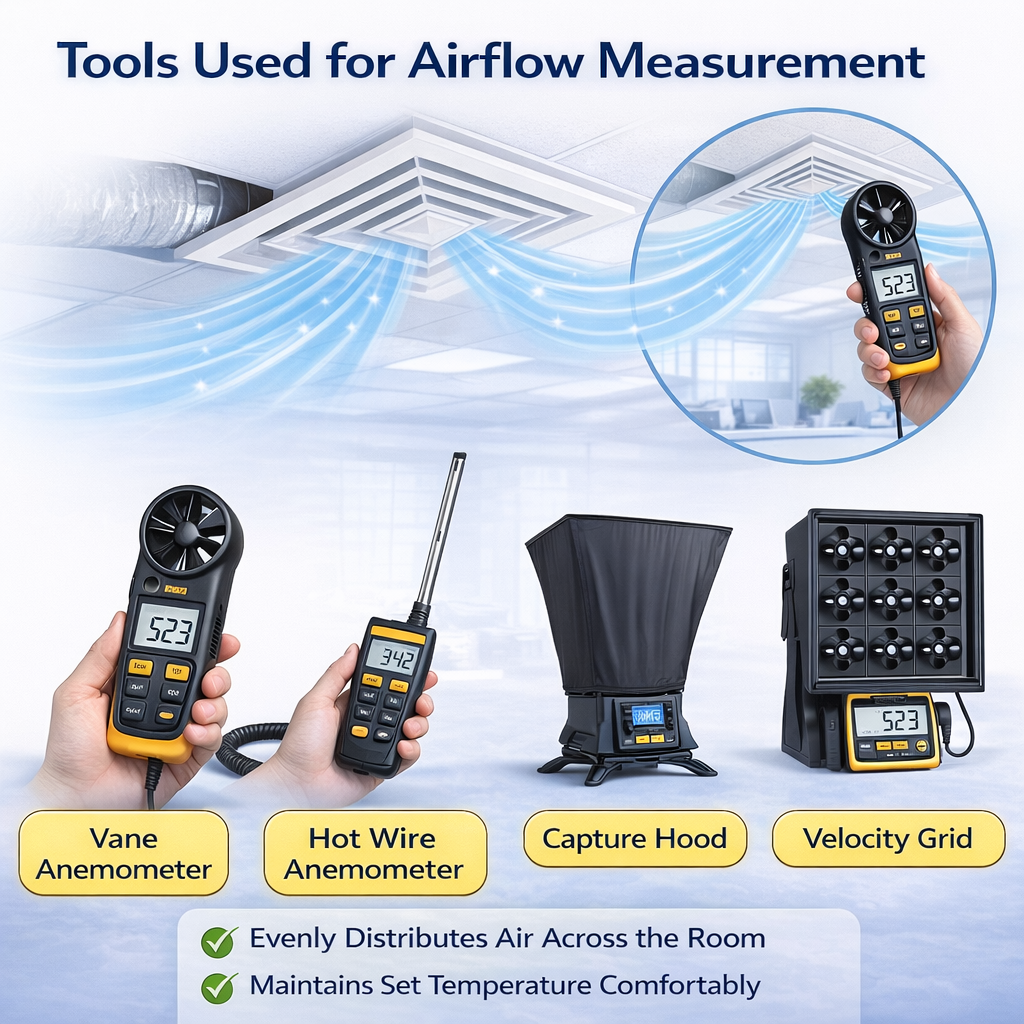
Types:
- Vane anemometer
- Hot-wire anemometer
Use:
Measures air velocity (FPM or m/s)
2. Flow Hood (Capture Hood)
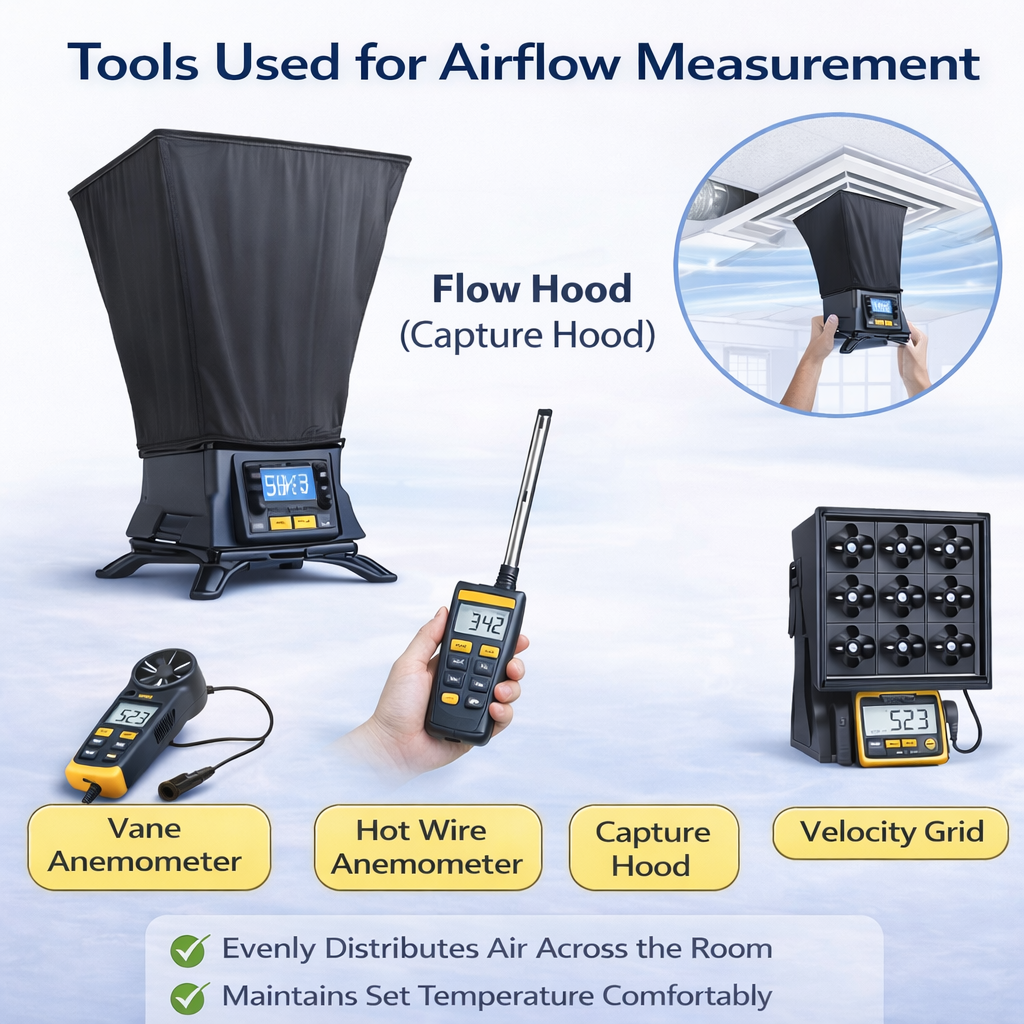
Use:
Directly measures CFM at registers
3. Pitot Tube
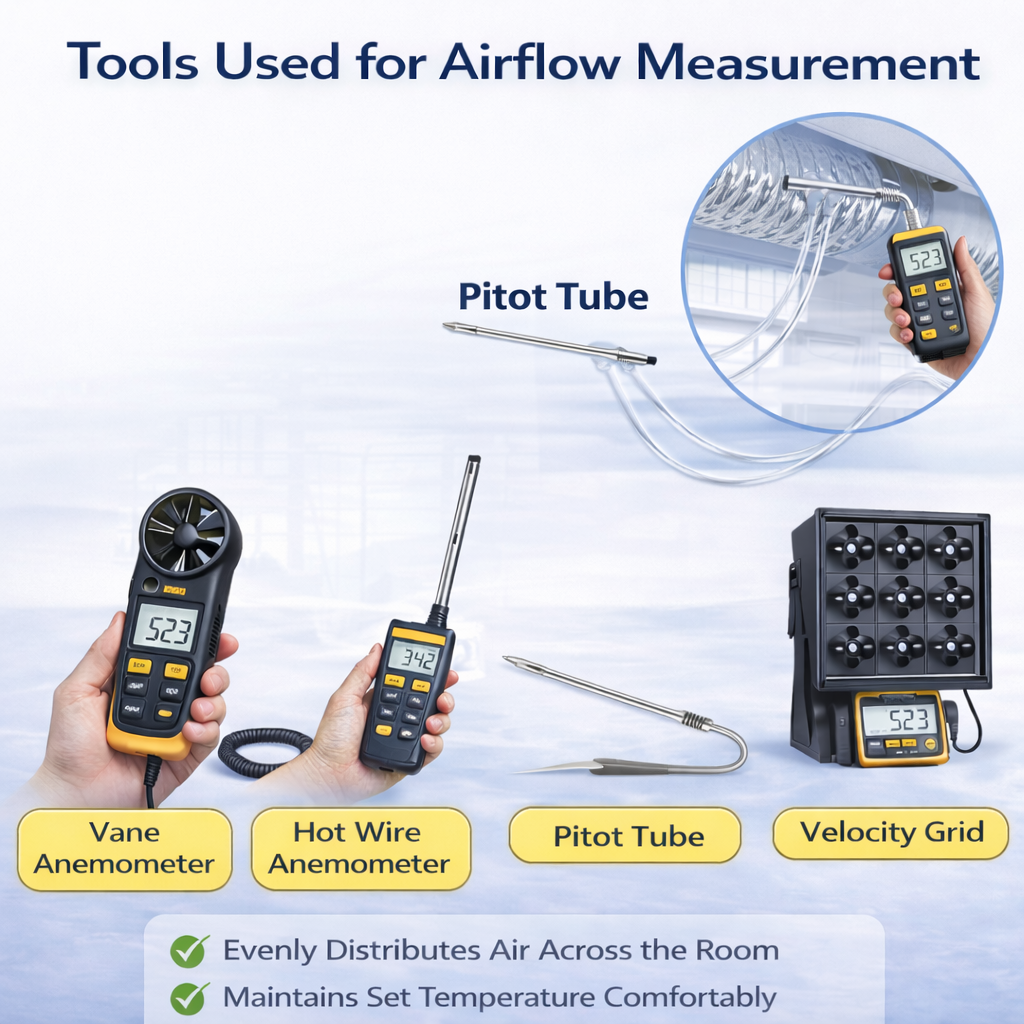
Use:
Measures duct velocity pressure
4. Manometer
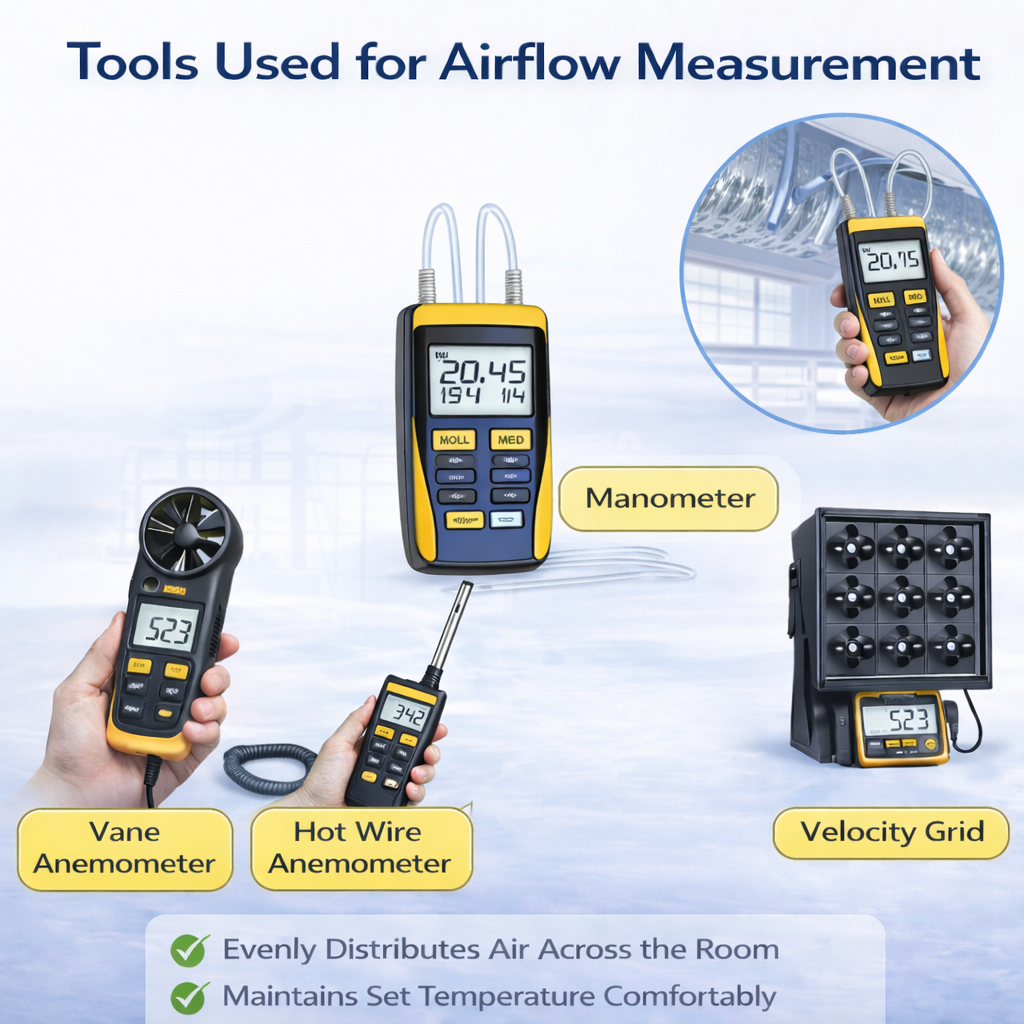
Use:
Measures pressure difference
How to Measure Airflow at Register (Grille/Diffuser)
Method 1: Using Flow Hood (Best Method)
Steps:
- Place hood over diffuser
- Ensure proper sealing
- Read airflow directly
Output: CFM value
Method 2: Using Anemometer
Formula:
CFM=Velocity × Area
Steps:
- Measure air velocity (FPM)
- Measure grille area (sq.ft)
- Multiply
Example:
- Velocity = 500 FPM
- Area = 2 sq.ft
CFM = 500 × 2 = 1000 CFM
Tips for Accurate Measurement
- Take multiple readings
- Avoid edge measurement
- Use average velocity
How to Measure Airflow in Duct
Method 1: Pitot Tube Traverse (Professional Method)
Formula:
Where:
- VP = Velocity Pressure
Steps:
- Drill test holes in duct
- Insert pitot tube
- Measure pressure
- Calculate velocity
- Multiply by area
Method 2: Anemometer in Duct
- Insert probe inside duct
- Take multiple readings
- Calculate average
Duct Airflow Calculation
Formula:
CFM=Velocity × Duct Area
Example:
- Velocity = 800 FPM
- Duct size = 2 ft × 1 ft
Area = 2 sq.ft
CFM = 800 × 2 = 1600 CFM
Round Duct Calculation
Formula:
Example:
- Diameter = 1 ft
Area = 0.785 sq.ft
CFM = Velocity × Area
Airflow Measurement in Diffusers
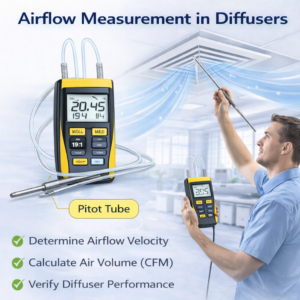
Tips:
- Measure at multiple points
- Average the readings
- Consider throw pattern
Air Balancing Process
Air balancing ensures proper airflow distribution.
Steps:
- Measure airflow
- Compare with design
- Adjust dampers
- Recheck airflow
Common Airflow Standards
| Application | Airflow (CFM/ton) |
|---|---|
| Comfort AC | 350–450 |
| High humidity | 400–500 |
| Data centers | 500–600 |
Common Mistakes in Airflow Measurement
- Measuring at wrong location
- Not averaging readings
- Ignoring duct leakage
- Using wrong instrument
- Not calibrating tools
Real Field Example
Office Room:
- Diffuser velocity = 400 FPM
- Area = 1.5 sq.ft
CFM = 400 × 1.5 = 600 CFM
Advanced Techniques
1. Traverse Method (ASHRAE Standard)
Multiple points measurement
2. Air Balancing Instruments
Digital flow hoods
3. Smart Sensors
IoT airflow monitoring
When to Measure Airflow?
- Commissioning
- Troubleshooting
- Energy audit
- Maintenance
Need Accurate Measure Airflow in HVAC for Your Project?
Get Expert HVAC Design Support from Vipul HVAC Solution Pvt Ltd
Stop guessing airflow requirements. Ensure your HVAC system is efficient, compliant, and future-ready with professional Airflow calculation and system design.
What You Get:
- Use flow hood for accuracy
- Always cross-check with duct reading
- Maintain 400 CFM per ton rule
- Balance system after installation
📞 Talk to HVAC Experts Today
📱 Call / WhatsApp: +91-9825636606
🌐 Website: www.vipulhvacsolution.in
📧 Email: info@vipulhvacsolution.in
Perfect For:
- Commercial Buildings
- Hospitals & Cleanrooms
- Malls & Offices
- Industrial HVAC Projects
Conclusion
Airflow measurement is not just a technical task—it’s the foundation of HVAC performance. Whether measuring at registers or ducts, using the right tools and methods ensures optimal comfort, efficiency, and system life.
Frequently Asked Questions (Airflow Measurement in HVAC)
Q1: What is airflow in HVAC systems?
Airflow in HVAC refers to the volume of air moving through ducts, registers, or equipment, typically measured in CFM, liters per second, or cubic meters per hour.
Q2: How do you measure airflow at a register or diffuser?
Airflow at a register can be measured using a flow hood for direct CFM reading or an anemometer by multiplying air velocity with the grille area.
Q3: What is the formula to calculate airflow (CFM)?
The basic formula is:
CFM = Air Velocity × Area
Where velocity is measured in feet per minute and area in square feet.
Q4: Which tool is best for measuring airflow in HVAC?
A flow hood (capture hood) is the most accurate tool for measuring airflow at registers, while a pitot tube and anemometer are used for duct measurements.
Q5: How is airflow measured inside a duct?
Airflow inside a duct is measured using a pitot tube and manometer or an anemometer. Multiple readings are taken and averaged to get accurate airflow.
Q6: What is a pitot tube used for in HVAC?
A pitot tube is used to measure velocity pressure inside ducts, which helps calculate air velocity and airflow.
Q7: What is the ideal airflow per ton in HVAC systems?
The standard airflow is typically 350 to 450 CFM per ton for comfort cooling applications.
Q8: Why is airflow measurement important?
Airflow measurement ensures proper cooling, energy efficiency, balanced air distribution, and prevents equipment damage.
Q9: What mistakes should be avoided when measuring airflow?
Common mistakes include measuring at wrong locations, not averaging readings, using uncalibrated instruments, and ignoring duct leakage.
Q10: What is air balancing in HVAC?
Air balancing is the process of adjusting airflow in ducts and registers to match design requirements for optimal system performance.


1 Response
[…] Airflow direction is indicated by arrows drawn on ducts. These arrows show how air moves from equipment to diffusers or exhaust points. […]