Types of Pipes Used for Chilled Water
Types of Pipes Used for Chilled Water (New Technology)
Introduction
Chilled water piping is the backbone of modern HVAC systems, especially in commercial buildings, data centers, hospitals, and industrial facilities. With the rapid evolution of HVAC technology, the materials and types of pipes used for chilled water systems have also undergone significant transformation.
Today, engineers and HVAC contractors are no longer limited to traditional steel pipes. New-age materials such as PPR, HDPE, CPVC, and pre-insulated piping systems are revolutionizing efficiency, durability, and installation practices.
In this comprehensive guide, we will explore:
- Traditional vs modern chilled water pipe materials
- New technologies in piping systems
- Advantages and disadvantages of each pipe type
- Selection criteria for HVAC projects
- Expert recommendations for Indian conditions
What is a Chilled Water Piping System?
A chilled water piping system is used to circulate cooled water (typically 5°C to 12°C) from chillers to air handling units (AHUs), fan coil units (FCUs), and other cooling equipment.
Key Functions:
- Transport chilled water efficiently
- Maintain temperature with minimal losses
- Resist corrosion and pressure
- Ensure long-term reliability
Why Pipe Selection Matters in HVAC
Choosing the right pipe material directly impacts:
- Energy efficiency
- System lifespan
- Maintenance cost
- Installation time
- Leakage risks
Poor pipe selection can lead to:
- Corrosion
- Scaling
- Energy loss
- Frequent breakdowns
Classification of Chilled Water Pipes
Chilled water pipes can be broadly divided into:
1. Traditional Pipes
- Mild Steel (MS)
- Galvanized Iron (GI)
- Copper
2. Modern / New Technology Pipes
- PPR (Polypropylene Random Copolymer)
- HDPE (High-Density Polyethylene)
- CPVC (Chlorinated Polyvinyl Chloride)
- Pre-insulated pipes
- Composite pipes (MLCP / PEX-AL-PEX)
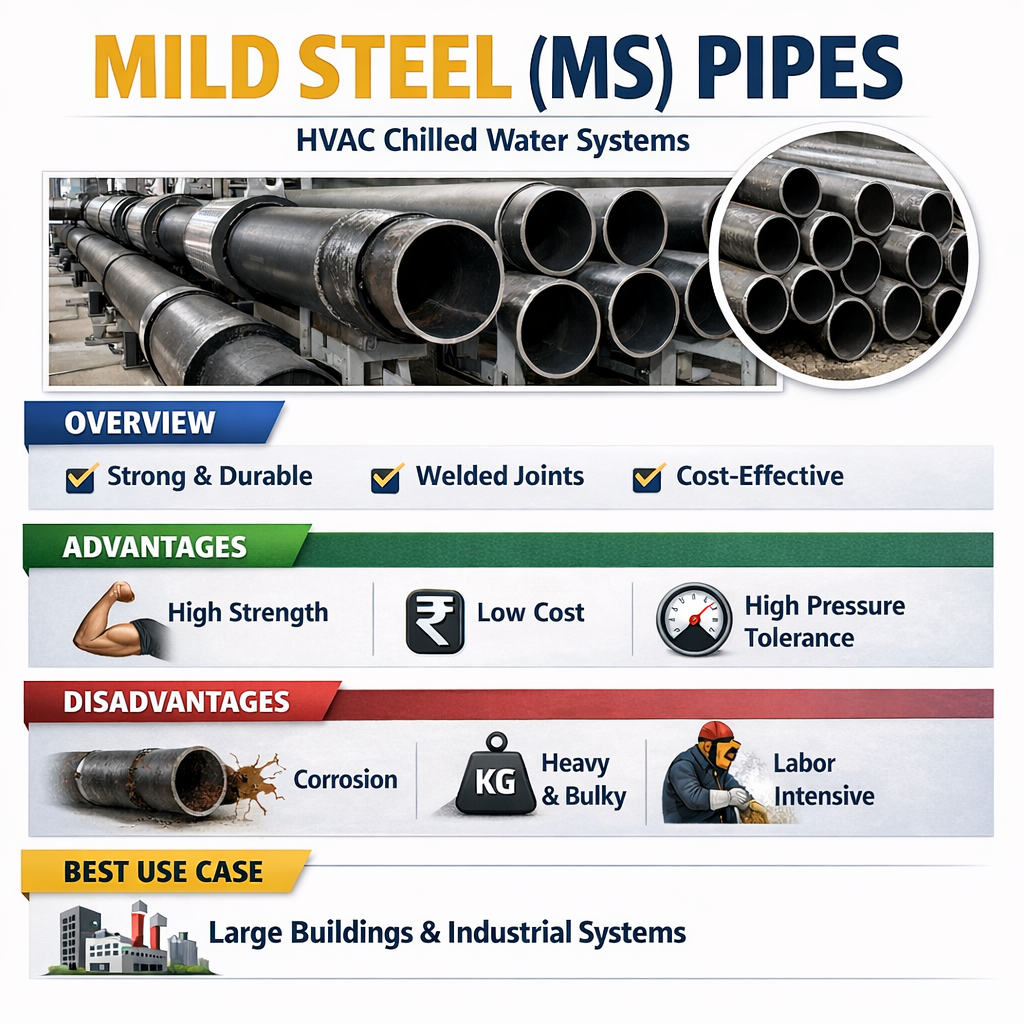
1. Mild Steel (MS) Pipes
Overview
Mild steel pipes are the most commonly used pipes in traditional HVAC systems.
Features
- High strength
- Suitable for large diameter systems
- Welded joints
Advantages
- Strong and durable
- Cost-effective for large projects
- High pressure tolerance
Disadvantages
- Corrosion issues
- Requires insulation + coating
- Heavy weight
- Labor-intensive installation
Best Use Case
- Large commercial buildings
- Industrial HVAC systems
2. Galvanized Iron (GI) Pipes
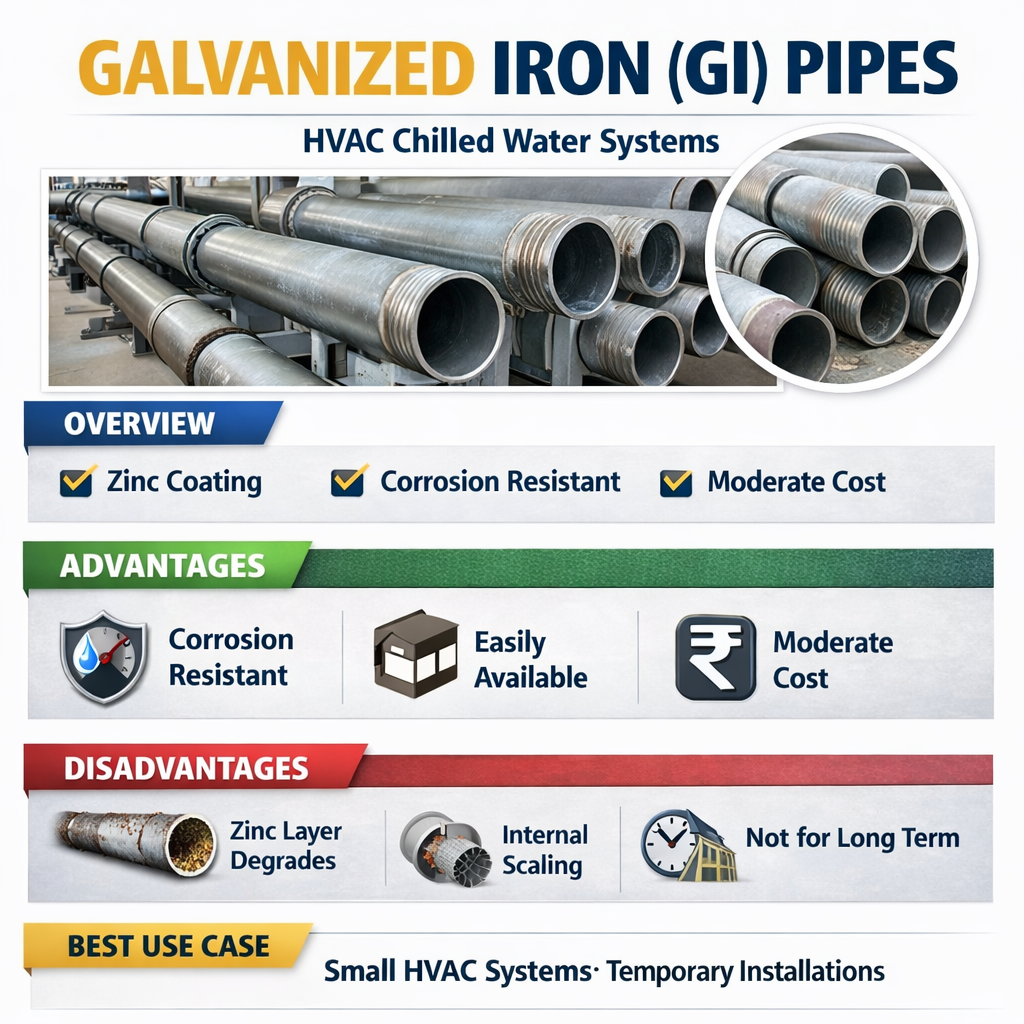
Overview
GI pipes are coated with zinc to prevent rust.
Advantages
- Better corrosion resistance than MS
- Readily available
- Moderate cost
Disadvantages
- Zinc layer degrades over time
- Internal scaling
- Not ideal for long-term chilled water
Best Use Case
- Small HVAC systems
- Temporary installations
3. Copper Pipes
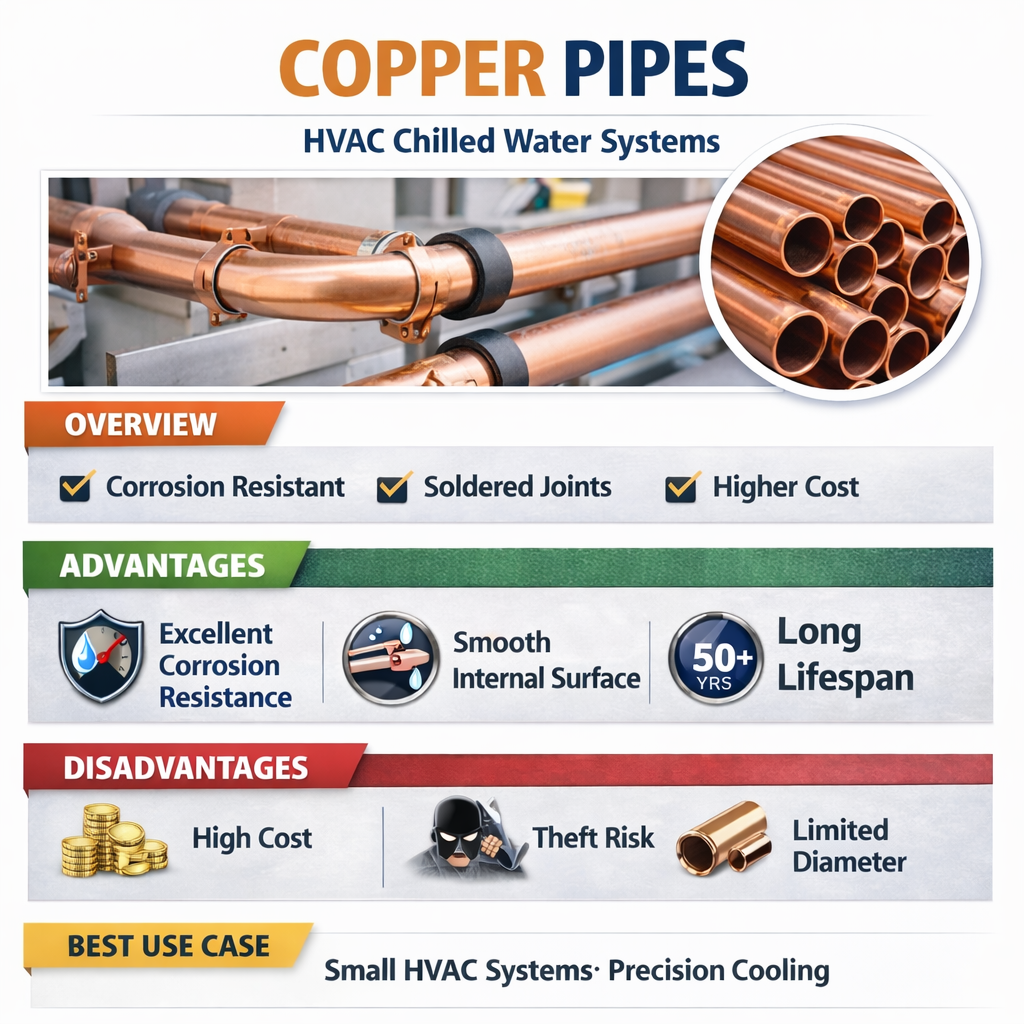
Overview
Copper pipes are widely used in refrigeration and small chilled water systems.
Advantages
- Excellent corrosion resistance
- Smooth internal surface
- Long lifespan
Disadvantages
- High cost
- Theft risk
- Limited for large diameters
Best Use Case
- Small systems
- Precision cooling
4. PPR Pipes (New Technology)
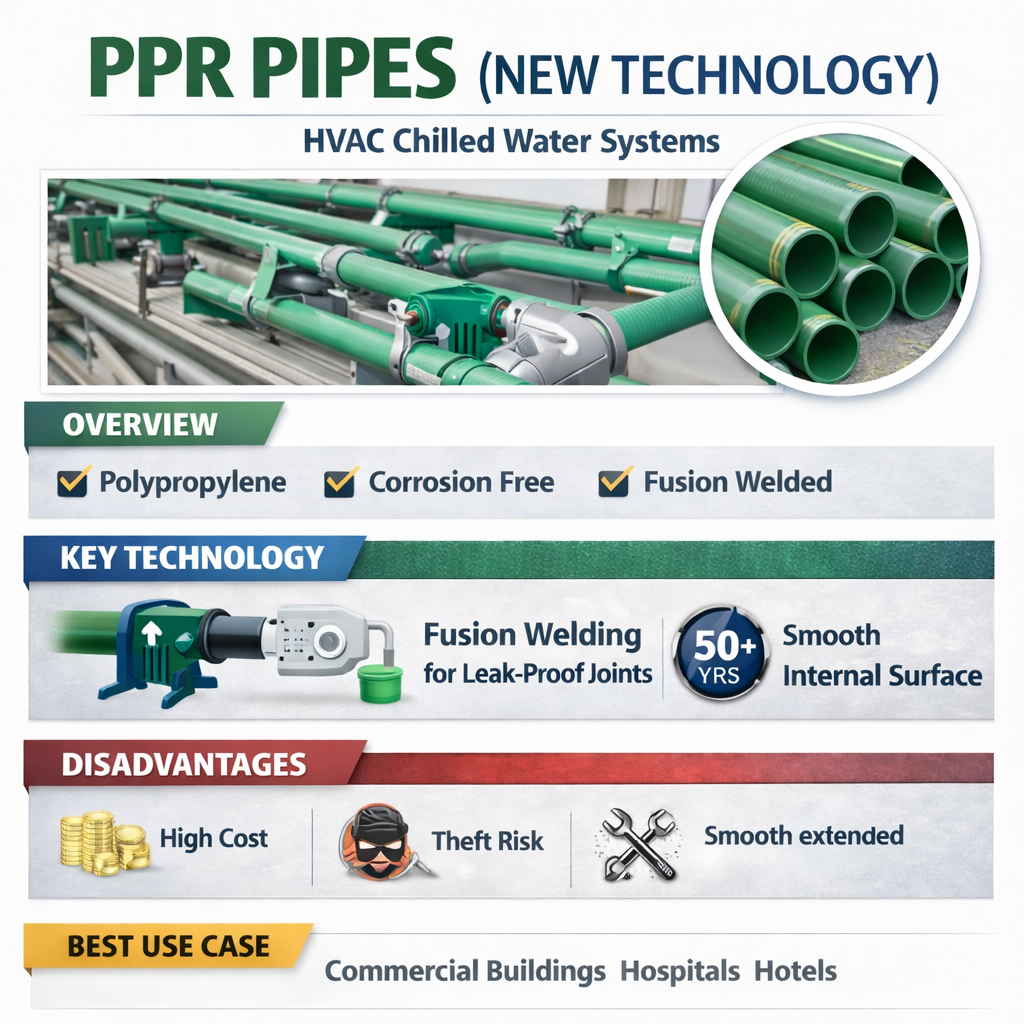
Overview
PPR (Polypropylene Random Copolymer) pipes are becoming extremely popular in modern HVAC systems.
Key Technology: Fusion Welding
- Heat fusion creates leak-proof joints
- No threading or welding required
Advantages
- Corrosion-free
- Long life (50+ years)
- Smooth internal surface (low friction loss)
- Lightweight
- Easy installation
Disadvantages
- Limited temperature range
- Requires skilled fusion welding
Best Use Case
- Commercial buildings
- Hospitals
- Hotels
5. HDPE Pipes (High-Density Polyethylene)
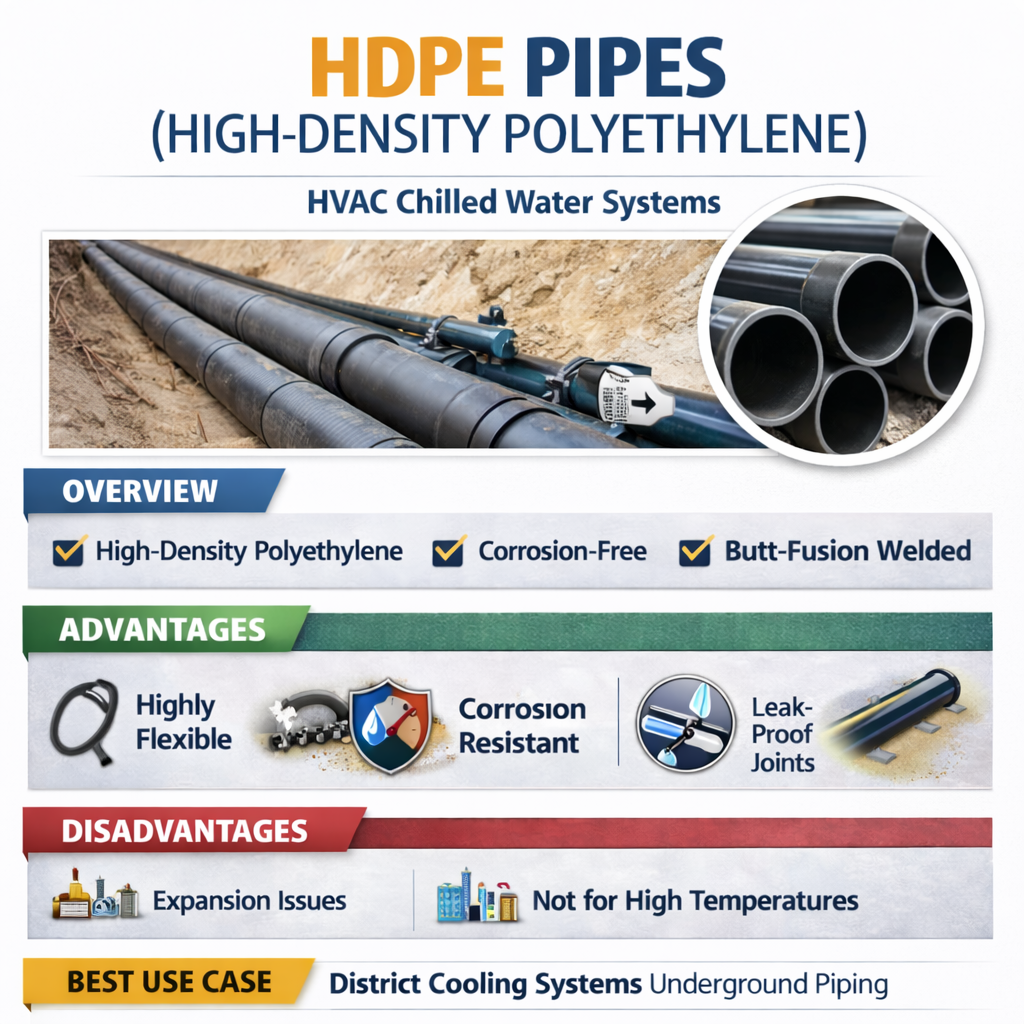
Overview
HDPE pipes are widely used for underground chilled water distribution.
Advantages
- Highly flexible
- Corrosion-resistant
- Leak-proof joints (butt fusion)
- Ideal for buried pipelines
Disadvantages
- Not suitable for high temperature
- Expansion issues
Best Use Case
- District cooling systems
- Underground piping
6. CPVC Pipes
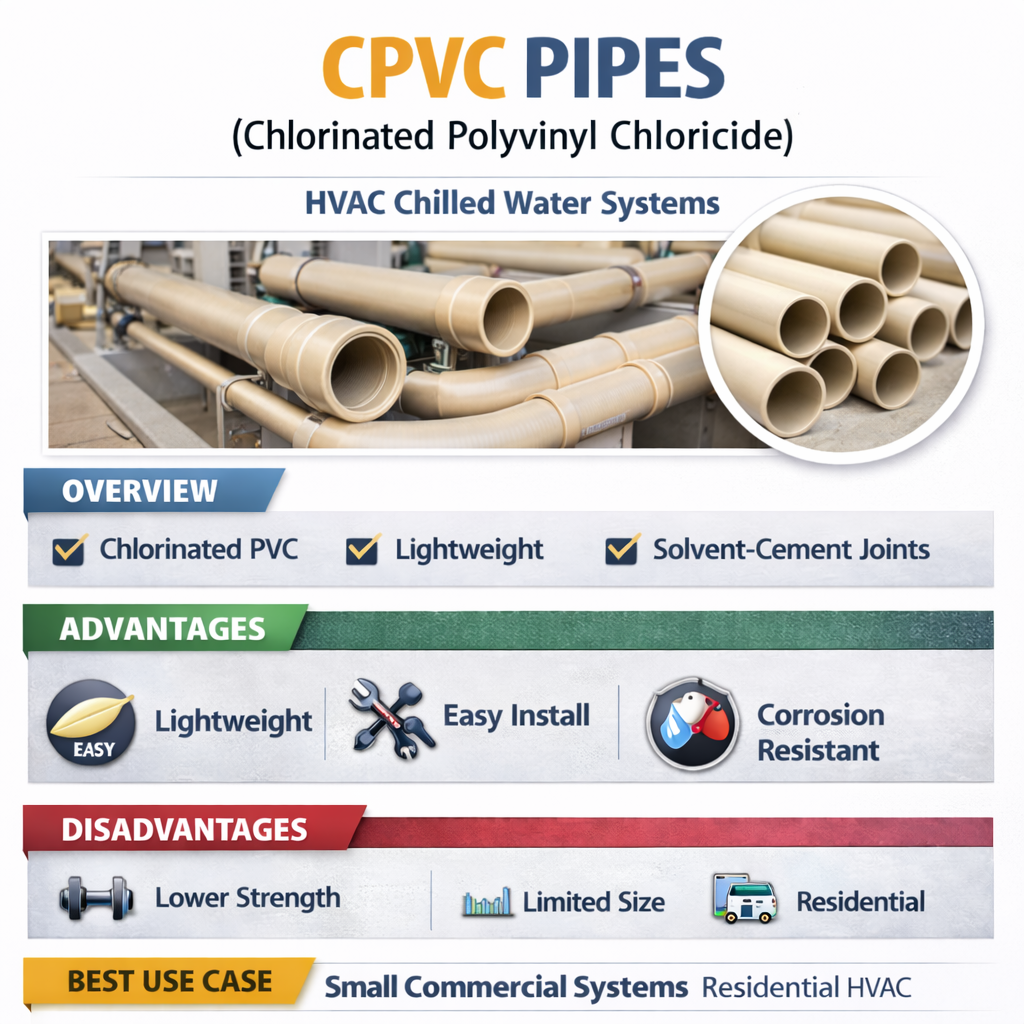
Overview
CPVC pipes are modified PVC pipes with higher temperature resistance.
Advantages
- Lightweight
- Easy installation
- Corrosion-resistant
Disadvantages
- Lower strength than steel
- Limited diameter availability
Best Use Case
- Small commercial systems
- Residential HVAC
7. Pre-Insulated Pipes (Advanced Technology)
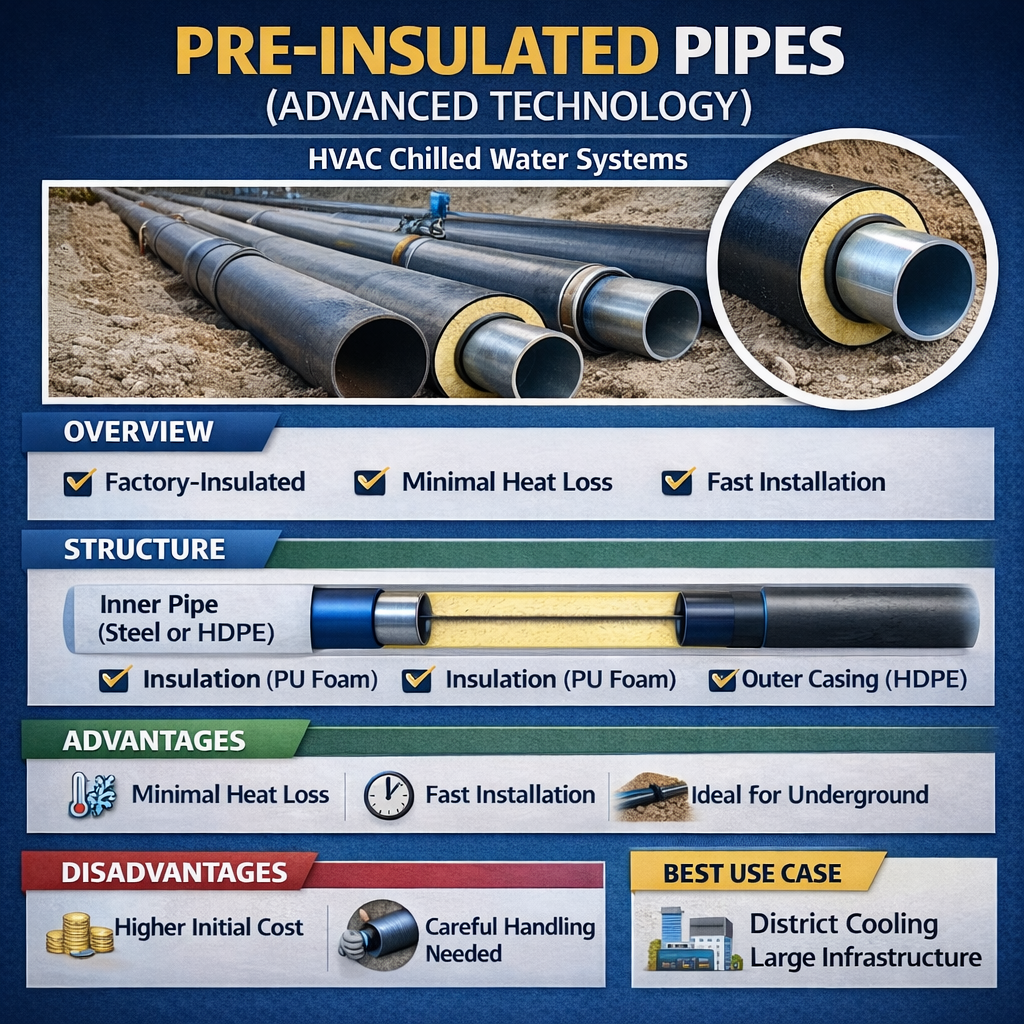
Overview
Pre-insulated pipes come with factory-applied insulation and outer casing.
Structure
- Inner pipe (steel or HDPE)
- Insulation (PU foam)
- Outer casing (HDPE jacket)
Advantages
- Minimal heat loss
- Fast installation
- Long lifespan
- Ideal for underground
Disadvantages
- High initial cost
- Requires careful handling
Best Use Case
- District cooling
- Large infrastructure projects
8. Composite Pipes (PEX-AL-PEX / MLCP)
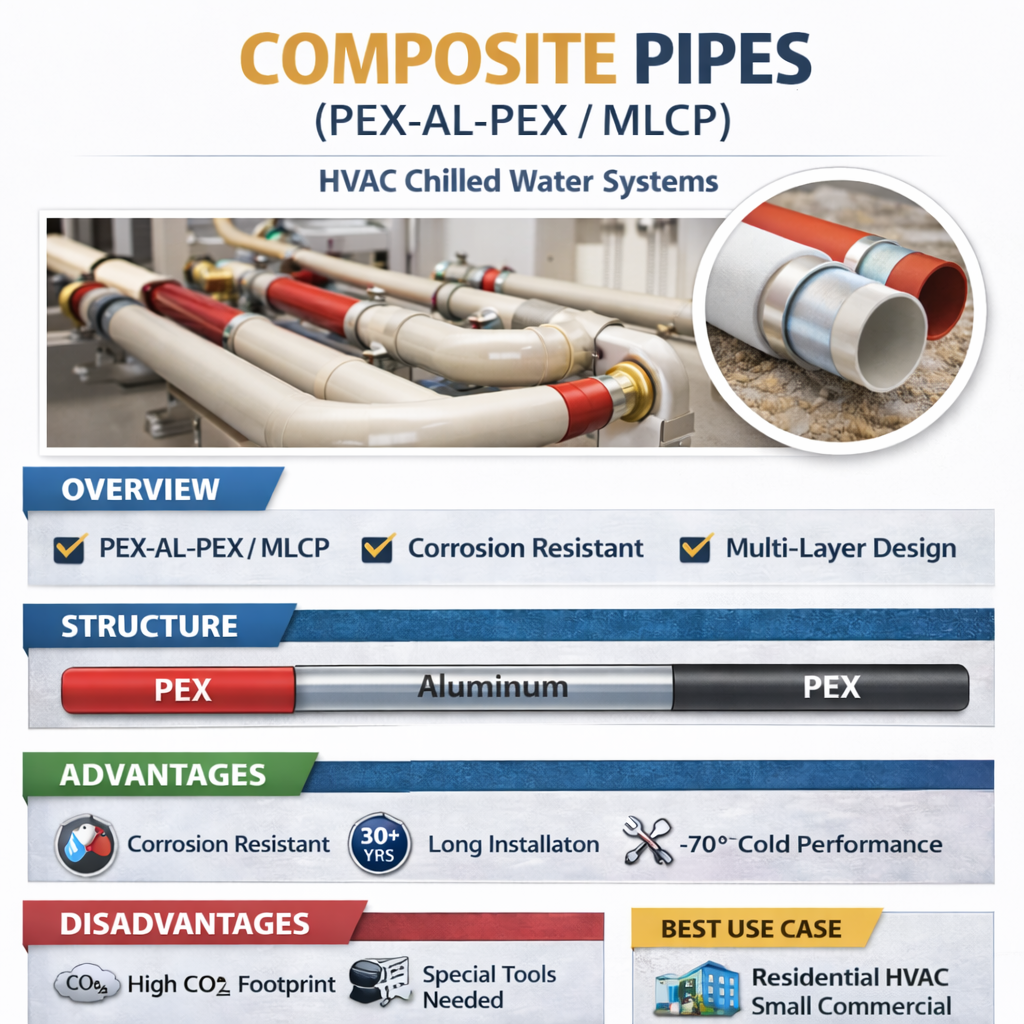
Overview
Composite pipes combine plastic and aluminum layers.
Advantages
- Lightweight
- Flexible
- Corrosion-resistant
- Low thermal expansion
Disadvantages
- Limited size
- Moderate pressure capacity
Best Use Case
- Small HVAC systems
- Residential projects
Comparison Table of Chilled Water Pipes
| Pipe Type | Life Span | Cost | Corrosion Resistance | Installation | Best Use |
|---|---|---|---|---|---|
| MS Pipe | 20–30 yrs | Low | Poor | Difficult | Large projects |
| GI Pipe | 15–20 yrs | Medium | Moderate | Moderate | Small systems |
| Copper | 30–50 yrs | High | Excellent | Moderate | Small systems |
| PPR | 50+ yrs | Medium | Excellent | Easy | Modern buildings |
| HDPE | 50+ yrs | Medium | Excellent | Easy | Underground |
| CPVC | 25–30 yrs | Low | Good | Easy | Residential |
| Pre-insulated | 30–50 yrs | High | Excellent | Fast | District cooling |
| Composite | 25–40 yrs | Medium | Excellent | Easy | Small systems |
Latest Innovations in Chilled Water Piping
1. Smart Pipes with Sensors
- Leak detection
- Temperature monitoring
- IoT integration
2. Anti-Microbial Coatings
- Prevent bacterial growth
- Ideal for hospitals
3. Nano-Coating Technology
- Improves flow efficiency
- Reduces scaling
4. Flexible Modular Piping
- Faster installation
- Reduced labor cost
Pipe Selection Criteria (Expert Guide)
When selecting chilled water pipes, consider:
1. Project Size
- Large project → MS / Pre-insulated
- Medium → PPR / HDPE
2. Budget
- Low → CPVC
- Medium → PPR
- High → Pre-insulated
3. Installation Location
- Underground → HDPE
- Indoor → PPR
4. Temperature & Pressure
- High pressure → Steel
- Moderate → PPR
Installation Best Practices
- Proper insulation is critical
- Use vapor barrier
- Avoid thermal bridging
- Ensure proper support spacing
- Pressure testing before commissioning
Common Mistakes to Avoid
- Wrong pipe sizing
- Poor insulation
- Mixing incompatible materials
- Ignoring expansion/contraction
- Improper jointing
Future of Chilled Water Piping
The HVAC industry is rapidly moving toward:
- Plastic-based piping systems
- Smart monitoring solutions
- Energy-efficient materials
- Sustainable and recyclable pipes
Expert Recommendation
VIPUL HVAC Solution Pvt Ltd
Based on modern HVAC trends in India:
- Best Overall Choice: PPR Pipes
- Best for Underground: HDPE
- Best for Mega Projects: Pre-insulated pipes
📞 Contact:
- +91 8000392000
- +91 8000092000
🌐 Website:
📧 Email:
Pro Tip:
For long-term performance and low maintenance, avoid traditional MS pipes unless required for high-pressure systems.
Conclusion
The evolution of chilled water piping has transformed HVAC system design. While traditional pipes like MS and GI still exist, modern materials such as PPR, HDPE, and pre-insulated pipes are becoming the industry standard.
Choosing the right pipe is not just about cost—it’s about efficiency, durability, and future readiness.
Frequently Asked Questions (FAQs)
Q1: What are the most commonly used pipes for chilled water systems?
The most commonly used pipes include Mild Steel (MS), PPR, HDPE, CPVC, and pre-insulated pipes. Modern HVAC systems prefer PPR and HDPE due to their corrosion resistance and long lifespan.
Q2: Which pipe is best for chilled water piping?
PPR pipes are considered the best overall choice due to their leak-proof joints, long life (50+ years), and low maintenance. For underground applications, HDPE pipes are highly recommended.
Q3: Why are PPR pipes gaining popularity in HVAC systems?
PPR pipes are gaining popularity because they are corrosion-free, lightweight, easy to install using fusion welding, and provide excellent durability compared to traditional steel pipes.
Q4: What is the lifespan of chilled water pipes?
The lifespan depends on the material:
- MS pipes: 20–30 years
- PPR & HDPE: 50+ years
- Copper: 30–50 years
- CPVC: 25–30 years
Q5: Can CPVC pipes be used for chilled water systems?
Yes, CPVC pipes can be used for small and residential chilled water systems. However, they are not ideal for large commercial applications due to lower strength and size limitations.
Q6: What are pre-insulated pipes in HVAC?
Pre-insulated pipes come with factory-applied insulation and outer casing, reducing heat loss and installation time. They are widely used in district cooling and large infrastructure projects.
Q7: Which pipe is best for underground chilled water piping?
HDPE pipes are the best choice for underground chilled water piping due to their flexibility, corrosion resistance, and leak-proof fusion joints.
Q8: What is the difference between PPR and HDPE pipes?
PPR pipes are mainly used for indoor applications and have rigid structure, while HDPE pipes are flexible and ideal for underground installations.
Q9: Why are traditional MS pipes being replaced in HVAC systems?
MS pipes are prone to corrosion, require heavy maintenance, and involve labor-intensive installation. Modern pipes like PPR and HDPE offer better performance and lower lifecycle cost.
Q10: How do I choose the right pipe for a chilled water system?
You should consider project size, budget, installation location (indoor/underground), temperature, and pressure requirements before selecting the pipe material.